The AI Race Needs a Democratic Compute Coalition, Not a Subsidy Contest

Working across research, policy, and data-driven analysis, the Editorial Board ensures that published pieces reflect a consistent institutional perspective grounded in quantitative reasoning and long-term structural assessment.
Authored On
Modified
AI leadership depends on power, chips and secure infrastructure
A democratic compute coalition could align faster delivery with allied cooperation
Success depends on resilience, access and wider business adoption

About 415 terawatt-hours of electricity were consumed by data centers in 2024, equal to nearly 1.5% of global demand. Consumption could reach 945 terawatt-hours by 2030. This estimate goes beyond software and includes power plants, transmission lines, chips, minerals, permits and public consent. The core policy issue at hand is no longer whether democracies should deploy more computing power, but whether they can build it at speed, share capacity amongst trusted allies and ensure wider public access for all of society. A democratic compute coalition would link domestic reform with allied coordination, but it requires more robust rules. This coalition should move towards a system of reciprocal infrastructure sharing with clear terms and conditions governing, among other things, speedier permitting, financing, grid access and access to advanced chips all tied to responsibilities in national security, grid balancing, the delivery of public benefits and the empowerment of smaller enterprises. Without such terms, coalition members will instead focus on using subsidies against each other to divert investment from one another. If they impose these conditions, the individual strengths of partner nations will have a transformative effect on the participating economies.
A Democratic Compute Coalition Starts With Time-to-Power
Speed is by far the biggest bottleneck. The U.S. still houses much of the world's high-performance AI capability, but that is predicated on a struggling power infrastructure. In 2023, data centers used 176 terawatt-hours in the U.S., a 4.4% share of total U.S. electricity use. It is estimated to be as much as 6.7-12% of national consumption by 2028, according to the government, depending on server efficiency, the rate at which infrastructure is deployed and how much the AI it supports is used. The reality is simple: data centers are becoming one of the biggest new sources of electrical demand. Europe is grappling with the same challenges from a lower base, having only outlined a €200 billion plan that includes a €20 billion fund for large AI gigafactories, but announced money doesn't equate to operational capability, particularly if the project is waiting on a substation, a permit, or improved transmission lines. This demonstrates why queue time is so critical. The U.S. grid has nearly 2,600 gigawatts of proposed generation and storage waiting to be connected at the end of 2023; nearly all are zero-carbon generation or storage. Among requests submitted between 2000 and 2018, only 14% of proposed capacity had reached commercial operation by the end of 2023.
The median project that achieved operational status at the end of 2023 had spent 5 years waiting after its initial grid connection request. This is not an issue of not enough proposed capacity, but rather of a lack of delivered capacity. The financial loss of that delay was calculated in a recent financial model, estimated at roughly $550 million for a one-year delay or 5.5% of a typical 100 MW data-centre roughly $10 billion life-cycle value. It should be noted that this calculation is a modeled estimate rather than an observed average. Either way, there is a policy imperative at hand that the loss of a single year may well be more significant than fluctuations in power costs or government subsidies.
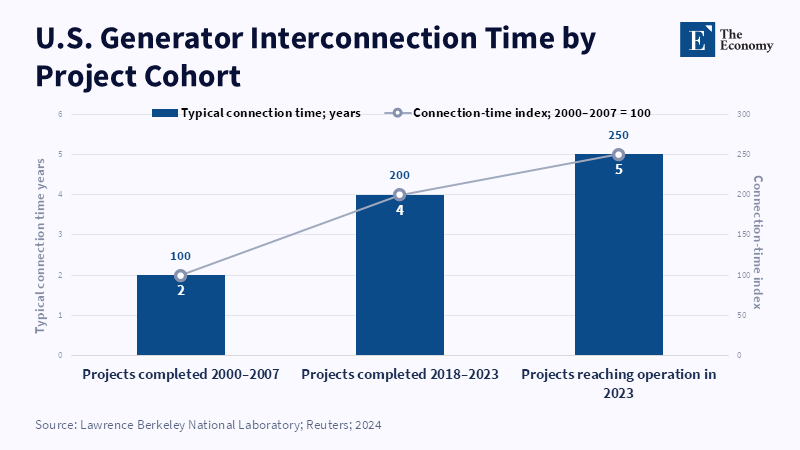
The strength of any coalition should therefore be measured by its members' "time-to-power", rather than the length of public announcements and announcements. Urgent decisions regarding large projects could be subject to expedited review under specific criteria. Developers opting for this faster process should agree to pay for the improvements necessary for grid connection and agree to flexible-load terms when the grid is under strain. Developers must also explain how consumers can be shielded from the costs of over-development and where on-site solutions can compensate when infrastructure isn't available. On-site generation may offer short-term solutions, but these cannot become an excuse to disregard proper grid planning. Local infrastructure options, including local grids, local batteries, onsite renewables, or small nuclear power, are not without their own localized costs and challenges. Faster approvals need to retain public consent as well as expediency and require public input about the impact of projects on local electricity costs, water usage, emissions and land use prior to development commencing. With these protections in place, a swift outcome may occur that is fair as well as efficient; otherwise, "speed" becomes just another hollow phrase used in empty political promises.
Reciprocity Must Replace Allied Subsidy Competition
No single democratic nation possesses all of the inputs necessary to design, build and deploy advanced AI. The US provides capital markets, technology giants and chip design; South Korea and Taiwan possess significant manufacturing capability; the Netherlands and Japan build the machinery. Canada and Australia, as well as various European countries, bring power, energy resources, skilled workers and stable jurisdictions. These capabilities are complementary but they cannot guarantee secure integration without structure. Critical mineral supply chains demonstrate a worrying trend of increasing dependency; three countries account for 86% of the global refining capacity of six key energy minerals. The leading supplier in each market accounted for about 90% of refined supply growth between 2020 and 2024. A disruption in just one of these markets could derail development on both AI and energy globally.
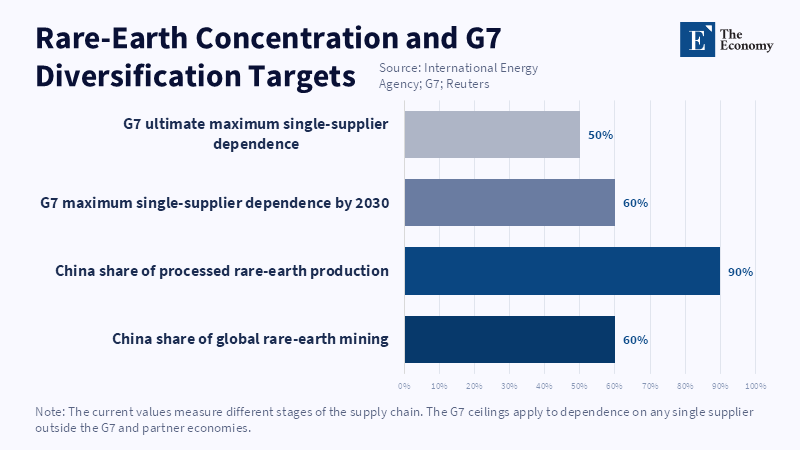
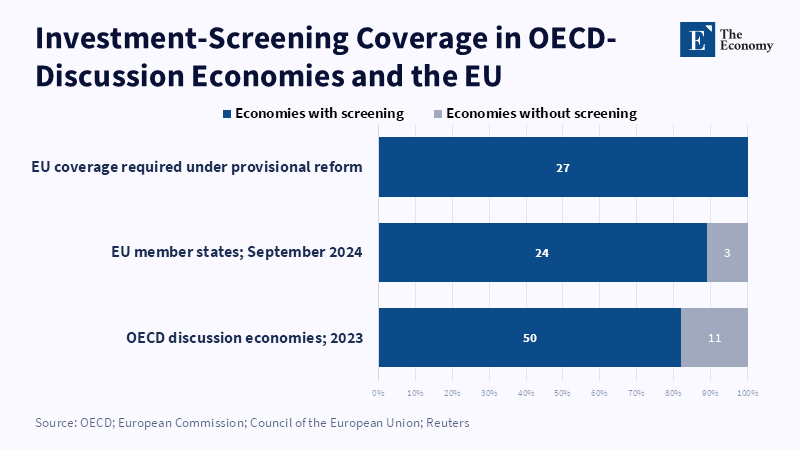
Cooperation must, therefore, provide something to all participants. A shared "infrastructure passport" would allow qualified projects in member states expedited review, bypassing repeated, duplicative analyses between national authorities. An AI data center that meets mutually agreed-upon security parameters in one EU member state should qualify for an expedited review in other member jurisdictions. The coalition should agree to a common set of criteria regarding cybersecurity, chip transfers and non-diversion, incident reporting and model transparency. By agreement, coalition member states also receive more predictable access to essential resources like development funding, industrial equipment, cloud and compute capacity and emergency supplies. It is an equal partnership in which each member state is expected to offer something significant in exchange for these benefits, such as prioritizing grid connection and infrastructure development in exchange for direct investment from the US. Security and nondiversion measures need to have equal standing in a discussion about chip and computational power sharing; conversely, grid connection should come in tandem with a willingness to allow access to pooled development finance for critical infrastructure projects like grids. Mutual aid need not only involve the promise of money, but a reciprocal agreement that states themselves will be incentivized through enhanced grid connections.
This proposition is naturally prone to criticism on the grounds of "red tape." That criticism must be acknowledged, but it ignores the current reality of multiple, separate national reviews for nearly identical projects, inconsistent technology adoption policies and potentially capricious export restrictions. The goal here is not an international governing body, but a unified acceptance of limited critical technical standards. National governments retain the ability to block a project for clearly demonstrated security risks, but a single process for routine reviews could streamline decision-making, build upon existing frameworks like the G7's emphasis on responsible AI and avoid the repeated miscommunication and potential political deadlock found in current interactions.
A Democratic Compute Coalition Must Reach Firms, Not Just Campuses
Even with abundant power, the value of deployed computing resources remains unrealized if it is concentrated only within the exclusive campuses of technology giants. Surveys indicate that nearly 43% of U.S. workers use generative AI at work, compared with 32% across six European countries. A narrower definition of using AI in the production and delivery of goods and services had similar results: about 7% of US firms engaged in this, but just 4% in Europe. Age, education, job type and firm size explain some of this gap, but not the rest; in reality, it was the willingness of employers to provide and encourage access that accounted for over 80% of the disparity in uptake. This has profound policy implications; a country that possesses an abundant infrastructure of technology but fails to spread the benefits does not necessarily gain economic traction.
This means the democratic compute coalition must include an adoption strategy. Public spending should not simply end with the deployment of large data centers or offer preferential access to cloud computing only for large corporations; the public has been asked to make infrastructure decisions and as a result, must also have access to the technologies they helped finance. That necessitates affordable and secure access to computing power for small and medium-sized businesses (SMBs), clear instructions and technical expertise for navigating new tools and established protocols for incorporating business data and use.
Pooled procurement may help lower overhead costs for SMBs and regional centers may offer valuable support in altering workflows at the firm level, such as for a manufacturing company seeking to implement AI and its manufacturing processes, rather than focusing only on helping it to purchase expensive tooling and software that it won't use. Public procurement agencies should look to commission solutions based on clear technical specifications and with low risk. The intent should be to ensure that ordinary businesses are not locked out of adopting technology due to costs and risks and to prove the productivity of AI technology on a wide scale, not just at flagship research campuses.
These programs will inevitably attract criticism that such a proposal only serves to funnel resources through government channels into a few corporate hands or reward a particular group of companies. That criticism is valid if the programs lack a rigorous structure, but such criticisms typically do not hold if programs provide temporary assistance, competitive bids from suppliers and demand-based incentives. For instance, compute credits would have a defined expiration date and businesses would have to provide results about how those resources were used, such as through time saved, improved output, or higher quality of goods, alongside reporting on changes in their processes. Providers would need to compete on security and speed of service and data portability should always be considered as a feature that allows users to take their information with them if they choose.
Finally, there should be common metrics across the coalition on uptake at the SMB level, across different industries and regions, to ensure equitable distribution of computational resources among the population and across business sizes. Installed chips are inputs, not outcomes; the crucial outcome measure must be about how much production, revenue, service and resilience gains accrue when a country can leverage the technology and not on a simple statement of its presence.
A Democratic Compute Coalition Needs an Enforceable Contract
Effective coalitions will have a scorecard and all members should report metrics related to, among other things: the time it takes to get approval for and power a large computing project; the addition of new generation and storage capacity; the impact on consumer electricity bills derived from these additions to grid load; and how many more businesses are now provided with supported computational capacity. They should also present data on: cyber incidents, areas where mineral supply chains may be dependent on only a small number of nations and where critical mineral refining is happening outside of these dominant three suppliers. Such metrics would identify significant weaknesses before they become crises. They would also allow governments to better compare policies across different nations.
A coalition needs teeth. A nation's subsidy package may be large, yet it may still lag a rival that spends less and delivers secure capacity in three years rather than seven. Member states fulfilling their key requirements must receive preferred treatment in investment reviews and procurement channels and be prioritized during periods of critical component and resource shortage. States failing basic tests on security and non-diversion, for example, may lose such benefits.
A small permanent secretariat within the coalition could help manage its affairs without interfering in the national decision-making of governments, while tying pooled infrastructure support to clear milestones This helps to avoid problems with free-riding, extravagant pledges with no delivery and shifting national priorities due to elections or geopolitical strains that governments face. It fosters a long-term commitment that outlasts political fluctuations because it is anchored in a defined contract.
The upfront electricity figure in 2024 shows just how critical this issue is. The demand for computing power won't abate while democratic governments continue to hash out the optimal system structure. As the global power system evolves and data centers electricity demand more than doubles between 2024 and 2030, the contest over where that infrastructure will be deployed will intensify. This build-out could proceed through uncoordinated projects, poorly integrated on-site systems, subsidy competition and weak community safeguards; or, it could proceed on the basis of collaboration under the clear terms and conditions defined by a democratic compute coalition. The most powerful tool here is not merely public funding but a concrete contract among member states that rewards speedy deployment of infrastructure as well as public and environmental protections and spreads the benefits of computational power beyond a select number of elite companies. Democratic governments should negotiate that contract now, before today’s infrastructure choices harden into tomorrow’s strategic dependence.
This article is based on an original research article published by The Economy Research. For the original version, please refer to A Policy Architecture for a Democratic Compute Coalition: Domestic Reform and Allied Coordination for AI Infrastructure.
The views expressed in this article are those of the author(s) and do not necessarily reflect the official position of The Economy or its affiliates.
References
Bick, A., Blandin, A., Deming, D.J., Fuchs-Schündeln, N. and Jessen, J. (2026) Mind the Gap: AI Adoption in Europe and the US. CEPR Discussion Paper No. 21337. London: Centre for Economic Policy Research.
Bick, A., Blandin, A., Eberly, J.C., Patnaik, S. and Steinsson, J. (2026) ‘Why is the U.S. outpacing European countries in AI adoption?’, Brookings Podcast on Economic Activity, 28 May. Washington, DC: Brookings Institution.
European Commission (2025) AI Continent Action Plan. Brussels: European Commission.
Group of Seven (2024) Apulia G7 Leaders’ Communiqué. Borgo Egnazia: Group of Seven.
International Energy Agency (2025a) Energy and AI. Paris: International Energy Agency.
International Energy Agency (2025b) Global Critical Minerals Outlook 2025. Paris: International Energy Agency.
OECD (2024) Investment Policy Developments in 61 Economies between 16 March 2023 and 15 February 2024. Paris: OECD Publishing.
Phillips-Robins, A., Tawil, T. and Winter-Levy, S. (2026) The Compute Coalition: How to Build the Future of AI in the Free World. Washington, DC: Carnegie Endowment for International Peace.
Rand, J., Manderlink, N., Gorman, W., Wiser, R.H., Seel, J., Mulvaney Kemp, J., Jeong, S. and Kahrl, F. (2024) Queued Up: 2024 Edition—Characteristics of Power Plants Seeking Transmission Interconnection as of the End of 2023. Berkeley, CA: Lawrence Berkeley National Laboratory.
Shehabi, A., Smith, S.J., Hubbard, A., Newkirk, A., Lei, N., Siddik, M.A.B., Holecek, B., Koomey, J.G., Masanet, E.R. and Sartor, D.A. (2024) 2024 United States Data Center Energy Usage Report. Berkeley, CA: Lawrence Berkeley National Laboratory.
The Economy Research Editorial (2026) ‘A Policy Architecture for a Democratic Compute Coalition: Domestic Reform and Allied Coordination for AI Infrastructure’, The Economy Research, 19 June.
Working across research, policy, and data-driven analysis, the Editorial Board ensures that published pieces reflect a consistent institutional perspective grounded in quantitative reasoning and long-term structural assessment.