Trusted Information Is the New Mainstream

Working across research, policy, and data-driven analysis, the Editorial Board ensures that published pieces reflect a consistent institutional perspective grounded in quantitative reasoning and long-term structural assessment.
Authored On
Modified
Mainstream media status no longer guarantees public trust
Trusted information must be proven through visible evidence and repeated scrutiny
AI makes misinformation cheaper, so truth must become easier to test

Today, a new warning sign is displayed: only 28% of Americans say they trust the mass media to report the news fully, accurately and fairly. That is not just a branding problem. It is a crisis of the traditional shortcut which treated a trusted outlet as a proxy for truth. Today, 58% of online news users across 48 markets say they are concerned about telling what is real and what is false online. That is the real policy challenge. Misinformation is not thriving only because falsehoods are alluring; it is thriving because Americans no longer concur over who has earned the right to settle the matter of fact. Trusted information, not mainstream status, is the scarce public good in the next era of media policy.
Trusted Information Needs Proof, Not Prestige
The old dichotomy of "mainstream media" versus fringe media now explains too little. It is easy for a network to be big and professional and well known and still be rejected by millions as unwelcome partisanship. CNN is a prime example. It is one of the best-known news brands in the world. It is also a symbol of mistrust for many conservatives after years of public attacks from Donald Trump and his allies. The issue isn't whether those attacks were fair. The issue is that having a big audience no longer automatically guarantees credibility. "Mainstream" refers to reach, format and institutional history. It does not itself bestow credibility.
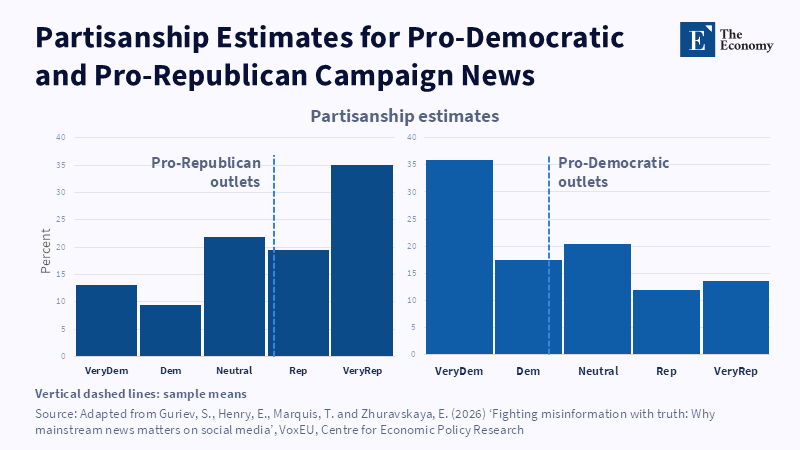
That is important because much of the anti-misinformation advice all this year has still rested on the expectation that if the public is simply returned to "credible sources," the problem will shrink. That advice is not worthless. It is just too basic. It is most effective with low-conflict topics such as weather warnings, safety alerts and official public records. It is less effective with a claim that is political, identity-based, or in reference to the moral tribe of the individual. In that context, a source badge may already be tainted by suspicion. A fact from a hated source may be viewed less as support and more as a stratagem.
The numbers speak to the magnitude of this break. The Reuters Institute has found that worldwide, trust in news remains stable at 40%, though behind this stability lie strong national divides, with Greece and Hungary sitting near the bottom, at 22%. Gallup shows the level of confidence in the U.S. media at 28%, the first time it has read below 30% in that trend. Pew has found that 57% of U.S. adults "have little or no confidence that journalists usually behave in the public interest." These numbers do not suggest a rejection of facts by the citizenry; rather, they reflect a rejection of the old channels of information, the old messenger. Reliable knowledge must now be demonstrated through process, rather than asserted through status.
Trusted Information Is Built Before a Crisis
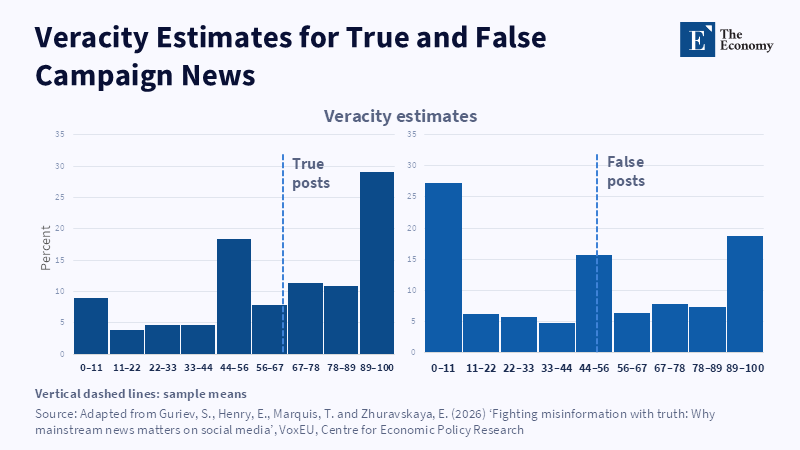
The first thing is to stop thinking about misinformation as a remediation exercise. Corrections do count, but they come too late. Misinformation travels with virality, emotionality and novelty. A seminal study of Twitter reported that false news traveled farther, faster, deeper and more broadly than the truth across many categories of information. That early finding is most frequently blamed on automated spreading machines, or bots, but the study showed the role of individuals as well. This is significant because it underscores a harsh reality. The failure isn’t exclusively technical. It's social: humans share what they want to feel is urgent, interesting, or useful to their tribe.
This is where trusted information can hope, more than "mainstream media," to be a policy frame. Trusted information has to be built before the rumor is in the air. It is built in the course of many repeated acts: displaying sources, rectifying mistakes on a program, distinguishing news from analysis, articulating uncertainty and resisting the condescending attitude that produces a sense of manipulation in the audience. Newsrooms cannot demand trust only in a time of crisis. Public agencies cannot demand belief only when a threat rumor is already raging. Trust is a reserve, recuperated slowly, expended rapidly.
There is evidence that small design changes can help. Accuracy reminders, compelling people to pause, could lower people's propensity to tweet false headlines in many studies. One large experiment before the U.S. midterms found that a simple prompt to think before reposting reduced false sharing without reducing true sharing. A later study found that the effect was stronger when users also saw clear, less contentious true information. That last nudge is crucial. This research suggests that it is not only false warnings that are needed. A minimum level of constant flow regular factuality that can anchor judgment.
This, at best, a straightforward lesson quickly becomes a pressing policy requirement. When producing journalistic content, the issue is not only accuracy. It is whether the evidence is present sufficiently prominently to persuade a doubtful reader. When hosting social media platforms, the issue is not only labeling false content. It is whether good context is readily available at the critical moment of doubt. When managing a public body, it is not only about establishing a website but also about having citizens already familiar with where to turn before panic unfolds. Trusted information is a public norm, rather than a one-off communication.
Trusted Information Cannot Depend on Platforms Alone
The platform layer sharpens the problem. News is no longer mostly found by visiting a front page, purchasing a newspaper, or watching a scheduled bulletin. In the United States, social and video networks have surpassed television news, news websites and news applications as their go-to places. Among 48 markets, younger adults are far more likely than older users to use social and video networks as their primary source of news. That doesn't mean that younger crowds are lazy. It means that their trust map is flatter. A journalist, a podcaster, a friend, a comment thread and an AI wrap-up may share equal prominence on the same screen.
And this flattening diminishes the news brand's old paternalist power. It also diminishes simple fact-checking. When an ordinary viewer encounters a correction as just another voice in a partisan roar, that correction may fail to build trust. On the contrary, it may validate the worry that powerful players are trying to curtail debate. This is the reason why content removal is such a fickle solution in the political realm. For every constituency that demands platforms take down more false or dangerous content, there are others observing that same move and denouncing censorship. In the United States, the division divides along party lines. A policy that appeals to one half of the country may appear as authoritarianism to the other half.
The better approach is not to abandon moderation, but to shift the needle of policy toward transparency, user empowerment and the repeatability of standards. Platforms should explain what causes their algorithms to elevate, lower, identify, or excise a given piece of content. Users should be granted genuine access to verified researchers; political influencers, paid promotion, recommendation algorithms and AI summaries should be made transparent in their effects on public information. This will be more effective than merely making a synthetic commitment to increase "high-quality news," because if the populace does not agree on which brands constitute quality, a favored outlet list will not solve the trust problem.
The EU's Digital Services Act is heading toward the same conclusion, an approach in which giant websites and online services are conceptually treated as machines that can introduce public danger. Great idea, but also a not-fully-formed one. It might prove too glacial or cumbersome or too reliant on self-disclosed platform data that might be wrong or unreliable. But the idea is correct. Platforms need to be held to account not only for bad content. They also need to be scrutinized by policies other than misinformation bans to analyze the structures selecting between them. Purely hostile or impenetrable shells of information will not long harbor trustworthy information.
Trusted Information Needs Collective Scrutiny
AI now increases the penalty for procrastination. Generative tools have eliminated the cost of producing convincing disinformation. A malefactor no longer requires a press room, a set, or indeed any strong writing. They can simply generate fake quotes, doctored voices, phony pictures and professional-looking summaries that look fairly phlegmatic and professional. The risk is not so much the lurid deepfake. It is a boring conspiracy that looks good enough. A massive pan-European survey of AI-helped answers in the news found that 45% contained one or more significant flaws, while 81% were flawed in some way. That should end the myth that AI can serve as a cheap truth machine.
The public already feels this. According to the Reuters Institute, just 7% of consumers of online news in markets surveyed used AI chatbots for news every week, but as much as 15% of those under 25 did. Meanwhile, audiences had both positive and negative expectations for AI, that it would make news cheaper and faster, yet less transparent, less accurate and less trustworthy. This is a good reminder. If AI is to be the new open doorway to news, it must not be a black box that robs publishers of traffic, rewrites reporting and hides the provenance of a neat answer.
It is not nostalgia for a vanished media age. It is a tighter bargain between providers of information and receivers of information. The providers should treat the brand-building process as a contractual guarantee of proof, not just personality. The providers should publish corrections conspicuously. They should introduce sourcing tradecraft into the visual vernacular. They should label opinion as opinion. They should refuse to ape the traffic-growth tactics of outrage-investing, even when they work. This is not a luxury. It is a survival technique. In a low-trust marketplace, the only sustainable brand is one that can be audited by its stakeholders.
The consumers require a useful routine of collective scrutiny. This is not to say that each person needs a full-time investigator. It is to say that as individuals we need to pause before rushing to judge, to look for other credible reports of the same fact, seek original sources when they exist and judge emotional presentation for what it is. The good advice that media literacy educators have been offering the public for the past decade remains accurate directionally, yet it must be amended for greater sincerity. "Verify your sources" is too weak when the source is in dispute. The more effective challenge is to identify, compare and reconcile.
Trusted Information Must Be Easy to Test
The probable criticism is obvious. It feels too gradual for the rapidity of today’s information. It demands too much of exhausted citizens. Both are legitimate. But the alternative is more dangerous. If trust is handed over to a few established brands, half of the public might dismiss the verdict without ever examining it. If trust is handed over to algorithms, business interests will attempt to preserve attention. If trust is handed over to artificial intelligence, with fluency indistinguishable from veracity. The only sustainable solution is concrete stages. Newsrooms generate tangible evidence. Platforms reveal the techniques of reach. Public offices archive who says what. Citizens develop new shared habits of doubt.
This should be treated as a wake-up call, a second chance to get it right, not as a death sentence. If less than a third of Americans trust mass media, then shouting "mainstream" in people's faces isn't the solution. Rebuilding trustworthy information from the ground up is. The task now is fewer appeals to institutional trustworthiness and more visible evidence. Fewer trusting correction calls and more trusting claimed habits. In the AI age, the side that wins won't be the one with the loudest microphone; it'll be the one with the easiest system for testing truth-claims.
The views expressed in this article are those of the author(s) and do not necessarily reflect the official position of The Economy or its affiliates.
References
BBC (2018) ‘How you can fight fake news’, Beyond Fake News. London: British Broadcasting Corporation.
Eddy, K. and Shearer, E. (2025) ‘How Americans’ trust in information from news organizations and social media sites has changed over time’, Pew Research Center.
European Parliament (2025) ‘Disinformation: 10 steps to protect yourself and others’. Brussels: European Parliament.
Gallup (2025) ‘Trust in media at new low of 28% in U.S.’ Washington, DC: Gallup.
Guriev, S., Henry, E., Marquis, T. and Zhuravskaya, E. (2026) ‘Fighting misinformation with truth: Why mainstream news matters on social media’, VoxEU, Centre for Economic Policy Research, 9 June.
Lawrence, T.E. and Hicks, J. (2025) ‘How to combat misinformation and find reputable sources online’, The Jed Foundation.
Newman, N., Ross Arguedas, A., Robertson, C.T., Nielsen, R.K. and Fletcher, R. (2025) Digital News Report 2025. Oxford: Reuters Institute for the Study of Journalism.
Pennycook, G. and Rand, D.G. (2022) ‘Accuracy prompts are a replicable and generalizable approach for reducing the spread of misinformation’, Nature Communications, 13, 2333.
UNICEF (2025) ‘A quick guide to spotting misinformation’. Geneva: UNICEF Europe and Central Asia.
Vosoughi, S., Roy, D. and Aral, S. (2018) ‘The spread of true and false news online’, Science, 359(6380), pp. 1146–1151.
Working across research, policy, and data-driven analysis, the Editorial Board ensures that published pieces reflect a consistent institutional perspective grounded in quantitative reasoning and long-term structural assessment.