Why Public Trust in AI Keeps Slipping and What Actually Fixes It

Working across research, policy, and data-driven analysis, the Editorial Board ensures that published pieces reflect a consistent institutional perspective grounded in quantitative reasoning and long-term structural assessment.
Authored On
Modified
Public trust in AI is falling even as use rises, and marketing isn't why
Rushed rollouts, low-friction tools, and narrower hiring are the real causes
Better deployment and real entry paths, not ad rules, will rebuild trust
Public trust in AI has been sliding even as more people use it every single day. That gap between rising use and falling confidence deserves more attention than it usually gets. A recent Brookings analysis blamed the slide mainly on marketing. It argued that young people's distrust comes from how AI companies have promoted technology and that stricter advertising rules would eventually restore confidence. That explanation sounds tidy, but it skips over the more obvious cause sitting in plain sight. Companies selling AI are locked in fierce competition for market share, revenue and enterprise contracts. They have little reason to make their own product look worse in public and every reason to do the opposite. If AI trust keeps falling anyway, poor marketing is probably not the real driver behind it. A more grounded explanation looks at what technology actually does to ordinary people. It happens in ordinary transactions, day after day, not in a coordinated messaging failure that fierce competition among AI vendors makes unlikely anyway.
The scale of the underlying shift makes this question worth taking seriously rather than treating it as a side issue. Nearly half of American adults now use an AI chatbot regularly, a sharp jump from just a few years earlier and almost as many have tried ChatGPT specifically. Adoption has moved from early curiosity to near mainstream use in a short stretch of time. Trust has not kept pace with that growth. Roughly half of adults say they feel more concerned than excited about AI's expanding role in daily life, a share that has climbed steadily since 2021. This shows up across age groups, occupations and political lines, not just among younger users, which suggests something more structural is generating that concern. Millions of people are now forming their own judgments about AI reliability. They do this through direct, repeated contact with these systems, not through anything a company claims about its own product. What changed over the past few years is not public relations. It is the sheer number of people interacting with these systems often enough to draw their own conclusions.
The Cost of Getting AI Wrong at the Point of Contact
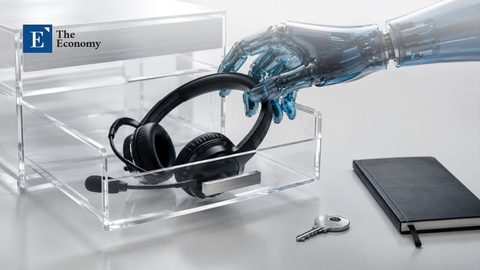
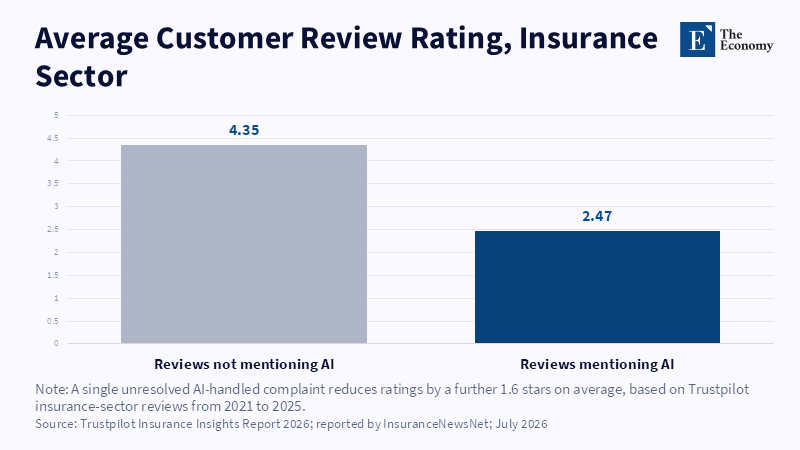
The clearest evidence for what is actually driving distrust sits in customer service, where the gap between promise and delivery plays out constantly. Insurance companies mentioned in AI-related reviews score far lower on average than companies whose reviews never bring AI up at all. A single complaint that an AI system failed to resolve and never escalated to a person costs a firm well over a full star in customer ratings. That kind of damage is not a communications problem in any meaningful sense. No clever slogan fixes that. A chatbot that loops a frustrated customer through the same unhelpful suggestion three or four times will not be saved by better branding. Neither will one that blocks a clear path to a human who could actually fix it. The thing producing that low rating is not a message. It is the software itself and the choices a firm made about how to deploy it.
Firms rolled out AI-based customer service faster than the underlying technology could reliably handle the job. Many stripped away the human escalation paths that used to catch AI's mistakes before a customer ever noticed them. Academic research backs this up with more than anecdote. Replacing human staff with AI agents measurably lowers how warm and capable customers think a company is. That drop in perceived warmth ties directly to lower trust. It also makes customers far less willing to forgive a service failure. The market has already begun correcting itself in response. Companies that cut customer service staff too aggressively are now rehiring for similar roles, often under different job titles. The AI trust they burned through during those cuts turned out to be far more expensive to rebuild than it was to lose. Firms that kept a clear, reachable person behind every consequential decision report far less of this damage. A customer who can still reach an accountable human stays far more forgiving than one who cannot.
Why People Stop Verifying What AI Tells Them
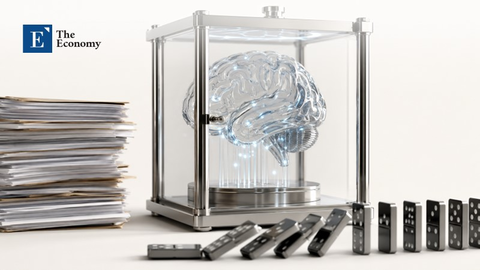
Part of the broader concern about AI centers on how easily people hand their own judgment over to a machine. This gets framed in public debate as a general crisis of critical thinking, but the more useful question is why certain tools make that handoff unusually easy. A calculator forces a person to know which operation to run and it gives a clear, checkable result that a person can quickly recognize as wrong. A generative AI system produces a fluent, confident answer whether or not that answer is correct. It offers almost no built-in signal when something has gone off track. That difference matters more than it first appears. It changes what kind of attention a tool actually demands from the person using it.
Researchers have started calling this specific behavior cognitive surrender rather than treating it as ordinary delegation to a tool. Controlled studies find that people using AI assistance perform noticeably better in the moment, but they lose real ground on independent tasks once that assistance is taken away. The size of that effect depends heavily on how a person actually uses the tool. Someone who engages with it strategically loses far less ground than someone who hands over the whole task. This distinction matters most for students and early-career workers. They have not yet built the judgment that lets a person catch an AI system's mistakes on their own. Without that foundation, they have little to fall back on once verification stops being optional. A recent survey found that most teenagers have already used an AI chatbot. A majority said using it to shortcut schoolwork was at least somewhat common among their peers. That suggests this risk is already showing up well before students reach the workforce.
Jobs Are Changing, Not Disappearing
Job displacement tied to AI is real, but its actual shape is considerably narrower than most headlines suggest and the details carry real weight for policy. Recent data on AI-related job postings shows that only a small share targets entry-level candidates, while the large majority target senior workers who already have experience. That is not the same thing as AI wiping out work across the economy as a whole. Employment in occupations most exposed to AI has actually grown faster since the pandemic than it did before it. Wages in those same occupations have climbed too. That cuts hard against the simple story of AI quietly erasing jobs in the background. Broader global forecasts point to a similar, more modest picture once the noise settles. Job losses and job creation largely offset each other over the next several years.
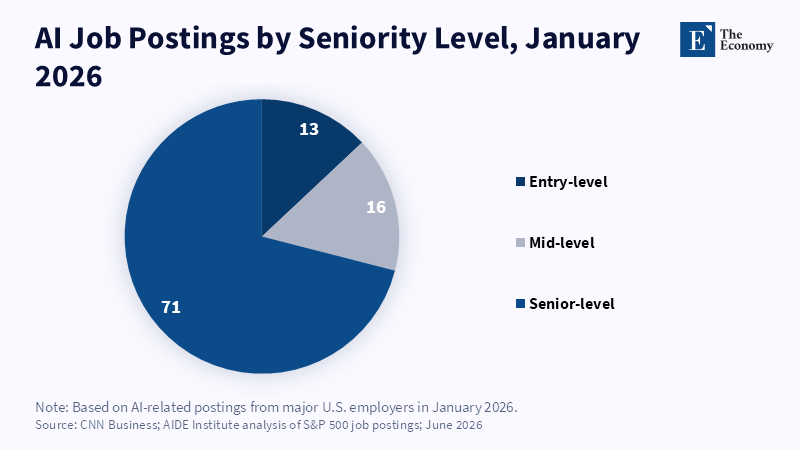
What the postings data really shows is a narrowing of entry points rather than a shrinking of work overall. Firms will pay for people who can already direct, correct and integrate AI output. They are far less willing to invest in training people who cannot yet do that. Research from OpenAI's own economics team found that a large share of AI use already crosses traditional occupational lines. A salesperson explores a dataset that once required a dedicated analyst. A small business owner drafts a contract that once would have gone straight to outside counsel. Work is being redistributed across roles faster than job titles or hiring practices are catching up. Official labor statistics likely understate how much genuine adaptation is already happening beneath the surface. This lines up with older research on how technology reshapes employment rather than erasing it. That research shifted attention away from fixed job titles and toward the smaller tasks that make up any given role.
What Would Actually Rebuild Trust in AI
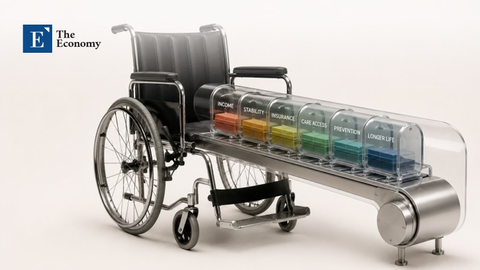
None of this means AI adoption should slow down, or that firms were wrong to experiment with technology in the first place. The deeper problem is not technology itself so much as how unevenly its benefits and its risks end up distributed across the workforce. Workers who already know how to direct and check AI output capture most of the gains. Workers who have not yet had a real chance to build that skill absorb most of the cost, through narrower hiring and fewer entry points into the field. Left alone, the current market shows little sign of closing that gap on its own and public sentiment is likely to keep track of that imbalance closely. None of this cancels out the genuine gains AI has brought to fields like legal drafting, financial analysis and basic design. Those gains extend a much older lineage running through calculators, spreadsheets and search engines. They are not something entirely new.
Rebuilding AI trust will not come from regulating what AI companies are allowed to say in their marketing campaigns. It will come from how firms actually deploy these systems day to day and from how quickly new entry points into AI-supervised work open up for beginners. That means funding real training pathways instead of treating them as an afterthought. It means keeping a clear, reachable human in the loop for consequential decisions. It also means building apprenticeship routes into AI-related roles instead of hiring almost exclusively at the senior level. What ultimately decides whether people trust AI is not a company's advertising budget. It is what happens the next time a customer files a claim. It is what happens when a graduate applies for a first job, or when a worker wonders whether the tool they use daily will still leave room for her in five years. Policy and firm practice that target that gap directly, rather than restraining AI adoption or promoting it rhetorically, are what will actually shift how people feel about technology over time.
The views expressed in this article are those of the author(s) and do not necessarily reflect the official position of The Economy or its affiliates.
References
Acemoglu, D. and Restrepo, P. (2019) 'Automation and new tasks: how technology displaces and reinstates labor', Journal of Economic Perspectives, 33(2), pp. 3–30.
Autor, D.H., Levy, F. and Murnane, R.J. (2003) 'The skill content of recent technological change: an empirical exploration', Quarterly Journal of Economics, 118(4), pp. 1279–1333.
Chin, C. and Richmond, A.M. (2026) How AI Is Expanding What People Do at Work. San Francisco: OpenAI Economic Research, 27 July.
Duffy, C. (2026) 'AI is sparking a jobs boom: just not for newbies', CNN Business, 11 June.
Faverio, M. and Kikuchi, E. (2026) Key Findings About How Americans View Artificial Intelligence. Washington, DC: Pew Research Center, 12 March.
Gartner, Inc. (2026) Gartner Predicts Half of Companies That Cut Customer Service Staff Due to AI Will Rehire by 2027. Press release, 3 February.
Gleap Team (2026) Why Customers Are Frustrated by AI Customer Service, and How to Fix It in 2026. Gleap, 27 April.
Lv, X., Yang, Y., Qin, D. and Liu, X. (2025) 'AI service may backfire: reduced service warmth due to service provider transformation', Journal of Retailing and Consumer Services, 85.
Morgan, R. (2026) 'AI communication gap leaves negative impression on customers', InsuranceNewsNet, 3 July.
Pew Research Center (2026) Americans' Views on AI Chatbots, Smart Devices and AI's Impact. Washington, DC: Pew Research Center, 17 June.
Risko, E.F. and Gilbert, S.J. (2016) 'Cognitive offloading', Trends in Cognitive Sciences, 20(9), pp. 676–688.
Shaw, J. and Nave, G. (2026) 'Cognitive surrender: distinguishing generative-AI reliance from cognitive offloading', as discussed in Faster Completion, Less Learning: Generative AI Reduced Study Time on Math Problems and the Knowledge They Build. arXiv preprint.
Stewart, J. and Tanner, B. (2026) 'Policy, not PR, will determine Gen Z's trust in AI', Brookings, 22 July.
Swiss Institute of Artificial Intelligence (2026a) 'The AI Labor Divide: Who Wins, Who Survives, and Who Falls Away'. SIAI AI Memo, 13 February.
Swiss Institute of Artificial Intelligence (2026b) 'Cognitive Outsourcing in Education: Why AI's Real Classroom Crisis Is Verification, Not Cheating'. SIAI Research, 24 July.
Vanguard (2025) analysis cited in CNN Business, 18 December.
Working across research, policy, and data-driven analysis, the Editorial Board ensures that published pieces reflect a consistent institutional perspective grounded in quantitative reasoning and long-term structural assessment.