Tax the Load, Not the Algorithm: A Smarter Model for AI Data Centre Taxation

Working across research, policy, and data-driven analysis, the Editorial Board ensures that published pieces reflect a consistent institutional perspective grounded in quantitative reasoning and long-term structural assessment.
Authored On
Modified
Data-centre hosts should recover identifiable local costs
Server location cannot reveal where all AI rents arise
Facility charges and wider profit allocation require separate rules

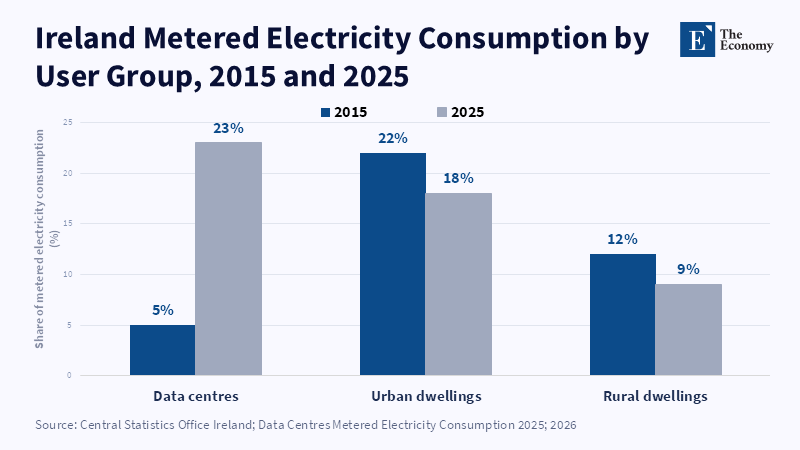
In Ireland, data centres absorbed 23 percent of metered electricity in 2025, a rise from 5 percent in 2015. This is high enough to support a clearer taxing argument. It is also high enough to mask the wrong argument. A server farm exerts real strain on power networks, water networks, land, planning offices and communities. Its physical presence, however, disguises where the largest AI profits accrue. A chip could be designed in one country, fabricated in another, installed in a third and managed in a fourth by a cloud-services contract. A server farm may produce outputs for a factory in a fifth. Accordingly, AI tax policy must be more precise. Tax the local burden where appropriate, but do not pretend that the server hall carries the full weight of AI. Europe now needs more compute and greater discipline in resource use simultaneously. The two cannot be reconciled unless tax policy disaggregates the costs of hosting machines from the profit generated across the wider AI supply chain.
AI Data Centre Taxation Starts with the Wrong Map
The central policy question is often too narrow. The question is whether data centres should be taxed for being large, immobile and conspicuous. The real question is what a host country has provided, what costs the facility has imposed and what income has been genuinely earned at the site. This shift in emphasis is important because the value of AI does not reside in one location. Compute has a location. Electricity has a location. Engineers have a location. The contracts, the patents, the models, the data rights and the customers all can have distinct locations. A host country can have a compelling claim regarding land use, grid congestion and facility operating profit without simultaneously having a just argument over all cloud, model, software and market rents. Respecting the separation of these maps will lead to just AI data centre taxation. A rule must correspond to the kind of value or expense in question. A local charge must explain itself in relation to local presence. A tax on wider profit must explain itself in relation to who created, controlled and received the benefit.
This divide is even reflected in tax law. A mere web presence does not translate into where business occurs. The mere use of a hosting arrangement may not equate to the availability of a server to the customer. The presence of a server in a permanent establishment does not determine the profit attributable to it and the transfer-pricing rules convey the same message. Legal ownership of software or a model does not by itself confer the full return being earned. The central question is whether it was produced, modified, maintained, protected and used by anyone and whether anyone controlled the related risks. The same logic applies in reverse. A data centre operator supplying space, power and support services is not necessarily entitled to the model rent. Consequently, physical location is an inadequate proxy for taxation. It may indicate the presence of hardware, a service and a profit-making operation, but alone cannot fully describe the income flows from cloud-based licenses, data sets and client agreements.
The proxy becomes weaker as the workload type is brought into play. Data centres are multi-use assets. They serve AI training, AI inference, off-the-shelf cloud services, storage, streaming, enterprise software and a number of other things. The needs of training and inference are different, too. Training can be scaled into huge clusters where power, chips and deployment speed are within reach. Inference may need to sit closer to users where latency, security and data constraints are tighter. A single tax based on floor space, rack numbers, or total power will affect these activities differently. It will also tax non-AI workloads as AI; it will tax workloads under the AI heading. Building policy around the host rather than the measured burden is an administrative shortcut, not a well-reasoned measure of value. The right instrument begins by gauging the host and stops far short of capturing income that belongs elsewhere.
AI Data Centre Taxation Must Follow the Value Stack
The AI economy is best mapped as a stack, not a single industry. At the bottom are chip design, chip fabrication, memory and advanced equipment. These are followed by servers, networks, storage, the cooling systems and the data centre shell. Then come the site-specific inputs such as electricity, grid access, water and land. Cloud companies offer capacity through user interfaces, scheduling tools, contracts and managed services. Model developers provide trained systems, safety work, testing and interfaces to products and services. Software companies and data owners turn those systems into products. Adopting firms and final users then employ those products to reduce costs, raise quality, or increase output. Each layer can earn an ordinary profit. Some layers can also earn scarce rents when a bottleneck occurs. The essential point for AI data centre taxation is that the bottleneck can shift. During a chip shortage, rent may shift upstream. When grid access is limited, rent may shift towards grid-access providers. When models are easier to replicate, data, workflow and distribution are more valuable.
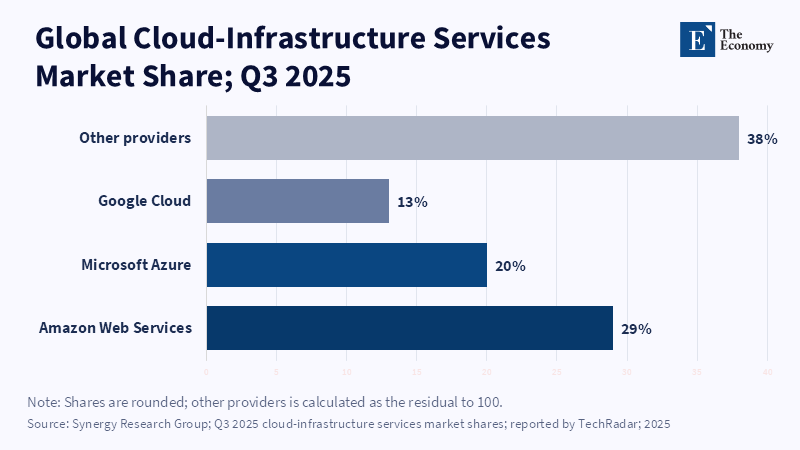
The same distinction applies to AI value. Not all gains accrue as profit to a cloud or model company. Some are transferred through faster design, lower downtime, better forecasting and higher output; others through lower prices or better services. A plant may gain from an imported model running in a foreign data centre, leaving much of the added value in the internal production system, within the factory, workers, customers and parent. It is this value that is to be taxed, as well as the factory site and the host, ideally leading to a cost centre for the latter. This subtlety answers one of the best-known precedents. Data centres are vital infrastructure and should receive a large part of the tax burden, but do not necessarily control the excess profit. Ports are physically vital to trade: a port city in the country collects its tax, so why should a long-haul ship crossing the port pay more than a small toll?
The volume of electricity use underpins the argument for local charges, but not for a claim over the whole AI surplus. Global data-centre electricity use was around 415 TWh in 2024 and is expected to reach nearly 945 TWh in 2030. That growth will demand new generation capacity, robust grids, additional storage and demand management. It will also raise hard questions about water, backup power and local air pollution. These are not abstract. They are direct costs related to a location. A larger power bill does not establish that all of the related economic benefit belongs there. It establishes that the host needs a robust method of recovering infrastructure costs. The two systems are distinct and the differences are straightforward. Resource use creates a local fiscal claim. The more expansive business chain creates a separate profit-allocation question. Conflating the two may seem practical, but it merely undermines the robustness of each.
What Host Jurisdictions Can Fairly Charge
The host jurisdiction has several practical and defensible charging options. It can tax land, buildings and the operating profit of the site. It can charge for permits, road access, fire planning and public safety. It can recover the cost of a dedicated connection, a new substation, or broader grid upgrades. It can price reserved capacity when a project blocks scarce grid capacity. It can charge for water usage, wastewater treatment, carbon emissions and local pollution from backup gensets. It can also require better reporting on energy and water efficiency. Those actions are based on an obvious rule: where the site receives services or causes harm, it pays. The evidence confirms that basis. Connections in Europe often take over two years and queues in major hubs take seven to ten. In 2024, EU transmission system operators spent €4.3 billion on remedial action to contain congestion. They should not shift those costs to households and other businesses without limit.
Ireland illustrates why public concern is justified. Data centres have increased from accounting for around 5% of metered electricity in 2015 to almost 23% in 2025. Such an energy load has a material impact on national planning, not merely at the facility level. It influences option value, network reinforcement planning and the speed at which customers other than the largest users can access power. So taxing AI data centres needs a solid basis of audited measurements of load factors. Regulators require trustworthy figures for peak, annual electricity use, water use, backup generation, grid services and heat reuse. These should inform charges on the basis of measured resource demands instead of a generic depiction of a site as "AI." A grid-supporting facility that reduces load at times of system fragility should face a different charge from a guaranteed power site. A site with headroom already in place should not be treated as one with significant reinforcements to be installed. So this is more complex than a simple tax, but it is also far more resistant to abuse.
A robust policy model requires three separate ledgers. One details local resource costs and environmental harm. Those should have a price on the site. The second details the ordinary operating profit of the facility operator. That should be taxed as normal corporate profit. The third thus captures broader rents for chips, cloud control, models, applications, data, entry to market and enterprise proliferation. Those rents will mandate transfer pricing, corporate taxation, treaty rules and, in settled cases, market-based distribution. Separation of the three ledgers provides a more defensible system. It also reduces the prospect that a local infrastructure charge becomes a disguised tax on the global digital economy. Detractors may argue that tough local charges will lock in investment. Poorly designed charges will do that. Cost-based charges may, however, improve project selection. They encourage sites with real grid capacity, efficient cooling and useful demand flexibility and support public confidence in new capacity as a means of avoiding cross-subsidies.
Europe Needs a Two-Track AI Data Centre Tax Strategy
Europe faces a significant policy dilemma. Firstly, it requires increasingly stringent controls on energy efficiency and system performance. Secondly, it requires substantially increased levels of domestic compute. The AI Continent Action Plan set out to deliver a tripling of EU data centre capacity over a five- to seven-year period. At the same time, grid connections may take two to ten years and data centres may account for 10 percent of EU electricity demand growth by 2030. A blunt facility levy would exacerbate this dilemma. It would impose an excise on a scarce resource when policy is seeking to grow that very resource. Therefore, the solution is not to abandon facility taxation, but rather, to implement two parallel strategies. The first should ensure each project bears its own local grid costs and satisfies standards. The other should ensure wider AI profits are taxed through rules that follow ownership, contracts, control, users and markets. AI data centre taxation should not be compelled to fulfil both mandates. The two-track model can also lead to a more coherent compute policy.
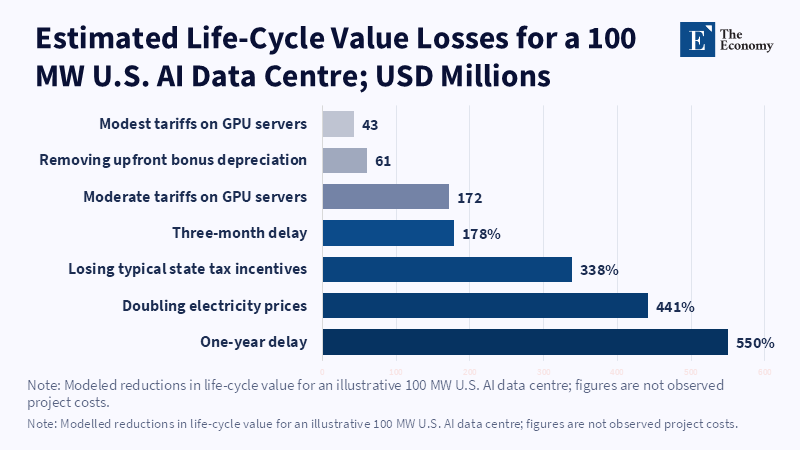
Europe cannot expect every workload in every country. Some expensive training jobs might be less costly to run in power-rich jurisdictions with faster permitting but many inference tasks may need to remain near European users for latency, security, resilience and public oversight. Those strategic public-interest systems may need stricter location rules than routine commercial workloads. Tax rules should distinguish those conditions and reflect those differences, rather than try to treat them as one. Connection queues should reward ready projects with flexible connection arrangements. Public investments should emphasize shared infrastructure, research access and essential capacity, not blanket tax relief, regardless of facility size. Performance metrics should be pushed to simple benchmarks and high minimums, but those metrics should be functionally separate from a tax on global AI rent. Good rules give each tool a purpose and evaluate it on its own. The strongest objection to this approach is that taxing only the facility may leave mobile AI rents lightly taxed. That very real risk, however, does not justify taxing the server hall. Large cloud providers may be able to shift workloads, change their contractual arrangements, or pass facility costs through to smaller customers. University-based, mobile-oriented start-ups and local clouds are often less able to absorb. A facility levy may therefore simply transfer like-for-like the main rent to those with the least market power.
Profit must be addressed directly. That necessitates stronger transfer-pricing rules, more intense scrutiny of intangible income, effective minimum-tax controls and a serious debate on market jurisdiction for cross-border digital services. Although important, these are hard tasks. Lack of an easy solution does not validate a worse solution. It makes international tax cooperation even more urgent. Ireland's 23 percent figure must pass the test. It shows that data centres can impose a major burden on a host economy. It does not show that the host is entitled to all the value of each chip, each model, each license, each workflow and each customer linked to those sites. Europe must respond to those two facts together. Data centres should pay for land, power, water, congestion and pollution. Their profit should be taxed where it is earned. The wider AI rents should be tracked through the wider chain and taxed with rules designed for profit, ownership and markets. The conclusion, therefore, is clear. Stop trying to give one visible building the entire AI tax system. Build an intensive local charging system that is firm, proportionate and open. Then build a separate transnational system that tracks value beyond the server rack. Charge for the load when it lands. Charge for the rent when it is generated.
This article is an independent editorial summary of “[AI and Tax] Data-Center Taxation and the Geography of AI Value” from Swiss Institute of Artificial Intelligence, following the conference Inequalities in Longevity, held at Fondazione Giorgio Cini in Venice on 3–4 July 2026.
It has been prepared by The Economy Review to present the principal arguments and policy implications of the original research to a wider audience. It is not an official abstract, a verbatim reproduction, or part of the Fondazione Giorgio Cini conference proceedings.
References
Amaro, F. and Picciotto, S. (2026) Possible EU Own Resource Based on a Digital Levy: Cross-Border Services Trade, Digital Transformation and Tax Implications. Brussels: European Parliament.
Central Statistics Office Ireland (2026) Data Centres Metered Electricity Consumption 2025. Cork: Central Statistics Office.
European Commission (2024) ‘Commission Delegated Regulation (EU) 2024/1364 of 14 March 2024 on the First Phase of the Establishment of a Common Union Rating Scheme for Data Centres’, Official Journal of the European Union, L 2024/1364.
European Commission (2025) The AI Continent Action Plan. Brussels: Directorate-General for Communications Networks, Content and Technology.
European Commission (2026a) Proposal for the Cloud and AI Development Act. COM(2026) 502. Brussels: European Commission.
European Commission (2026b) Energy Performance of Data Centres. Brussels: Directorate-General for Energy.
European Commission (2026c) ‘Rating Scheme for Data Centres in the EU—Commission Launches Call for Feedback’, 27 March. Brussels: Directorate-General for Energy.
European Parliament and Council (2023) ‘Directive (EU) 2023/1791 of 13 September 2023 on Energy Efficiency and Amending Regulation (EU) 2023/955’, Official Journal of the European Union, L 231, pp. 1–111.
European Union Agency for the Cooperation of Energy Regulators (2025) Market Monitoring Report: Electricity Wholesale Markets. Ljubljana: ACER.
Google (n.d.) Hamina, Finland—Google Data Center Location. Google Data Centers.
Google Cloud (2026) Google Contracting Entity. Google Cloud.
International Energy Agency (2025) Energy and AI. Paris: IEA.
International Energy Agency (2026a) ‘Data Centre Electricity Use Surged in 2025, Even with Tightening Bottlenecks Driving a Scramble for Solutions’, press release, 16 April. Paris: IEA.
International Energy Agency (2026b) Key Questions on Energy and AI. Paris: IEA.
International Monetary Fund (2024) Broadening the Gains from Generative AI: The Role of Fiscal Policies. Washington, DC: International Monetary Fund.
Lee, K. (2026) ‘Data-Center Taxation and the Geography of AI Value’, SIAI Research Working Paper Series. Schindellegi: Swiss Institute of Artificial Intelligence.
OECD (2017) Model Tax Convention on Income and on Capital: Condensed Version 2017. Paris: OECD Publishing.
OECD (2019) Taxing Energy Use 2019: Using Taxes for Climate Action. Paris: OECD Publishing.
OECD (2022) OECD Transfer Pricing Guidelines for Multinational Enterprises and Tax Administrations 2022. Paris: OECD Publishing.
OECD (2025) Competition in Artificial Intelligence Infrastructure. OECD Roundtables on Competition Policy Papers, No. 330. Paris: OECD Publishing.
OpenAI (2026) Europe Terms of Use. Updated 16 January 2026.
Phillips-Robins, A., Tawil, T. and Winter-Levy, S. (2026) The Compute Coalition: How to Build the Future of AI in the Free World. Washington, DC: Carnegie Endowment for International Peace.
Pilz, K. and Heim, L. (2023) ‘Compute at Scale: A Broad Investigation into the Data Center Industry’, arXiv, 2311.02651.
Sastry, G., Heim, L., Belfield, H., Anderljung, M. et al. (2024) ‘Computing Power and the Governance of Artificial Intelligence’, arXiv, 2402.08797.
Stanford Institute for Human-Centered Artificial Intelligence (2026) Artificial Intelligence Index Report 2026. Stanford, CA: Stanford University.
Synergy Research Group (2025) ‘Cloud Market Share Trends—Big Three Together Hold 63% While Oracle and the Neoclouds Inch Higher’, 19 November. Reno, NV: Synergy Research Group.
Working across research, policy, and data-driven analysis, the Editorial Board ensures that published pieces reflect a consistent institutional perspective grounded in quantitative reasoning and long-term structural assessment.