Europe’s AI Fiscal Capacity Depends on More Than Adoption

Working across research, policy, and data-driven analysis, the Editorial Board ensures that published pieces reflect a consistent institutional perspective grounded in quantitative reasoning and long-term structural assessment.
Authored On
Modified
Europe can benefit from foreign AI without capturing an equal share of its rents
Fiscal resilience requires compute, capital, ownership and local industrial capability
The viable strategy is high adoption with minimum technological sovereignty

A fivefold increase in euro-area residents’ payments to U.S.-registered intellectual-property owners is not an AI number on its own. That is precisely why it matters. It shows how a place can wield cutting-edge technology, raise productivity and, ultimately, send more of the resulting income abroad. The test of Europe’s AI fiscal capacity will be what AI adoption delivers inside Europe. It requires not just access to powerful models but taxable profits, skilled employment, ownership and productive assets. Imported AI can boost wellbeing. But they can also trigger even greater dependence on foreign cloud services, proprietary software and capital flows. The core policy concern is not a question of technological purity. It is whether Europe’s domestic firms and infrastructure, transport systems and health services can be built at scale alongside rapid adoption. That foundation, in turn, needs to support pensions, hospitals, prisons and primary schools. A continent can unlock more productive efficiency while the largest new streams of rent flow elsewhere. That is the risk Europe faces.
Why Europe's AI Fiscal Capacity Cannot Rest on Adoption Alone
Europe's focus has shrunk to a race over frontier models. On that score, the distance is stark. In 2025, the United States built 59 notable models and China built 35. Industry produced over 90 percent of them. Private AI investment in the United States totaled around $285.9 billion. China recorded $12.4 billion, but this does not include all government-backed investment. Europe need not reach those numbers, model for model. That kind of target would absorb scarce capital and yield far less public benefit. Yet the gap itself matters because frontier companies do more than build models. They build developer ecosystems, govern access, establish prices, provide cloud capacity and create intellectual property. All of these activities generate recurring revenues. Europe can purchase the end results, but purchasing a service is different from gaining ownership of an asset.
To settle such disagreements, the access/capture distinction should be decisive. A European producer may use a foreign platform to improve its own manufacturing efficiency, service delivery or engineering processes. Those improvements can then raise local output and taxable profit. Simultaneously, some of the resultant extra value may escape via cloud contracts, software licenses, model subscriptions and intellectual-property payments. The resulting fiscal outcome will vary with the location of the additional profit. It may accrue entirely within Europe's borders. Adoption figures alone cannot reveal the true bounds of that net. They cannot show whether Europe is paying for widespread AI with meager economic rewards.
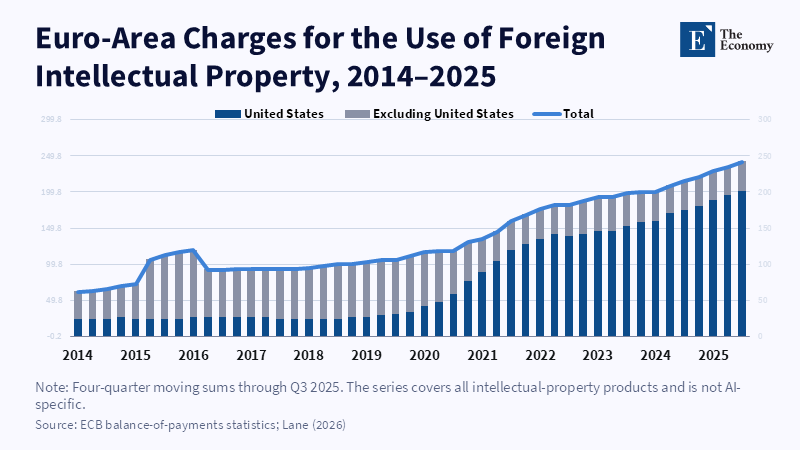
The strongest rebuttal is that foreign ownership does not impoverish Europe. European investors hold foreign equities and, within the euro area, can receive dividends and capital gains from leading technology firms. Residents of the euro area own a significant fraction of the world's listed equity. These holdings produced around 200 billion dollars of capital gains in 2025, equivalent to around 1.3 percent of euro-area GDP. This channel is significant and undermines the claim that every foreign profit is lost. It cannot eliminate the fiscal issue entirely. Portfolio gains are concentrated, volatile and only partly taxed. They cannot fully compensate for the local fiscal effects of headquarters, listings, supplier networks, executive functions, high-paying employment, dealer links and corporate tax payments. Exposure to foreign winners can be beneficial.
Compute, Cloud and Capital Shape Europe's AI Fiscal Capacity
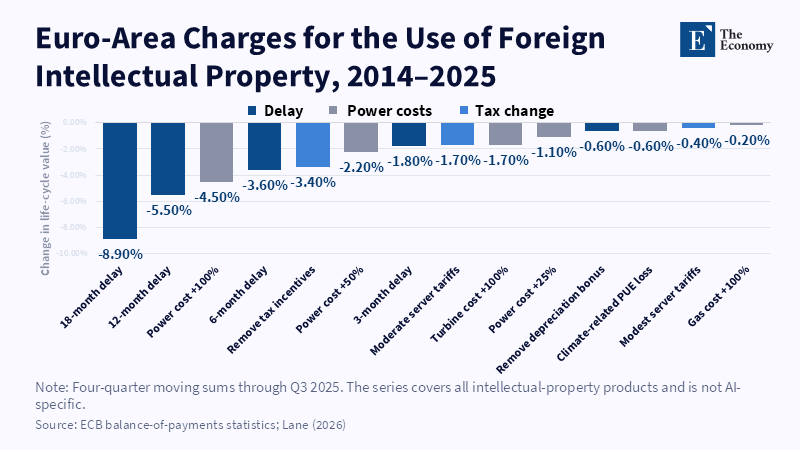
The infrastructure race is often defined by announced gigawatts and investment figures. A more relevant metric is how quickly capacity becomes operational on the grid. A modeled 100 MW data center loses more than $500 million of lifetime value when the start of operations is delayed by just one year. Meanwhile, in this scenario, the cost of delay outweighs the impact of much higher electricity prices. This reorders what matters in policy. Fast permitting, grid connections, transparent queue mechanisms and dependable clean energy can be even more vital than broad-based tax breaks. The gigafactories, supercomputers and AI labs everyone is planning in Europe will enable more access. But these announcements alone do not create capacity: sites have to be developed, semiconductors manufactured, power installed and networks built. Data centers already account for about 2.5% of overall EU electricity demand. Installed capacity, meanwhile, is forecast to reach about 12 GW in 2025 before climbing to 28 GW through 2030. In this light, delay is not just a planning issue. It is a bottleneck of industrial significance.
Cloud control is just as vital as the hardware. AWS, Microsoft Azure and Google Cloud account for around 75 percent of the EU cloud-infrastructure market, while around 13% is held by EU providers. That does not suggest foreign services should be disbanded. They deliver the size, tools and services European businesses need right now. Cutting off choice would push up prices and slow uptake. The concern arises when one vendor dominates storage, model access, orchestration, customer data and migration conditions within the same stack. Such a structure can turn ordinary reliance into strategic dependence. Europe's strategic position is in better shape when buyers are free to switch providers, migrate data and combine services in a cost-effective manner. The concrete objective is contestability. By offering open standards, multi-cloud architecture, portability and convincing native European alternatives, bargaining power improves without hardware entrapment.
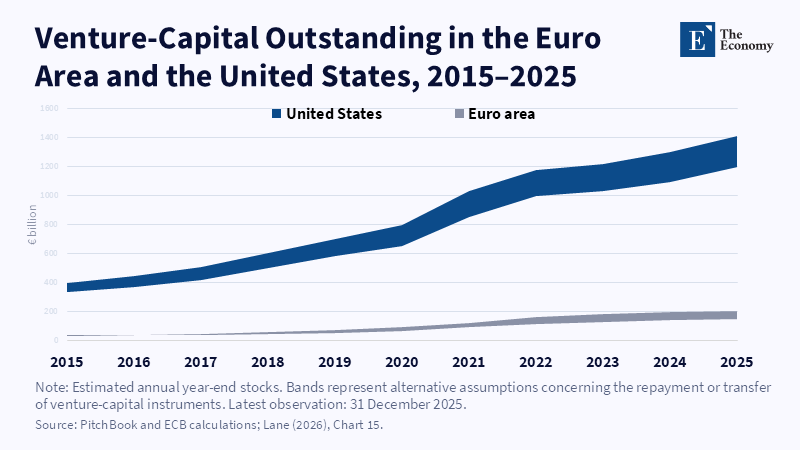
Capital is the other weak link. Europe is wealthy, yet the benefits do not flow far enough down the chain when firms are most vulnerable to moving their base offshore. EU households hold around a third of their financial assets as cash and deposits. The venture capital pool is also far smaller than in the US. The ECB estimates the capital available in venture-capital funds to be about € 150 billion in the EU, compared with € 930 billion in the US. It is not just that there are fewer start-ups. It reflects weaker late-stage finance, fewer big exits and greater pressure to move the holding company or headquarters abroad. Around 10 percent of scale-ups in the EU relocate abroad, with 85 percent moving to the US. Europe may retain the engineers, head researchers and scientists, while losing the legal base, commercial leadership and the capitalized value. This retained activity preserves activity but weakens fiscal capture.
Industrial Diffusion Must Create Local Value, Not Thin Use
The best route for Europe may be to deploy AI in existing sectors where it already has deep expertise. An enterprise survey of the EU in 2025 revealed that 20 percent of EU businesses employing ten or more people already used one or more specified AI technologies. Adoption reached 55 percent for large firms, but only 17 percent for small ones. That reveals why sweeping claims of an AI economy are exaggerated. Large firms have the data teams, budgets and process expertise that small firms often do not. Evidence from the euro area showed that two-thirds of firms had some employee use of AI, but only 7 percent reported significant operational use. Europe has moved beyond experimentation, but has not yet achieved deep operational integration.
Policy should measure process change, not license count. A company that simply grants employees access to a chatbot may record adoption even if there is no change in throughput, cost, or product quality. Value appears when the AI is applied to production planning, logistics, maintenance, research, fraud detection, energy consumption and customer interfaces. In manufacturing, applications increased from 7 percent of firms in 2021 to 11 percent in 2024, with the strongest uptake in pharmaceuticals and electronics. Most AI systems were purchased rather than built in-house. This does not necessarily point to underinvestment. There will be a few companies dedicated to training their own frontier models. The danger is that Europe imports the core models but does not develop the local layers around them: those that include integration, enterprise software, compliance, data engineering and process redefinition. These capabilities create skilled jobs, taxable profits and exports.
Public procurement may facilitate those local levels of providers, but only if certain conditions are met. A shallow "buy European" strategy could preserve uncompetitive providers and raise public costs; procurement should instead reward open standards, portability, auditability and resilience. European providers should only win where their performance is comparable, not simply because they are European. In health, energy, transport and administration, public clients could create the demand for a secure cloud environment, specialized models and specific tools. They could also demand systems that did not lead to permanent vendor lock-in. This would not be a subsidized European functionality; it would be a market-building exercise. It would sustain Europe’s AI fiscal capacity. Firms and skills would be created to meet public and private requirements. Competitive pressure from outside Europe would be maintained. The end aim is not for the European stack to be self-contained. The end aim is for it to be sufficiently developed, validated and transferable.
Minimum Viable Sovereignty Is the Practical Fiscal Strategy
The phrase technological sovereignty is often taken to mean self-reliance. This is the wrong standard. Europe does not have to produce everything from scratch. It does not even need to own everything-from every chip design and model, to every platform, every data center. What it does need is enough capacity in a handful of layers to avoid dependence as a matter of course and enough AI income remaining in its tax base in order to preserve bargaining power. This is minimum viable sovereignty. It combines high adoption with targeted ownership. The priority areas are those where absence would weaken bargaining power. Examples include rapid access to compute, secure cloud capacity, scale-up finance, the manufacturing skills for integrating new digital technologies, specialized models and systems in the public sector. In fact, Europe already has strategic strengths in semiconductors, high-end manufacturing, pharmaceuticals, machinery and regulated sectors; policy should therefore build on those specific areas, rather than replicate America's entire platform economy. Selectivity is necessary because, given the way subsidies were spread across fashionable AI assets, Europe would simply waste scarce public funds if it chose to do likewise.
A fiscal scorecard would make the strategy measurable. Model counts and investment announcements are insufficient. The scorecard should also quantify time to power, announced versus deployed compute. It should quantify the location of scale-up HQs, the European share of ownership, outward payments for digital services and the depth of AI use within firms. Such metrics would not replace tax policy. They would measure whether industrial policy strengthens the future tax base, which would expose false signs of success. If a new data center entailed minimal direct investment, imported equipment, a large subsidy and few local linkages, it may add little domestic value. An entirely foreign model might be of great value if European firms built profitable products around it. The key concern is not where every component was developed. It is where long-lasting income, ownership and productive capacity are accumulating.
Europe's social model makes delay expensive. Social protection payments will total about €4.925 trillion in 2024, 27.3 percent of the EU GDP. Even when technology rents cross borders, these commitments remain local. Europe's AI fiscal capacity cannot therefore be an unintended side effect of adoption: it must be made into an explicit test of a compute policy, reforming capital markets, procurement and industrial strategy. The challenge is to do this without a retreat from foreign technology or rushing to clone every frontier asset. What is required is faster infrastructure, deeper scale-up finance, effective competition rules and serious investment in AI adoption in high-value sectors. The opening warning is therefore clear. Rising payments for foreign intellectual property are not evidence of failure, but a warning. Europe should deploy the world's best AI and a greater share of the value earned through that deployment must continue to be held, taxed and reinvested in Europe.
This article is an independent editorial summary of “[AI and Tax] Europe’s AI Race and the Fiscal State” from Swiss Institute of Artificial Intelligence, following the conference Inequalities in Longevity, held at Fondazione Giorgio Cini in Venice on 3–4 July 2026.
It has been prepared by The Economy Review to present the principal arguments and policy implications of the original research to a wider audience. It is not an official abstract, a verbatim reproduction, or part of the Fondazione Giorgio Cini conference proceedings.
References
ASML Holding N.V. (2026) Annual Report 2025. Veldhoven: ASML Holding N.V.
Banu, E., Derin, T., Evrard, J., Lambert, C., Legran, D. and Schuster, W.E. (2026) ‘Exploring the investor landscape for venture capital’, in European Central Bank, Financial Integration and Structure in the Euro Area. Frankfurt am Main: European Central Bank.
European Central Bank (2026) Financial Integration and Structure in the Euro Area. Frankfurt am Main: European Central Bank.
European Commission (2025a) Savings and Investments Union: Better Financial Opportunities for EU Citizens and Businesses. Brussels: European Commission.
European Commission (2025b) Apply AI Strategy. Brussels: Directorate-General for Communications Networks, Content and Technology.
European Commission (2026a) Proposal for the Cloud and AI Development Act. COM(2026) 502 final. Brussels: European Commission.
European Commission (2026b) Strategic Roadmap on Digitalisation and AI in the Energy Sector. COM(2026) 501 final. Brussels: Directorate-General for Energy.
European Investment Bank (2025) EIB Investment Survey 2025. Luxembourg: European Investment Bank.
European Investment Bank (2026) Drivers of Relocation by Innovative EU Startups and Scaleups. Luxembourg: European Investment Bank.
European Parliament (2025) Report on European Technological Sovereignty and Digital Infrastructure. A10-0107/2025. Brussels: European Parliament.
Eurostat (2025a) ‘20% of EU enterprises use AI technologies’, 11 December. Luxembourg: Eurostat.
Eurostat (2025b) ‘EU social benefits expenditure up 7% in 2024’, 7 November. Luxembourg: Eurostat.
Lane, P.R. (2026) ‘AI and the euro area economy’, keynote speech at the ECB-SAFE-RCEA International Conference on the Climate-Macro-Finance Interface, Frankfurt am Main, 23 March.
OECD (2026) Progress in Implementing the European Union Coordinated Plan on Artificial Intelligence, Volume 2: Uptake in High-Impact Sectors. Paris: OECD Publishing.
Phillips-Robins, A., Tawil, T. and Winter-Levy, S. (2026) The Compute Coalition: How to Build the Future of AI in the Free World. Washington, DC: Carnegie Endowment for International Peace.
Stanford Institute for Human-Centered Artificial Intelligence (2026) The 2026 AI Index Report. Stanford, CA: Stanford University.
Working across research, policy, and data-driven analysis, the Editorial Board ensures that published pieces reflect a consistent institutional perspective grounded in quantitative reasoning and long-term structural assessment.