Taxing AI Profits in Europe: Follow the Rent, Not the Tool

Working across research, policy, and data-driven analysis, the Editorial Board ensures that published pieces reflect a consistent institutional perspective grounded in quantitative reasoning and long-term structural assessment.
Authored On
Modified
AI does not create a separate and measurable tax base
Europe should tax economic rents and shifted profits, not AI use
A layered tax framework can protect revenue without discouraging adoption

Labor taxes and social contributions made up 51.5 percent of all EU tax revenues in 2024. That number, not a harbinger of mass unemployment, should inform the discussion of taxing the profits from AI in Europe. Europe already taxes one dominant source of income in the same way: labor. Those returns may instead show up on the balance sheets of others. They may go to higher corporate margins, license fees, capital gains, dividends, or profits booked in low-tax jurisdictions. This does not require a sudden contraction of fifteen million jobs. A modest shift away from employment income may be sufficient to undermine a payroll-based tax system. The mistake would be to respond to that risk through a new tax on algorithms, software or AI-enabled activity. That would hit the companies that use the technology, rather than reach the firms capturing most of its rents. Europe needs a better response: tax mobile profits, market-based value and realized rents, while exempting productive AI deployment.
Taxing AI Profits in Europe Starts with the Tax Mix
The first requirement is to separate fiscal risk from technological alarmism. Adoption of AI is widespread, but deep deployment remains scarce. The European Central Bank found that roughly 70 percent of surveyed firms in the euro area used AI in some form by the end of 2025, while only 7 percent used it to a large extent. This distinction is significant. It indicates that AI is not yet a uniform economic shock. Companies use it for customer service, coding, prediction, exploration, identity checks and routine office tasks. The benefits vary by sector and by training, data, management and new working procedures.
A tax based on how prevalent AI is, therefore, would be based on an unreliable criterion. It would treat a retailer running a rudimentary assistant similarly to a platform that possesses a model and user data and earns high profit margins. The genuine issue is not how frequently a tool is used. It is where the resulting income appears, who owns it and whether it stays within reach of European tax authorities. The change in focus alters the question policymakers are asking. AI-related profit does not appear neatly on a company’s account with an "AI profit" label. Its returns are combined with software, cloud provisioning, patents, brands, its own data, complex labor and organizational change.
An AI success can even raise profit, only because a company changed its process or combined the AI with a decade of previous research and development. A narrow levy would be asking tax authorities to disentangle intertwined causes that companies cannot always separate, while opening up a new avenue for corporations to game the system. They could, for instance, give one process a new name, make confusingly similar contracts, or classify similar tools separately. The more effective approach is to tax the income that is already present in accounts and in law. That means the profit that is not taxed at low rates across the world, such as dominant multinational profits, economic rents, income from patents, dividends, capital gains and sales made into European markets with no fixed presence. This approach is less novel than an AI tax. It is also easier to implement and administer, since it tracks the money, not the label that is affixed to the technology.
Why an AI Tax Targets the Wrong Base
The diverse geography of AI makes a narrow tax even more difficult to justify. One service might involve chips designed in one country and executing the instructions loaded from a cloud service, stored in another, owned by a third, used by a customer base spread from the UK to Greece. The broader rent is not dependent on that particular site. A data-center host has a clear basis for recovering costs associated with land use, grid demand, local access infrastructure, emergency response and pressure on local services. Such charges should be linked to measured local impacts. Nonetheless, one host nation does not claim a right to capture every nickel earned by the model owner, cloud provider, software vendor, or platform. The geography of compute represents only one aspect of value geography. If compute location were treated as the whole tax base, some facilities would be overtaxed and many critical rents would remain outside the host country's reach.
The principle is similar in the case of firms that simply use AI. An automation charge, tokens, models, or AI-supported work would increase the price of adoption within the EU. It would have affected low-margin factories, health centers, banks and modest service providers before reaching the global owners of the most valuable AI assets. Some proponents might contend that an AI levy is transparent and easy to implement. That argument is unconvincing. The levy would still require rules for defining AI, measuring its usage, isolating embedded software, treating open-source models and accommodating imported cloud services. It would apply to both ordinary returns and economic rents. A better system is characterized by shielding usual investment while appropriating returns above the default cost of capital. Cash-flow legislation and credits for corporate equity provide guidance for achieving that difference. They aren’t simple to implement across borders. However, the rule is correct. The tax ought to escalate when economic rent arise, not each time a business inserts an effective tool.
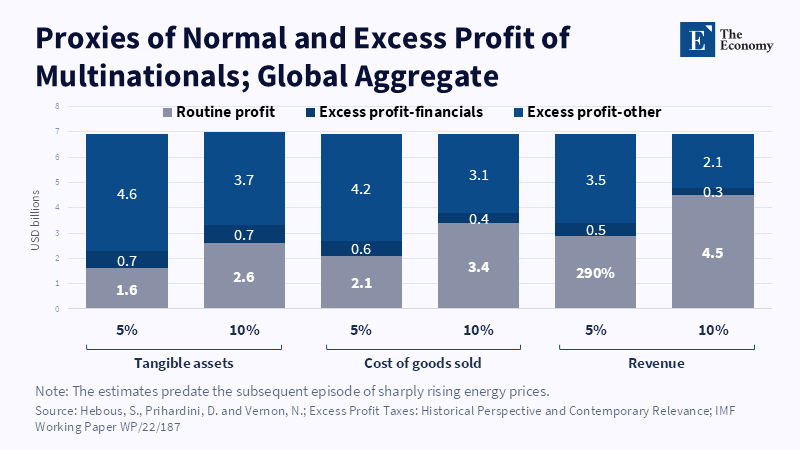
Economic-rent taxation also provides an answer to a familiar objection. Critics argue that high returns are the compensation for risk and should not be treated specially. That is valid for the normal returns needed to justify investment. It is less convincing when those profits are the returns to durable market power, unique data, state enforcement, network effects, or control of a rare technological choke point. A sophisticated rent-sensitive tax allows the investment costs and a normal return to be taxed at a lower rate. Where that is too difficult, governments can pick more observable points of tax collection. Capital gains realized from a sale and dividends, royalties, or fees paid to an investor reveal that a benefit has been earned by an owner. These sources of revenue must still account for mobility and the entrepreneur's inherent risk and indeed are more directly linked to realized income than a tax on AI use. The point is not to produce a perfect measure of AI rent, but that it is with existing taxes—such as realized income as opposed to hypothetical productivity gains-that we have a closer step toward taxing rents when they are a company's profits or an individual's wealth.
Pillar Two Protects the Floor, Not the Market
Europe already has one effective mechanism in place. EU minimum tax rules set a 15% minimum rate on both large multinational and large domestic groups with more than 750 million euros annual turnover. The OECD estimates that the tax could reduce profit-shifting by around 50% and could generate between 155 billion US dollars and 192 billion US dollars annually from corporate taxes. Research ordered by the European Commission's Directorates-General for Communications Networks, Content and Technology (DG CONNECT) and for Taxation and Customs (DG TAXUD), the Joint Research Center, in 2025, projects a short-term EU benefit of approximately 26 billion euros annually, which is a 7.1 percent increase in corporate income tax revenues. These calculations rely on modeled estimates rather than observed cash receipts and still underline the existence of an extensive system of country-by-country artificial erosion of earnings from business activity. For the proposed new taxation of profits resulting from AI developments in Europe, Pillar Two offers the best current safeguards for profits that are more mobile than workers or factories. There is little incentive to route with ease the shifting of income between corporations in heavily low-tax geographic locations. It is particularly true for AI-intensive firms that rely heavily on mobile intangible assets.
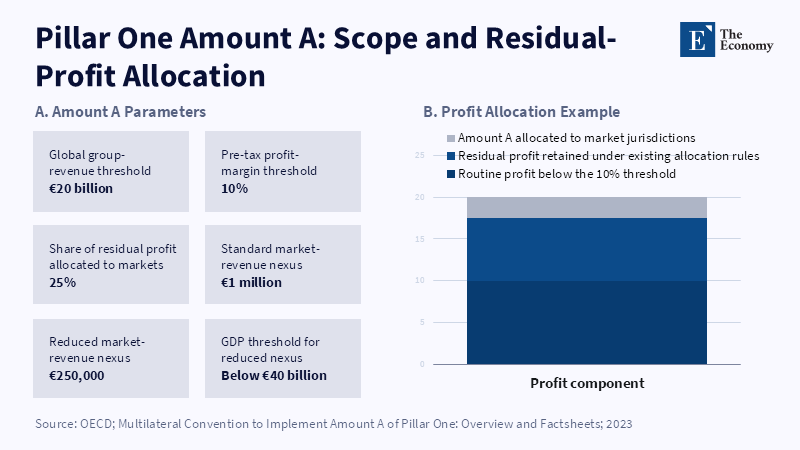
Yet Pillar Two still cannot determine which country the tax belongs to. It defends this minimum rate, but it does not grant additional revenue to a country merely because customers or users are located there. Pillar One was meant to fill that void. Its Amount A rule would target the world's largest and most profitable multinational groups. It would allocate 25 percent of profits in excess of a 10 percent margin to eligible market jurisdictions. But the multilateral convention has not yet been opened for signature and the system is not yet running. Europe, therefore, has a minimum rate but not a comprehensive system for sharing the remaining profit. That distinction matters as AI expands the range of remotely delivered services. A company can sell into a European market, learn from its consumers and users and be paid premium prices while leaving little taxable profit in that country. Minimum taxation constrains how far this final rate can drop, but it does not dictate which jurisdiction receives it.
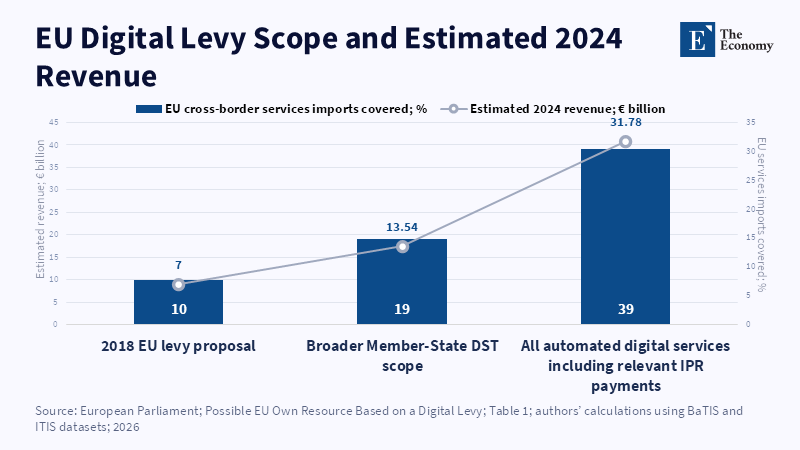
Digital services taxes are still tempting because their response to this market failure is rapid. France, Italy, Spain and Austria collected more than €1.5 billion in 2024 alone. European Parliament estimates suggest that a narrow EU levy could raise approximately 7 billion per year, while a broader levy could raise close to 13 billion. But these figures are still coarse; turnover taxes are blunt. They can burden a low-margin firm even if its profit accounts are thin and pass costs to advertisers, merchants, or consumers. Different national designs can also break up the Single Market. The best case is therefore for a temporary EU-wide measure, not a permanent patchwork. It should replace national levies, use clear thresholds and reporting rules and expire or be revised once a workable multilateral solution takes effect. It should be explained honestly. It is an imperfect turnover-based interim instrument for digital market access, not a precise tax on AI profits.
A Layered Plan for Taxing AI Profits in Europe
A credible strategy will require a toolbox because the problems differ. Pillar Two should be enforced through common filing standards, effective information exchanges and adequate resources to challenge cross-border companies and test complex multinational structures. Europe must continue work on Pillar One, since the market countries need a fair claim for value earned from their customers without a physical presence. Corporate reform requires protection for normal returns but must also examine more rent-sensitive designs. Capital gains, dividends, royalties and exit taxes should be tightened where realized gains escape the normal tax base. Local governments may charge data centers for identifiable land, grid, water and environmental costs. A short-term EU digital levy may fill part of the market-allocation gap, but only with a sunset clause and a single design. Each tool has a purpose. That is the discipline. Forcing them all into one AI tax would create a visible and economically weak policy.
Public support also needs a more transparent payoff. Europe supports research, chips, cloud capacity, start-ups and strategic technology through grants, loans, guarantees and equity. The EU Innovation Council fund acquires stakes in ventures that use public money to absorb early risk alongside private investors. If public money bears a significant share of the initial risk, then contracts can include warrants, royalties, convertible claims, or repayment related to eventual commercial success. This is not a way to say no to reasonable taxation. It is a way to prevent taxpayers from bearing losses while private owners retain all gains. Changes are needed in the way the tax system as a whole operates over time. Europe should not respond to a weakening labor-tax base by raising payroll taxes still further, nor by levying firms for substituting algorithms for work. This would harm both employment and productive AI adoption. Revenues need to be derived from mobile profits that are currently undertaxed, realized capital income, recurrent property bases and environmental costs. This is not to raise the cost of AI but to reduce the reliance of the fiscal system on wages alone.
The 51.5% share of labor taxation is a warning to Europe of things to come at the beginning of this debate. It demonstrates why fiscal policy cannot wait for evidence that an enormous number of jobs will be lost. Money flows before there is any collapse in jobs. Profits can become more mobile before tax revenues decline. Capital gains grow before governments agree on where the value was created. Thus, taxing AI profits in Europe must happen now, but the tax to be used is not an AI tax. The effective solution would be to enforce the minimum-tax floor, to secure limited market taxing rights, to tax realized rents and to recover identifiable local infrastructure costs, in order to moderate the bias for labor to bear the burden of taxation. The trade-off is not between innovation and revenue. It is between a blunt tax on adoption and a tax system that follows economic value. Europe should choose a harder design and a better target. Tax the rent. Leave productive AI adoption untaxed.
This article is an independent editorial summary of “[AI and Tax] Taxing AI Profits in Europe” from Swiss Institute of Artificial Intelligence, following the conference Inequalities in Longevity, held at Fondazione Giorgio Cini in Venice on 3–4 July 2026.
It has been prepared by The Economy Review to present the principal arguments and policy implications of the original research to a wider audience. It is not an official abstract, a verbatim reproduction, or part of the Fondazione Giorgio Cini conference proceedings.
References
Amaro, F. and Picciotto, S. (2026) Possible EU Own Resource Based on a Digital Levy: Cross-Border Services Trade, Digital Transformation and Tax Implications. Brussels: European Parliament.
Brun, L., Pycroft, J., Speitmann, R., Stasio, A.L. and Stoehlker, D. (2025) The Impact of the Global Minimum Tax on Corporate Tax Revenues: Evidence for EU Member States. Seville: European Commission Joint Research Centre.
Calvino, F. and Fontanelli, L. (2023) ‘A portrait of AI adopters across countries: Firm characteristics, assets’ complementarities and productivity’, OECD Science, Technology and Industry Working Papers, No. 2023/02. Paris: OECD Publishing.
Chaloupka, D., Lalinský, T. and Lopez-Garcia, P. (2026) What Separates Firms That Use AI Intensively from Firms That Don’t? Frankfurt am Main: European Central Bank.
Council of the European Union (2022) ‘Council Directive (EU) 2022/2523 of 14 December 2022 on ensuring a global minimum level of taxation for multinational enterprise groups and large-scale domestic groups in the Union’, Official Journal of the European Union, L 328, pp. 1–58.
European Central Bank (2026) Survey on the Access to Finance of Enterprises in the Euro Area: Fourth Quarter of 2025. Frankfurt am Main: European Central Bank.
European Commission (2024) Annual Report on Taxation 2024: Review of Taxation Policies in the European Union. Luxembourg: Publications Office of the European Union.
European Commission (2026) Data on Taxation Trends. Brussels: Directorate-General for Taxation and Customs Union.
European Innovation Council (2026) European Innovation Council 2026 Work Programme. Brussels: European Commission.
Eurostat (2025) EU and Euro Area Tax-to-GDP Ratio Up in 2024. Luxembourg: Eurostat.
Filippucci, F., Gal, P., Jona-Lasinio, C., Leandro, A. and Nicoletti, G. (2024) ‘The impact of artificial intelligence on productivity, distribution and growth: Key mechanisms, initial evidence and policy challenges’, OECD Artificial Intelligence Papers, No. 15. Paris: OECD Publishing.
Hebous, S. and Mengistu, A. (2024) Efficient Economic Rent Taxation under a Global Minimum Corporate Tax. IMF Working Paper WP/24/57. Washington, DC: International Monetary Fund.
Hourani, D. and Perret, S. (2025) ‘Taxing capital gains: Country experiences and challenges’, OECD Taxation Working Papers, No. 72. Paris: OECD Publishing.
OECD (2023) Multilateral Convention to Implement Amount A of Pillar One: Overview and Factsheets. Paris: OECD/G20 Inclusive Framework on Base Erosion and Profit Shifting.
Thomadakis, A. (2026) Could a Digital Services Tax Become an EU Own Resource? Revenue Potential, Policy Trade-Offs and Strategic Options. Brussels: European Parliament.
Working across research, policy, and data-driven analysis, the Editorial Board ensures that published pieces reflect a consistent institutional perspective grounded in quantitative reasoning and long-term structural assessment.