Why AI Fiscal Erosion Begins Before Jobs Disappear

Working across research, policy, and data-driven analysis, the Editorial Board ensures that published pieces reflect a consistent institutional perspective grounded in quantitative reasoning and long-term structural assessment.
Authored On
Modified
AI can raise productivity without causing broad job losses
Fiscal outcomes depend on who captures the gains
Tax bases weaken when income moves from wages to mobile or deferred returns

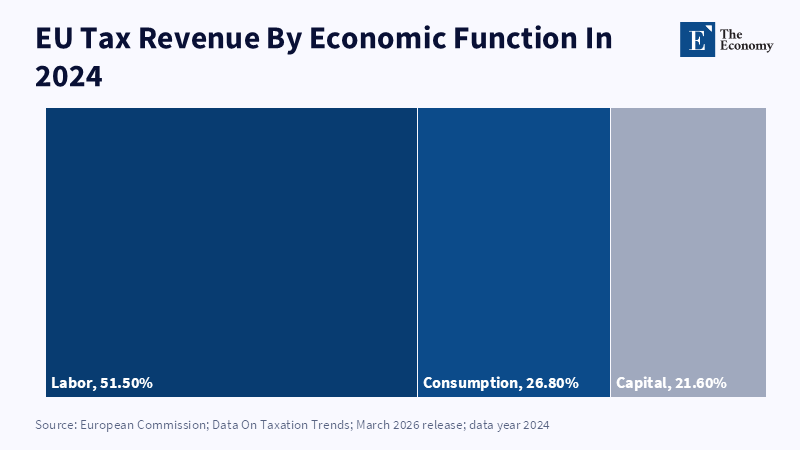
The most recent data from the European Union show that labor taxes—including social contributions-make up 51.5 percent of total tax receipts. That one statistic should be enough to reignite the debate about artificial intelligence and public finance. The fiscal peril does not lie in machines starting to replace all workers. It lies in the fact that income will drift away from salaried wages (taxed firmly and promptly by most governments) towards profits, capital gains and payments to foreign suppliers of technology. These components are much more difficult to tax at the same time and in the same place. AI tax base erosion will therefore begin before large-scale unemployment. Benefits may indeed flow to efficiency, firm growth and consumers. The public accounts may nevertheless erode if the income is not broad, does not stay put, does not arrive on time and is not booked by the resident tax collector. The key policy challenge is not whether AI creates value. It is whether each country can turn it into an expansive and resilient domestic revenue base.
AI Fiscal Erosion Begins with Income Distribution
Recent evidence supports a cautious view on AI productivity. In a 2023 experiment involving professional writers, using generative AI reduced the time to complete an article by 40 percent and increased perceived quality by 18 percent. A large-scale study of customer-service agents showed an average increase of 14 percent in issues resolved per hour; for inexperienced and lower-skilled workers, the improvement was as great as 34 percent. These findings are relevant because they demonstrate that AI can diffuse useful know-how and increase productivity for workers who begin with less experience. However, they do not demonstrate that entire jobs are 40 percent more productive. Almost every job requires judgment, validation, communication, coordination and ownership. AI may accelerate one phase while requiring additional review work in other areas. A task-level enhancement is tangible; whether this translates into a fiscal benefit depends on subsequent outcomes. The hours saved may translate into increased compensation, augmented output, reduced selling prices, higher profits, or an increased software bill.
That sequence of distribution lies at the heart of AI fiscal erosion. Governments do not tax productivity per se: they tax the income streams that productivity creates. A wage rise, for example, will support income tax and social contributions each month and a more competitive price may help households in the short term, yet consumer surplus is not directly taxable. A retained profit may be taxed as corporate income, but there are deductions, losses and cross-border structures that can counteract that. A higher company valuation may increase shareholder wealth many years before any tax liability from capital gains. And a payment to a foreign cloud or model provider may reduce the adopter’s domestic profit and shift supplier income abroad. The same output gain will produce a wide variation in government revenues. That fiscal conversion rate should be examined as closely as the productivity rate. A nation can increase its GDP, yet collect less revenue per euro of added value.
Task Exposure Is Not the Same as Fiscal Loss
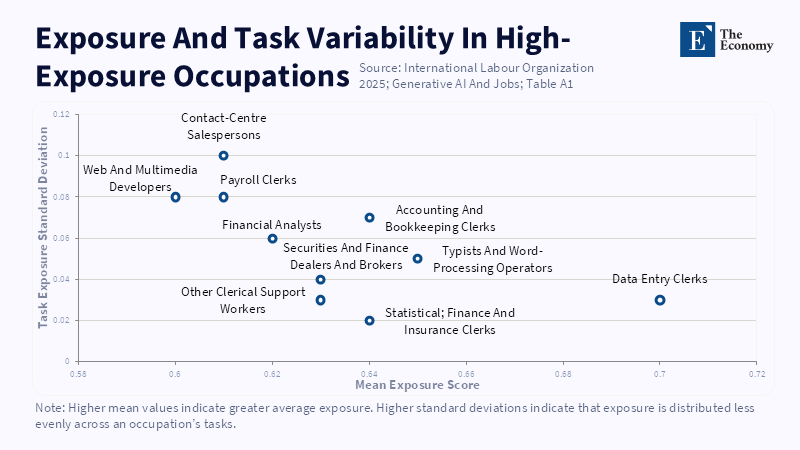
The second policy mistake is to treat occupational exposure as a prediction of job losses. The International Labor Organization estimates that one quarter of world employment is exposed in some way to generative AI. Just 3.3 percent is in the top category of exposure. At 34 percent, the share in high-income countries is much higher because clerical, professional and digital services occupations are more common. Exposure indicates where existing technologies might modify existing tasks. It does not predict whether firms will want to implement those technologies, grow output, or reallocate workers to those tasks. Danish administrative evidence gives a stark warning about alarmism. Two years after the advent of AI chatbots, researchers reported seeing no sign of effects on earnings or recorded hours in highly exposed occupations and no effects larger than about 2 percent of those outcomes.
However, that early stability should not be reassuring. Firms can make hiring decisions, even augmenting them, before they cut jobs. Entry-level jobs are a prime example because junior workers perform routine tasks while building experience. With AI, a new hire may learn faster, as customer-support evidence suggests. For firms, an added benefit of AI could be substituting for junior roles altogether to support existing senior workers. Such fiscal loss could later flow into small graduate cohorts, weaker contribution growth and fewer routes into middle-income employment. Sector conditions will matter, where demand may fall to free up investment, lower costs could allow more sales and jobs, but fixed demand may reduce labor input. Competitive firms may pass gains to customers, but firms with market power may retain them. AI fiscal erosion will not be a universal beginning-of-an-age employment shock, but will appear unevenly across occupations, ages, places and industries.
The Tax Base Moves Before Jobs Disappear
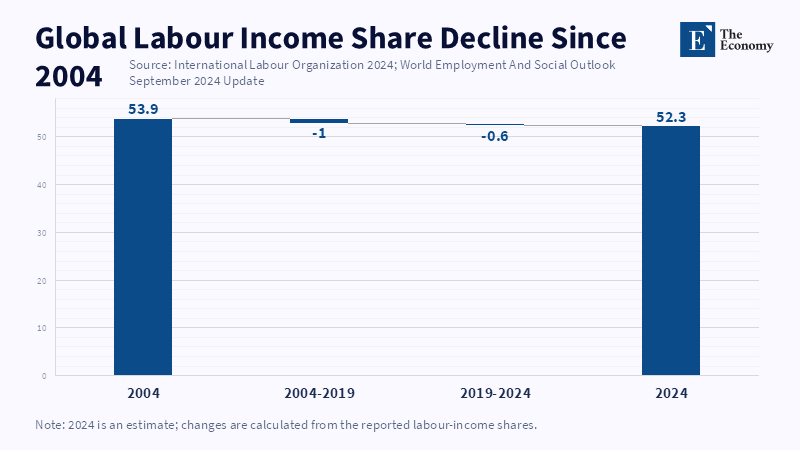
A decline in the labor share of income is not even necessary for fiscal stress to set in. The worldwide labor share of income had already dropped from 52.9 percent in 2019 to 52.3 percent in 2022 and remained close to that low through 2024. The rise of generative AI cannot be usefully blamed for that previous tendency. It shows that labor entered the AI era without a secure claim to productivity gains. Even a small shift from payroll to profit can seem like a change in scale given how the two bases track differently. Payroll is comprehensive, regular and locally anchored. Profit is concentrated, unstable and foreign-ownership and deduction-prone. Capital gains can be taxed. Payments to foreign suppliers leave the domestic tax base. Therefore, even an incremental adjustment in income shares can lead to a relative change in the timing and location of tax collections.
Firm evidence helps explain why ownership of home-grown firms and additional investment are relevant. A recent European Investment Bank survey of about 13,000 firms associated AI adoption with stronger productivity performance. The benefits mainly resulted from capital deepening rather than short-term job losses. In short, adoption alone does not suffice. The fiscal benefit should be greatest where firms develop their own software, skills, data architectures and new products around AI and lowest where they simply outsource existing back-office functions to cheaper foreign suppliers. AI fiscal erosion would be most probable where these factors have combined, such as where substantial payroll taxation, high service-sector share, weak capital income taxation, little ownership of digital assets and growing pension and health costs all intersect.
The conventional objection is that higher corporate-tax revenues will offset lost payroll revenue. This can be true, but only if a number of factors all align: the firm that adopts has to retain most of the gains after the costs of cloud access, models, software, IT consultants, additional infrastructure, etc.; the profit has to stay in this country; and the profit must become taxable after accounting for losses, allowances, interest and investment relief. Even then, corporate tax rests on a narrower base and company tax is more sensitive to the business cycle. Payroll revenue is derived from a stable base of millions of regular payments; in principle, any partly recovered revenue can be taxed more evenly and predictably than this at a time when it is already relatively volatile. The challenge is not only delivering the money, but how well, how predictably and how locally rooted it is.
Building a Tax Base That Can Survive AI
The answer is not a special tax on uses of AI. It would be very difficult to prescribe and implement such a levy without penalizing firms that choose to use AI to produce more, to raise standards of service and to support workers. The ideal is tax neutrality across the use of labor and capital. No tax rule should make replacing labor easier and raise the capital cost of expanding and upgrading labor, simply because the payroll is inherently more burdensome than machines, software, or retained earnings. Governments should think about investment relief, depreciation, social contributions, profit taxation and capital gains as one integrated system. The goal need not be to prevent automation. The goal must be to ensure that the tax code does not incentivize labor substitution when training, redesign and worker assistance could create greater social returns. Competition policy should also feature in this agenda. Competition will deliver productivity improvements throughout prices, wages and adoption. It will enlarge the critical mass of benefits that remain shadowed as rent.
The measurement must become much more actionable. Exposure rankings remain too distant from actual tax outcomes. Finance ministries need detailed linkages on AI use, employment levels, entry-level hiring, wage levels, sales, profit rates, imported digital services and tax contributions. They need to run several simulations in stress tests, not one prediction. One may posit strong wage growth and broad capital augmentation. A second may posit declining job levels and rising domestic profits. A third may posit a large share of the gain going to overseas suppliers. Policy then can respond to observed pressures. Wage insurance may be better for some mid-career displaced workers than generic long-term courses. Training funds should follow credible vacancies and measured earnings. Broad social insurance may need subsidized contribution levels where contribution density falls. These steps would counter AI fiscal erosion without assuming familiarity with the future of work.
AI can also reinforce the state’s own revenue system. A large majority of surveyed tax administrations use or are deploying AI and this is usually in compliance management, risk analysis, fraud prevention and client services. That provides a genuine counter-balance. This requires effective safeguards. Automation should not make any final decision without human oversight, legal safeguards and effective rights of appeal. Better enforcement cannot protect a collapsing base; however, it can prevent important losses in the midst of transformation. The same principle applies across the wider economy. Fiscal resilience will not come from taxing a declining wage bill more heavily, but from ensuring that productivity supports local wages, profitable domestic firms and taxable earnings and creating work that sustains public obligations.
The initial figure remains conclusive. More than half of tax revenue relies on labor. A slow withdrawal from payroll may therefore erode the state's ability to pay for pensions, health and adjustment support. AI fiscal erosion is not a natural consequence of improved technology. It results from poor wage pass-through, concentrated rents, foreign supplier capture and tax systems designed for an older mix of income. Policy must therefore keep pace with the people who benefit from the new technology, the places where the income is booked and the point in time when it is taxed. The pressing issue is not to estimate exactly how many of the working hours AI will substitute, but rather to safeguard the fiscal conversion of productivity so that it is not denied to the polity before the revenue gap appears. Growth that does not generate revenue cannot uphold public institutions that have historically made economic change politically possible, even in the face of high productivity.
This article is an independent editorial summary of “[AI and Tax] Labor Income, AI Rents and Fiscal Erosion” from Swiss Institute of Artificial Intelligence, following the conference Inequalities in Longevity, held at Fondazione Giorgio Cini in Venice on 3–4 July 2026.
It has been prepared by The Economy Review to present the principal arguments and policy implications of the original research to a wider audience. It is not an official abstract, a verbatim reproduction, or part of the Fondazione Giorgio Cini conference proceedings.
References
Acemoglu, D. (2025) ‘The simple macroeconomics of AI’, Economic Policy, 40(121), pp. 13–58.
Acemoglu, D., Manera, A. and Restrepo, P. (2020) ‘Does the US tax code favor automation?’, Brookings Papers on Economic Activity, 2020(1), pp. 231–300.
Autor, D.H. (2015) ‘Why are there still so many jobs? The history and future of workplace automation’, Journal of Economic Perspectives, 29(3), pp. 3–30.
Brynjolfsson, E., Li, D. and Raymond, L.R. (2023) Generative AI at Work. NBER Working Paper No. 31161. Cambridge, MA: National Bureau of Economic Research.
European Commission (2026) Data on Taxation Trends. Brussels: Directorate-General for Taxation and Customs Union.
European Investment Bank (2026) EIB Group Investment Survey 2025/2026. Luxembourg: European Investment Bank.
Gmyrek, P., Berg, J., Kamiński, K., Konopczyński, F., Ładna, A., Náfrádi, B., Rosłaniec, K. and Troszyński, M. (2025) Generative AI and Jobs: A Refined Global Index of Occupational Exposure. ILO Working Paper 140. Geneva: International Labour Organization.
Hampole, M., Papanikolaou, D., Schmidt, L.D.W. and Seegmiller, B. (2025) Artificial Intelligence and the Labor Market. NBER Working Paper No. 33509. Cambridge, MA: National Bureau of Economic Research.
Humlum, A. and Vestergaard, E. (2025) Large Language Models, Small Labor Market Effects. NBER Working Paper No. 33777. Cambridge, MA: National Bureau of Economic Research.
International Labour Organization (2024) World Employment and Social Outlook: September 2024 Update. Geneva: International Labour Organization.
International Monetary Fund (2024) Broadening the Gains from Generative AI: The Role of Fiscal Policies. Staff Discussion Note 2024/002. Washington, DC: International Monetary Fund.
Noy, S. and Zhang, W. (2023) ‘Experimental evidence on the productivity effects of generative artificial intelligence’, Science, 381(6654), pp. 187–192.
Organisation for Economic Co-operation and Development (2024) Tax Administration 2024: Comparative Information on OECD and Other Advanced and Emerging Economies. Paris: OECD Publishing.
Working across research, policy, and data-driven analysis, the Editorial Board ensures that published pieces reflect a consistent institutional perspective grounded in quantitative reasoning and long-term structural assessment.