Quantitative Easing and Inflation: Why the Same Policy Produced Different Outcomes

Working across research, policy, and data-driven analysis, the Editorial Board ensures that published pieces reflect a consistent institutional perspective grounded in quantitative reasoning and long-term structural assessment.
Authored On
Modified
QE saved 2008 without inflation but fueled a 40-year high in 2021
The difference was the regime: deep slack in 2008, near-full employment in 2021
Supply shocks plus unspent savings turned overheating risk into a real inflation surge
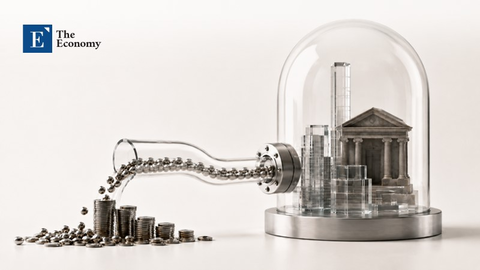
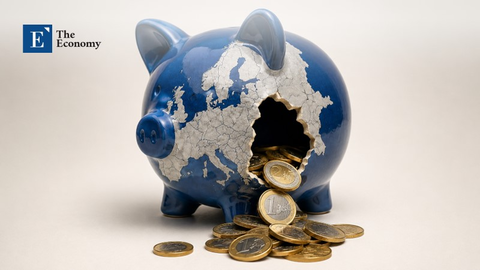
In June 2022, US consumer prices rose 9.1% over the previous year. That was the fastest pace since 1981 and it landed less than two years after the Federal Reserve had pumped trillions of dollars into the financial system to stop the pandemic economy from collapsing. Compare that with the decade after 2008, when the Fed ran three separate rounds of quantitative easing, quadrupled its balance sheet and inflation barely nudged above 2%. Same tool. Same central bank, more or less. Wildly different outcomes. That gap is the real puzzle sitting underneath the current debate about quantitative easing and inflation and it deserves a sharper answer than "printing money causes prices to rise." It didn't, not for a decade but inflation then accelerated rapidly. Understanding why matters far more than relitigating whether QE was a good idea in 2008. The question is why the identical medicine produced a fever the second time around.
A Tool That Worked, Then Didn't
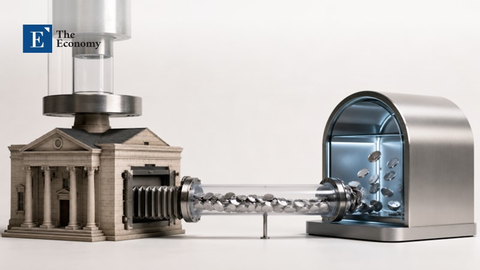
Start with what quantitative easing actually did after 2008. The US economy had just lost roughly nine million jobs. Credit markets froze. Banks stopped lending to each other, let alone to households and small businesses. The Fed cut its policy rate to zero and, with conventional ammunition exhausted, began buying long-term Treasuries and mortgage-backed securities. Its balance sheet grew from around $800 billion before the crisis to roughly $4.5 trillion by the time the third round of purchases wound down. Unemployment fell steadily. Growth resumed, if slowly. And inflation stayed stubbornly low, often below the Fed's own 2% target, for most of the following decade. Economists spent years worrying about the opposite problem: not enough inflation, not too much.
That track record built confidence that QE was a safe, reliable stabilizer. When COVID hit in March 2020, the Fed didn't hesitate. Its balance sheet went from about $4.2 trillion to nearly $9 trillion in two years, an even bigger expansion than the entire post-2008 program, compressed into a fraction of the time. Congress backed it up with roughly $5 trillion in fiscal relief across six separate bills, the CARES Act and the American Rescue Plan chief among them. By most accounts, it worked. The 2020 recession was the sharpest on record and also one of the shortest. But this time inflation didn't stay quiet. It roared. And by the time the Fed recognized the problem wasn't "transitory," prices were already running far ahead of wages for millions of households. The tool that had been credited with saving the financial system in 2008 was now being blamed for the worst inflation in forty years.
Two Regimes, Not One Playbook
The most convincing explanation for that split outcome and one worth taking seriously is that 2008 and 2021 were not the same kind of economic emergency wearing different clothes. They were two distinct monetary regimes and QE behaves differently in each. In 2008, the US economy fell into what amounts to a deep liquidity trap: a large, persistent gap between actual output and potential output, with inflation expected to undershoot the target for years. In that setting, additional liquidity mainly offsets deficient demand. It supports demand without straining supply, because supply has plenty of slack to absorb it. Factories were running well below capacity. Workers were unemployed and looking. There was room to grow into.
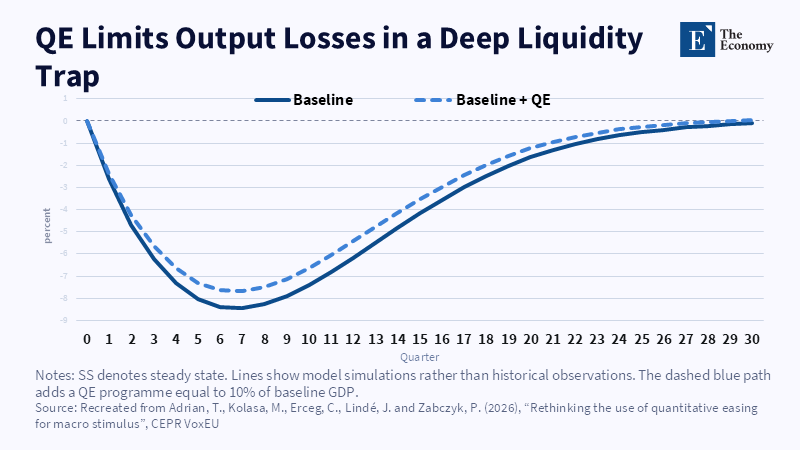
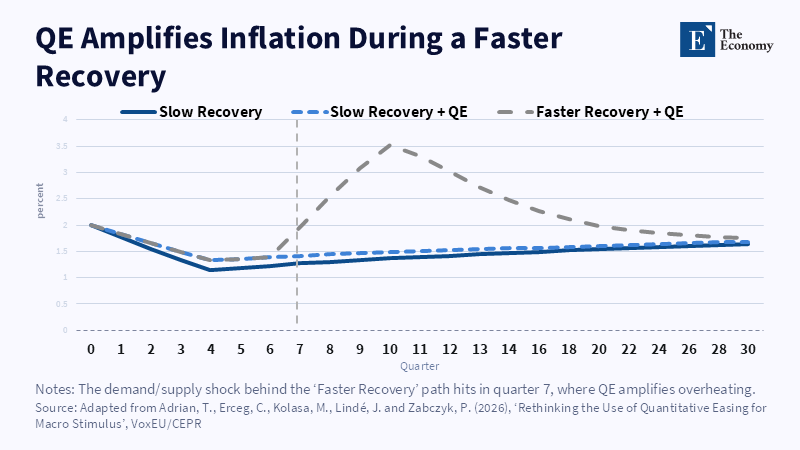
By 2021, the picture had already flipped. The initial COVID shock was brutal but brief and by the time large-scale asset purchases were still running at full tilt, the US economy was closer to full employment than policymakers realized in real time. That's a shallow trap, not a deep one and the same dose of stimulus lands very differently in a shallow trap than a deep one. Instead of filling slack, it pushes against a ceiling that's already close by. The result is more upward pressure on prices and less traction on real output. This distinction is genuinely useful. It explains, in a single stroke, why an identical policy instrument can be stabilizing in one episode and destabilizing in the next. The regime, not the tool, is doing the work.
What the Regime Story Leaves on the Table
Here's where the story needs a second ingredient, because the regime shift alone doesn't fully explain the size or the shape of what followed. Two forces layered on top of the shallow-trap dynamic and both came from the supply side rather than the demand side, which the regime framework is built to capture.
The first was a genuine supply shock, not a single event but a chain of them. Shipping containers piled up in the wrong ports. Semiconductor shortages stalled car production for the better part of two years. Then, in February 2022, Russia's invasion of Ukraine cut off a huge share of Europe's pipeline gas and benchmark Dutch TTF prices, which had averaged somewhere between €5 and €35 per megawatt-hour for the previous decade, spiked past €300 in August 2022, roughly ten times their historical range. Euro area headline inflation peaked at 10.6% that October and unlike the US figure, energy alone contributed more than four percentage points of that number. One bottleneck fed into the next. A chip shortage delayed a car, which pushed used car prices up, which fed into shelter and services costs as people renegotiated where and how they lived. Once that kind of chain reaction gets moving, it behaves less like a dial you can turn down and more like a system that has to burn through its own momentum. A supply shock cannot be switched off . You wait for it to lose energy and central banks can only speed that up so much by raising rates, since rate hikes work mainly on demand, not on gas pipelines or port congestion.
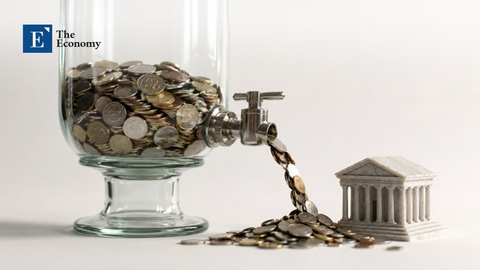
The second ingredient is the one that connects most cleanly back to the regime argument and it's the one the two-regime framing tends to underplay: there was already an enormous stock of dry powder sitting in the financial system before the supply shocks even hit. Pandemic-era transfers put money directly into household bank accounts on a scale never attempted before and much of it sat unspent through 2020 and into 2021 while lockdowns limited what people could buy. Savings rates spiked to levels not seen in generations. So when supply constraints finally collided with reopening demand, they didn't meet a normal, cautious consumer. They met a consumer sitting on an unusual cushion of accumulated cash, with a central bank still buying bonds and a fiscal authority that had just added trillions more. The shallow trap explains why that dose of stimulus overheated the system rather than filling it. But it took the accumulated liquid savings and the supply shock together to turn overheating into a genuine inflation surge. Take away the gas shortage and the chip crunch and the same monetary conditions probably produce a milder, shorter-lived overshoot. Take away the accumulated household savings and the supply shock probably produces a sharp but more contained price spike, closer to a stagflation scare than a sustained forty-year high. It was the combination that mattered, not either piece alone.
Lessons for the Next Downturn
This has real implications for how policymakers should think about the next recession, whenever it arrives. The temptation will be to treat 2008 as the template and reach for QE automatically. That's a mistake if the underlying conditions don't match. Before deploying large-scale asset purchases, central banks need a genuine read on how much slack exists in the economy, not just whether the policy rate has hit zero. A deep, persistent output gap is a green light. An economy already near full employment, even one that just went through a sharp shock, is a much closer call and probably calls for a smaller, more conditional programme with built-in escape clauses that let policymakers reverse course quickly if the recovery runs hot.
Just as importantly, monetary authorities need to build supply-side diagnostics into that decision, not treat them as an afterthought. A recession caused by collapsing demand required a different policy response from one caused by broken supply chains or an energy shock, even if both push unemployment up in the short run. QE is a demand tool. It can't unclog a port or replace a pipeline. Deploying it aggressively into a supply-driven downturn, especially one where households are already sitting on unusual savings, risks doing exactly what happened in 2021: intensifying inflationary pressure that monetary policy didn't start and can't easily put out.
That calculus should also weigh the fiscal terrain QE is deployed into. A government already facing rising debt-service burdens has less room to run large asset-purchase programmes than one where the interest-growth differential still favours growth. The dollar's shrinking convenience yield as the world's reserve safe asset makes that terrain less forgiving than it was in 2008. The same caution applies to the banking system underneath: when Credit Suisse's Additional Tier 1 bonds were wiped out while ostensibly junior bail-in debt was untouched, investors learned that emergency guarantees can reprice an entire creditor hierarchy overnight — a reminder that QE's assumptions about calm funding markets don't always hold.
Some will object that this is all hindsight, that no one could have known in early 2021 how severe the supply disruptions would become or that Russia would cut off European gas a year later. That's fair as far as it goes but it undersells what was visible at the time. Savings rates and near-full employment were both observable well before the invasion of Ukraine and they were the ingredients that made the system vulnerable to whatever supply shock came next. Others will argue this is really just a monetarist story, that expanding the money supply enough always produces inflation eventually and 2021 simply proves the rule that the 2010s temporarily disguised. That argument struggles to explain why a comparably enormous expansion after 2008 produced a decade of below-target inflation instead. The money supply grew both times enormously. The outcome differed because of where that money landed, how much slack it had to fill, and what shocks arrived to interact with it.
None of this argues for abandoning quantitative easing as a tool. It argues for using it with a sharper diagnosis of the disease before writing the prescription. The 9.1% inflation print of June 2022 wasn't proof that QE failed. It was proof that the same medicine, given in the wrong dose for the wrong condition, can turn a recovery tool into an inflation problem. Central banks that walk into the next crisis without asking whether they're facing a deep trap or a shallow one and without checking whether the private sector is already sitting on a large stock of unspent pressure are taking a substantially greater policy risk than they realize.
This article reflects the analytical judgment of The Economy Editorial Board and does not constitute policy advice or the official position of any affiliated institution.
References
Adrian, T., Erceg, C., Kolasa, M., Lindé, J. and Zabczyk, P. (2026) Rethinking the Use of Quantitative Easing for Macro Stimulus. London: Centre for Economic Policy Research, VoxEU Column, 29 July.
Adrian, T., Erceg, C., Kolasa, M., Lindé, J. and Zabczyk, P. (2026) Macroeconomic and Fiscal Consequences of Quantitative Easing. Cambridge, MA: National Bureau of Economic Research, NBER Macroeconomics Annual 2026 (forthcoming).
Britannica Money (2026) Federal Reserve Balance Sheet: What It Is and Why It Matters. Chicago: Encyclopaedia Britannica, Inc.
Bureau of Labor Statistics (2022) Consumer Prices Up 9.1 Percent Over the Year Ended June 2022, Largest Increase in 40 Years. Washington, DC: US Department of Labor.
Congressional Research Service (2025) The Federal Reserve's Balance Sheet. Washington, DC: Library of Congress.
Council of the European Union (2022) A Market Mechanism to Limit Excessive Gas Price Spikes. Brussels: Council of the European Union.
English, W. B. and Kohn, D. (2022) 'What if the Federal Reserve Books Losses Because of Its Quantitative Easing?', Up Front (blog), Brookings Institution, 1 June.
Eurostat (2022) Annual Inflation Up to 10.6% in the Euro Area. Luxembourg: Statistical Office of the European Union.
Federal Reserve Board (2022) Monetary Policy Report, Part 2: Monetary Policy. Washington, DC: Board of Governors of the Federal Reserve System.
Federal Reserve Board (2022) Federal Reserve Balance Sheet Actions and Activities. Washington, DC: Board of Governors of the Federal Reserve System.
Government Accountability Office (2023) COVID-19 Relief: Funding and Spending as of January 31, 2023. Washington, DC: US Government Accountability Office.
Liboreiro, J. (2022) 'Europe's Gas Prices Have Broken a New Record. How High Can They Go?', Euronews, 25 August.
Peter G. Peterson Foundation (2022) The Federal Reserve Will Begin Reducing Its Holdings of Treasury Notes and Bonds. New York: Peter G. Peterson Foundation.
Peter G. Peterson Foundation (2025) Here's What the Government Has Done to Respond to COVID. New York: Peter G. Peterson Foundation.
Richmond Federal Reserve Bank (2022) 'The Fed Is Shrinking Its Balance Sheet. What Does That Mean?', Econ Focus, Quarter 3. Richmond, VA: Federal Reserve Bank of Richmond.
.
Working across research, policy, and data-driven analysis, the Editorial Board ensures that published pieces reflect a consistent institutional perspective grounded in quantitative reasoning and long-term structural assessment.