How Labor Scarcity Can Turn Population Decline Into Productivity Growth

Working across research, policy, and data-driven analysis, the Editorial Board ensures that published pieces reflect a consistent institutional perspective grounded in quantitative reasoning and long-term structural assessment.
Authored On
Modified
Lower birth rates predict higher GDP per worker, not decline
Labor scarcity drives technology, not economic shrinkage
AI and robots may be repeating that pattern now, starting with China

A one-percentage-point drop in a country's birth rate is followed, forty years later, by GDP per worker that runs about 22 percent higher. After sixty years, the estimated gap widens to 29 percent. That's not a fringe estimate. It comes from seventy years of data spanning nearly every country with more than a million people, cross-checked against wage growth across 722 US commuting zones. If you grew up assuming that fewer babies means a smaller, poorer economy down the road, this number challenges the usual assumptions about demographic decline. It contradicts much of the conventional coverage of demographic decline over the past decade and it comes from researchers firmly within the mainstream of economic scholarship. The evidence does not suggest that population decline is costless. The math doesn't say population decline is free. It says something more interesting: the economy has a way of routing around missing workers and that workaround has a name.
Why Falling Birth Rates Do Not Necessarily Reduce Growth
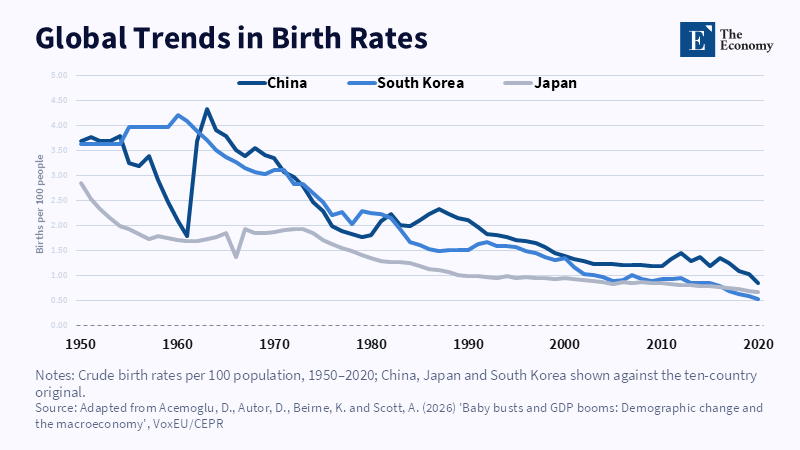
For most of the last fifty years, the demographic story has been simple and grim. Birth rates fall, the workforce shrinks, growth slows, pensions strain and eventually GDP shrinks along with the population. It's the plot of a hundred think-tank reports. The global crude birth rate did fall hard, from 3.78 births per 100 people in 1950 to 1.71 by 2025, a drop of more than half in three generations. The UN expects the global population itself to start shrinking in the second half of this century, something that hasn't happened since the bubonic plague. China, Japan and South Korea sit at the sharp end of this: birth rates of 0.63, 0.60 and 0.46 respectively, with populations expected to fall 20 to 30 percent by 2050 and workers over 45 making up roughly 60 percent of their labor force. On paper, this looks like a slow-motion economic disaster.
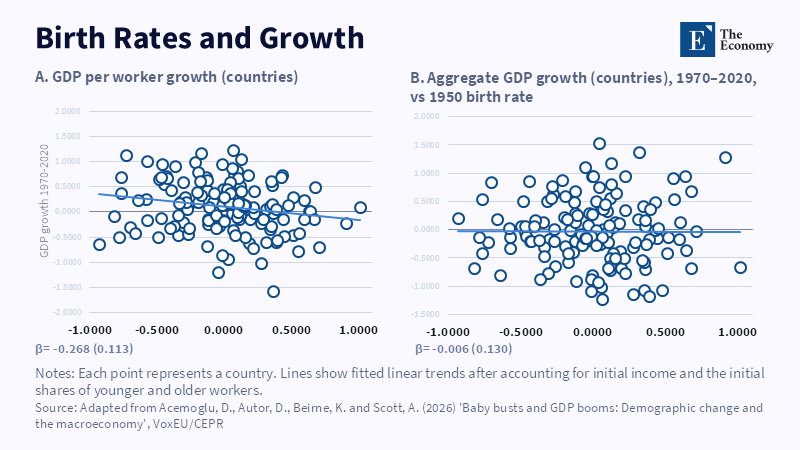
However, Acemoglu and his coauthors went looking for the disaster in the historical record and didn't find it. Using birth rates from decades earlier as a clean, predetermined source of variation, they show that countries with lower birth rates experienced higher GDP growth per working-age adult. For example, the 1950 birth rate predicts outcomes between 1970 and 2020, while US commuting zones with lower birth rates also experienced faster wage growth. Crucially, there was no meaningful hit to aggregate GDP or total earnings either. The per-worker gains were large enough to offset the shrinking pool of workers almost entirely. That's a genuinely unexpected result under the standard growth model, where a smaller workforce should mean a temporary bump in capital per worker that fades as the capital stock catches up, then a straightforward decline in total output. None of that shows up in the data.
How Labor Scarcity Drives Technology and Productivity
Several intuitive explanations do not appear to account for the result. It's not more women entering the workforce as families shrink. It's not a shift from "quantity" to "quality" parenting, where fewer kids get more schooling and become more productive adults. It's not agricultural workers moving into higher-output manufacturing jobs either. The researchers checked all three channels against both the cross-country data and the US regional data and none of them explain the pattern consistently. What does explain it is technology, specifically technology that gets built because labor got scarce. Countries with the steepest fertility declines shifted hardest into high-tech exports and high-tech employment. US regions with falling birth rates saw employment tilt toward R&D-heavy industries and a jump in labor-saving patents. Scarcity, in other words, doesn't just get absorbed. It gets engineered around.
One particularly useful piece of evidence comes from the effects of wartime deaths. World War II gives you an accidental natural experiment, because civilian deaths shrink a population without changing its age structure, while military deaths shrink it and skew it older, since it's mostly young men who die in combat. Total war deaths predicted lower future GDP per worker. Military deaths predicted higher GDP per worker. The distinction is initially counterintuitive but it lines up with the theory: it's the disappearance of young, cheap labor specifically that seems to trigger the technological response, not population loss on its own. A related study on French regions after World War I found the same pattern in patenting behavior. Scarcity of a particular kind of worker, not fewer people in general, is doing the work.
This is where the common framing breaks down. There's an instinct to think of productivity as something bounded by how many hands and minds a society has, so a shrinking population must mean a shrinking productive capacity. Acemoglu's data says that instinct mistakes the constraint. It isn't the number of workers that sets the ceiling on output. It's how much technology gets built to substitute for the ones who aren't there. A country can lose people and still get richer per head, as long as the loss is severe enough to force the investment that replaces them.
The Economic Risks That Technology May Not Offset
It would be dishonest to pretend the demographic-pessimism camp has gone quiet. It hasn't and the disagreement is worth taking seriously rather than waving away. OECD researchers estimate that the shrinking share of workers in the population will cut OECD-wide per capita income by close to 8 percent over the next three decades, with some countries facing a shortfall closer to 20 percent, even after accounting for people working longer as health improves. Economists at the European Stability Mechanism such as Pilar Castrillo, Katarina Gumanova and Konstantinos Theodoridis, modeled a one-point rise in the euro area's dependency ratio and found a lasting drag on productivity, with patent applications falling and wages too sticky to adjust downward, worsening the region's competitiveness over roughly a decade.
These aren't really contradicting Acemoglu's finding. They're describing the default path absent a strong technological response and both papers say so explicitly. The OECD authors point to artificial intelligence as a way to "overcome the aging challenge" by easing labor shortages. The ESM economists go further, stating outright that their model excludes the effects of migration and AI and that their estimates should be read as an upper bound on the damage, the worst case if nothing offsets it. They even calculate what it would take to cancel out the loss: a permanent rise in growth-enhancing investment worth about 0.2 percent of GDP for every one-point increase in the dependency ratio, a fairly modest ask against the scale of the problem. So the disagreement isn't really about whether technology can offset demographic drag. It's about whether that offset happens automatically, the way Acemoglu's historical data suggests it has for seventy years or whether it needs deliberate policy to show up on schedule.
AI Could Test the Labor-Scarcity Theory at Scale
One finding looks understated, mostly because its data runs through 2020 and the most interesting shift started after that. Since the early 2020s, has been a new kind of labor-saving technology scaling up fast: AI systems and increasingly capable robots doing work that used to require an actual human in the loop, not just assisting one. Call it superhuman labor, since in a growing number of narrow tasks these systems now outperform typical human workers on cost, consistency or both. China offers the starkest live example. Its working-age population, people between 15 and 64, is projected to fall from a peak of roughly 1 billion to around 300 million by 2100, a demographic contraction with no real historical precedent. At the same time, China's stock of industrial robots roughly doubled between 2021 and 2024 and now accounts for close to half the world's total, according to reporting in the Financial Times. It functions as an unplanned real-world test of the theory. If Acemoglu's mechanism holds at this scale and speed, China's response to catastrophic worker scarcity will be the most aggressive substitution of machine for human labor the world has seen.
This is also where the aging story and the automation story turn out to be the same story wearing different labels. An economy with fewer young workers and an economy automating away entry-level and mid-skill jobs both end up with output produced by fewer human hands relative to total activity. The mechanism Acemoglu identifies for demographic scarcity, where a labor shortage forces investment in labor-saving tools, is structurally identical to what happens when a company replaces a call-center team with an AI system or a warehouse crew with autonomous forklifts. Job losses in a well-defined sector, paired with rising output, isn't a paradox under this framework. It's just the aging mechanism running on a faster clock, with automation substituting for the missing young worker instead of waiting for a shrinking cohort to force the issue.
If this generalizes and there's a real reason to think it might once the current wave of AI deployment moves past pilot programs into a few more industries beyond software and customer service, it would confirm something the original paper only hints at: that the number of workers in an economy was never quite the right thing to track. What matters is the amount of highly productive capacity an economy can bring to bear, whether that capacity comes from people, machines or increasingly some blend of the two. Population size was always a rough proxy for that, useful when technology moved slowly enough that headcount and output tracked each other closely. It's a much weaker proxy now and every year that AI systems get cheaper and more capable, it gets weaker still.
None of this means demographic decline is costless or that policymakers should stop worrying about pension systems, regional depopulation or the social strain of an aging population. Those are real problems with real victims and GDP statistics don't capture all of them. But the growth story specifically, the fear that fewer babies today means a smaller economic pie forty years from now, doesn't survive contact with seventy years of data. The countries and regions that lost the most young workers didn't get poorer per capita. They built the tools that made up the difference and in most cases more than made up for it. Watching whether the current AI buildout follows that same path or breaks it, might be the more useful thing to track over the next decade than the birth rate itself.
The views expressed in this article are those of the author(s) and do not necessarily reflect the official position of The Economy or its affiliates.
References
Acemoglu, D. (2010) 'When does labor scarcity encourage innovation?', Journal of Political Economy, 118(6), pp. 1037–1078.
Acemoglu, D. and Restrepo, P. (2017) 'Secular stagnation? The effect of aging on economic growth in the age of automation', American Economic Review, 107(5), pp. 174–179.
Acemoglu, D., Autor, D., Beirne, K. and Scott, A. (2026) Baby busts and GDP booms: Demographic change and the macroeconomy. CEPR Discussion Paper 21673. London: Centre for Economic Policy Research.
André, C., Gal, P., Pereira, Á. and Schief, M. (2024) 'Demographic challenges to productivity: How to reconcile population ageing with economic growth?', ECOSCOPE, 17 June.
André, C., Gal, P. and Schief, M. (2024) Enhancing productivity and growth in an ageing society: Key mechanisms and policy options. OECD Economics Department Working Paper No. 1807. Paris: OECD Publishing.
Bergeaud, A., Chaniot, J. and Malgouyres, C. (2025) Escaping labor scarcity: Innovation and human capital after WW1 in France. CEPR Discussion Paper 20492. Paris and London: CEPR Press.
Castrillo, P., Gumanova, K. and Theodoridis, K. (2024) 'Population ageing and productivity: The innovation channel', ESM Briefs, 1 October. Luxembourg: European Stability Mechanism.
Financial Times (2026) 'Robot nation: China's bid to beat its demographic decline', 25 June.
Kotschy, R. and Bloom, D. (2023) Population aging and economic growth: From demographic dividend to demographic drag? CEPR Discussion Paper 18400. London: Centre for Economic Policy Research.
Working across research, policy, and data-driven analysis, the Editorial Board ensures that published pieces reflect a consistent institutional perspective grounded in quantitative reasoning and long-term structural assessment.