The AI Adoption Gap Is Now an Institutional Test

Working across research, policy, and data-driven analysis, the Editorial Board ensures that published pieces reflect a consistent institutional perspective grounded in quantitative reasoning and long-term structural assessment.
Authored On
Modified
The AI adoption gap is an institutional gap, not just a tool gap
The U.S. lead reflects stronger capital, management and skills systems
Europe must turn AI access into organised learning and deployment

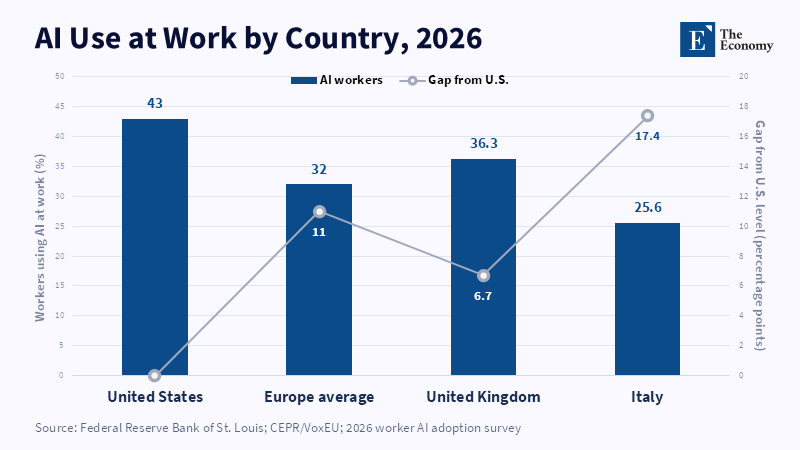
The most telling statistic is not how much a given AI model costs, how large a data center is, or how many start-ups are founded in a given year. It is the 11-point difference between workers using generative AI at work in the US and workers doing so in six large European economies. 43 percent of US workers said they use it at work in a typical week, compared to only 32 percent of workers in the European sample. That gap is sizeable on its own. But it does not even scratch the surface of the real issue. The AI adoption gap is not just about who does or does not access a tool; it is about who is pushed, trained, resourced and restructured to make the most out of it. AI now has the potential to put all of that economic learning in question. Those countries that manage to turn their use into a routine will accelerate. Those countries that see AI as a tool for optional software will lag behind.
The AI Adoption Gap Is An Institutional Gap
The stronger interpretation of the one opportunity gap in AI is that Europe does not suffer from weak curiosity or weak science. Europe has the research centers, the engineers, the universities, the industrial firms and the market to make use of innovation. But they do not change fast enough to change work, products and management systems. This is the issue at this point in time. Regulations, culture, or consumer access are at the heart of most policy debates. Each of these matters, but none of these suffice. A technology that changes writing, coding, designing, searching, selling, leading and governing cannot be assessed solely by consumer access. It has to be assessed by the institutions that make use normal.
The lead in the United States demonstrates how adoption becomes a system. Workers are more likely to use generative AI when firms provide tools, encourage use and allow safe experimentation. Firm backing matters because AI does not deliver productivity uplift by magic. It saves time when individual tasks are systematically decomposed. It enhances quality when staff can judge outputs. It alters efficiency when managers attempt to rewire workflows. It is not simply (or primarily) that employees timidly implement AI chatbots on the edges of familiar routines. Europe's problem thus is neither (merely) a deficiency of individual users, nor (more broadly) a threshold figure. It is a less sturdy link between individual experimentation and organizational change. The AI adoption deficit is a gulf between trial and application.
The firm-level data also warn against false comfort. In 2025, 20 percent of EU enterprises with at least ten employees used AI technologies, up from 13.5 percent in 2024. Europe is heading in that direction. Yet also the data presents a two-fold story: While 55 percent of large EU enterprises used the technology, actual adoption in small firms was still very limited. The business implications of this are significant, given that the share of employment outside the frontiers would be the highest; the results of this scenario cannot therefore be less than a more divided economy.
Capital Makes The AI Adoption Gap Wider
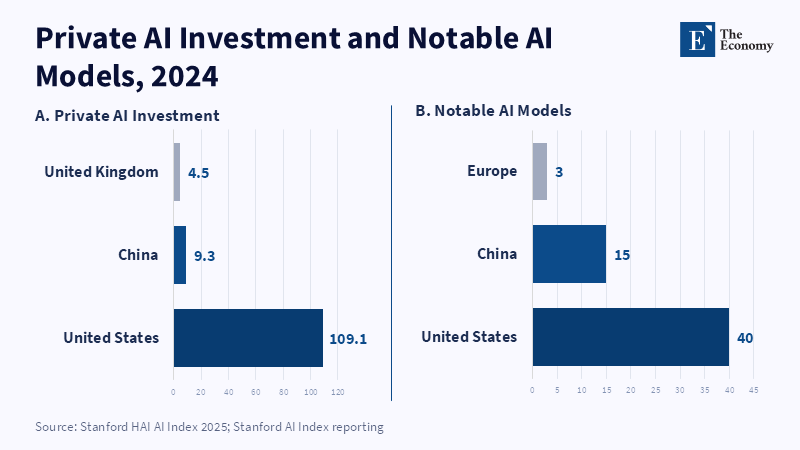
The AI adoption gap is a capital gap, too. In 2024, privately funded AI investment in the US was $109.1bn. It was almost 12 times that in China and far greater than the highest figures across Europe. While these need not indicate individual spending being productive, some will be squandered; some models will flounder; some companies will purchase high-cost hardware without a practical purpose, the volume counts. AI adoption calls for cloud contracts, data cleansing, security efforts, software integration, legal review, staff training and executive time: items that are not minor extras but which constitute the expense of converting a good into a working system.
Europe's problem with financing is not only that venture capital is smaller. It is that the challenge of scale is harder. A company may be able to test an AI product in a single country, but the high jump is still arduous against the maze of the single market. Different rules, languages, buying habits, tax regimes, working practices and customer interfaces all increase the cost of scaling up. This depresses the incentive to do it quickly and it also depresses the return from doing it quickly. If a European firm cannot scale across the single market as fast as a U.S. rival can scale across one domestic market, the profitable case for exploring ambitious AI strategies looks less compelling. So by one measure, fragmentation does not just slow down start-ups; it reduces the anticipated payoff from transnational organizational change.
So these are only frames of the most useful policy choices. Deregulation versus regulation is an excessively narrow one. Europe can protect rights and still develop improved adoption channels. The real question is whether rules are accompanied by markets that permit young companies to grow, public purchasers to pilot new systems and private investors to underwrite risky expansion. An AI order based on rights alone, with no capacity for adoption, will simply make Europe a cautious importer. The aim should be for a trusted AI market that also fosters firms able to compete within it. Trust cannot subsitute for scale without trust, as it is unsafe. You can only buy a scale. Scale without trust is also unsafe. Europe needs both.
Japan provides the same lesson, just via a different path. While Japan has a high amount of engineering strength and world-class industrial firms, adoption remains cautious. A 2024 corporate survey found that 24 percent of Japanese firms had introduced AI, while 35 percent planned to do so and 41 percent had no plan. OECD work also highlights weak business dynamism, low start-up growth and slow exit of low productivity firms. This is not Europe's precisely the same issue. However, it is a warning. Just because advanced economies are technically empowered does not mean they will learn fast.
Skills And Management Decide The AI Adoption Gap
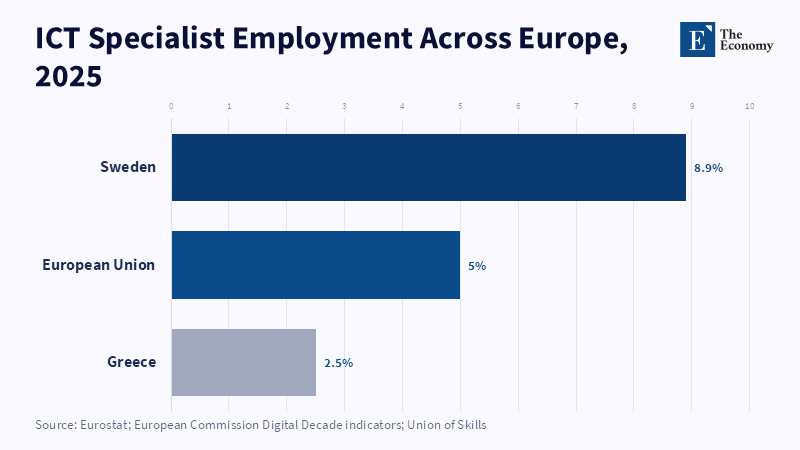
Skills are at the core of the AI adoption gap because AI rewards judgment. It does not eliminate the need for expertise. It increases the premium for people capable of framing better questions, testing the answers, cleaning data, protecting privacy and connecting model output into a real problem. Europe's digital foundation is too weak for that role. 56 percent of the EU's population aged 16-74 held at least basic digital skills in 2023, far short of the target 80 percent for 2030; in 2024, the EU had 10.3 million ICT specialists, more than 9.7 million behind the target for 2030. These are not theoretical or conceptual skills targets. They are ceilings of diffusion.
The point is not that all workers should become programmers-that would be the wrong answer. The point is that, at a minimum, more workers will need sufficient digital fluency to utilize AI responsibly and enough domain knowledge to recognize its limitations. While initial productivity studies seem encouraging, their results actually support this conclusion. Customer-support agents who got help from AI showed increased solving efficiency, especially if they were less experienced. Writing task tests confirmed faster finishes and better quality. Consulting experiments revealed improvements over the tasks that AI was best at, but also errors if workers used it outside the areas in which it performed best. The message is clear: AI work is most successful when organizations provide their people with training on what it can and cannot do.
Thus, management quality becomes a central policy issue. Better-managed firms are more likely to provide tools, direct their use and redesign the task. Poorly managed firms may name AI use but leave work unchanged. They may create risk, because staff will rely on public tools with an insecure data policy or no review. That's shadow adoption, not transformation. It can produce leaks, weak decisions and worker mistrust. The AI adoption gap will therefore grow inside as well as between firms. Some staff will be trained to use AI as a real work system. Others will be ordered to "use AI" without time, direction, or security.
It's here that education systems matter, but the answer is not simply to add more AI courses. The far more critical challenge is to recreate the pipeline from school mathematics and statistics to vocational training, university research, applied engineering and workplace training. Public administrations require the same skill base. A government that cannot purchase a well-installed digital system effectively will be unable to steer diffusion. A school, hospital, tax office, or local authority with no data culture will not become a smart user just because there is a model to hand. The skills agenda, then, is economic infrastructure. It is as vital as the road and energy grids of the previous growth wave.
The AI Adoption Gap Requires A State That Builds
This is a key point often missed. The state is not just a referee; it is also a customer, a funder, a trainer, a standards-setting body and a partner in developing common capacity. In the United States, public research, military demand, university contribution, immigration, science agencies and procurement policies have all played a role. China has emerged with a more centralized implementation of this. Currently, Europe is trying to catch up with its AI Continent initiative, incorporating a 200 billion euro injection, AI factories and backing of gigafactories. Clearly, the scale of the problem is becoming understood.
The danger is that Europe builds programs but not flywheels. For a flywheel, you need feedback. Public support can give shared computing, open test beds, sectoral data capacity and pathways to purchase that allow companies to learn with customers. It should monitor progress from pilots to daily use. Too many AI policies count announcements, not real change of practices; the same mistake is made inside firms where management celebrates tool access without having finished the hard work of restructuring roles, incentives, data systems and quality assurance. Adoption policy needs measures of depth, too.
Critics will argue that rapid AI adoption brings waste, job anxiety, bias, surveillance and weaker labor power. Those dangers are genuine. They are not a sufficient excuse for institutional delay. Up until now evidence does not reveal widespread job elimination at sector level from greater AI adoption, but only reveal transitions within tasks, ages and skill groups. Therefore, there is no reason to prohibit adoption until every capacity is addressed. The solution is to coerce adoption with worker representation, job training rights, accountability trail and social cushion. An economy without a highly skilled workforce and a sluggish economy is an unsafe economy. It is where employees face AI tardily, with less room for control.
The next stage of the AI adoption gap will be less visible than the first. It will not appear only in worker or firm surveys. It will appear in how quickly public agencies approve better services, how fast hospitals clean data, how well manufacturers redesign maintenance, how easily small firms access secure tools and whether universities keep talent close to growing companies. The 43 percent versus 32 percent gap is not the final statistic. It is an early warning that institutional learning is already becoming uneven.
Hence, the call to action is both very simple and very difficult to take. Europe must stop allowing AI adoption to be a second-order issue that comes after regulation, after research, after digital access. It is here that all three will be tested. The priority isn't to copy Silicon Valley, erode rights, or chase every new model release. The priority is to forge a state of adoption and a market of adoption simultaneously. That is capital, that is talent, that is teams that can redesign work, that is public procurers that can create demand for trusted systems. The AI adoption gap won't close via speeches on sovereignty and it will only close when its use becomes a form of institutionalized learning.
This article is based on an original research article published by The Economy Research. For the original version, please refer to Why Europe Is Falling Behind in the AI Adoption Race.
The views expressed in this article are those of the author(s) and do not necessarily reflect the official position of The Economy or its affiliates.
References
Bick, A., Blandin, A., Deming, D.J., Fuchs-Schündeln, N. and Jessen, J. (2026) Mind the Gap: AI Adoption in Europe and the U.S. NBER Working Paper No. 34995. National Bureau of Economic Research.
Bick, A., Blandin, A., Deming, D.J., Fuchs-Schündeln, N. and Jessen, J. (2026) ‘Differences in AI Adoption in Europe and the US: Explanations and Implications for Productivity Growth’, VoxEU / CEPR, 9 April.
Bick, A., Blandin, A., Eberly, J.C., Patnaik, S. and Steinsson, J. (2026) ‘Why Is the U.S. Outpacing European Countries in AI Adoption?’, Brookings Institution, 28 May.
Brynjolfsson, E., Li, D. and Raymond, L.R. (2025) ‘Generative AI at Work’, The Quarterly Journal of Economics, 140(2), pp. 889–942.
Dell’Acqua, F., McFowland III, E., Mollick, E.R., Lifshitz-Assaf, H., Kellogg, K.C., Rajendran, S., Krayer, L., Candelon, F. and Lakhani, K.R. (2023) Navigating the Jagged Technological Frontier: Field Experimental Evidence of the Effects of AI on Knowledge Worker Productivity and Quality. Harvard Business School Working Paper.
Draghi, M. (2024) The Future of European Competitiveness. European Commission.
European Commission (2025) AI Continent Action Plan. European Commission.
Eurostat (2025) ‘20% of EU Enterprises Use AI Technologies’, Eurostat News, 11 December.
Eurostat (2026) ‘Towards Digital Decade Targets for Europe’, Statistics Explained. European Commission.
Eurostat (2026) ‘Use of Artificial Intelligence in Enterprises’, Statistics Explained. European Commission.
Maslej, N., Fattorini, L., Perrault, R., Gil, Y., Parli, V., Kariuki, N., Capstick, E., Reuel, A., Brynjolfsson, E., Etchemendy, J., Ligett, K. and Lyons, T. (2025) The AI Index 2025 Annual Report. Stanford Institute for Human-Centered Artificial Intelligence.
Noy, S. and Zhang, W. (2023) ‘Experimental Evidence on the Productivity Effects of Generative Artificial Intelligence’, Science, 381(6654), pp. 187–192.
OECD (2024) OECD Economic Surveys: Japan 2024. OECD Publishing.
OECD (2025) Artificial Intelligence and the Labour Market in Japan. OECD Publishing.
Reuters and Nikkei Research (2024) ‘More Than 40% of Japanese Companies Have No Plan to Make Use of AI’, Reuters, 17 July.
The Economy Research Editorial (2026) ‘Why Europe Is Falling Behind in the AI Adoption Race’, The Economy, 4 June.
Working across research, policy, and data-driven analysis, the Editorial Board ensures that published pieces reflect a consistent institutional perspective grounded in quantitative reasoning and long-term structural assessment.