[Europe’s Fiscal Turn] Reviewing the RRF - Recovery Performance

Working across research, policy, and data-driven analysis, the Editorial Board ensures that published pieces reflect a consistent institutional perspective grounded in quantitative reasoning and long-term structural assessment.
Authored On
Modified
The RRF supported recovery but implementation lagged
Milestones improved control without guaranteeing outcomes
Its deeper legacy is shared European fiscal capacity

By May 2026, the Commission had paid out some €400 billion via the Recovery and Resilience Facility. Nevertheless, €177 billion of the €577 billion fund had not been paid out. There were just around three months to go before the 31 August deadline for all milestones and targets. That time window sets the scene for this Recovery and Resilience Facility review. It was a scheme that paid out, sustained public investment and pushed past stall points on reform. It also demonstrated the difficulty of guiding crisis finance through complex permitting constraints and a front-loaded deadline. The RRF is not a usual EU expenditure scheme, so a simple pass-or-fail rating would be deceptive. Its short-term fiscal brake, tempo and long-term purpose do not lead to one conclusion. After five years, the fundamental lesson remains straightforward. The EU created an innovation in common fiscal action. Its control framework often represented established procedures better than the long-term effect of the expenditure.
What a Recovery and Resilience Facility Review Must Measure
The Commission sold EU bonds, then issued grants and loans to states. States developed national Recovery and Resilience Plans comprising investments and reforms. These included: new or refurbished rail services; renovated homes; refurbished courts; and improved online public services. Funds were released according to pre-agreed reform milestones and targets. A milestone could be a new law; a target, a number of refurbished homes or new jobs aided. Traditional EU funds refinance eligible invoices. The RRF updates this model: at each step, an eligible state proceeds with a release claim in exchange for linking milestones and targets. Planned expenditure was verified - yet each euro paid did not refund an invoice. While this results- and performance-based logic can promote reform and shave invoice verification, it can also weaken the link between cash received, costs incurred and benefits realized.
At the end of the €577 billion fund, there were €360 billion in grants and €217 billion in pledged loans. As of May, about €400 billion had been sent to states. An allocation is a legal amount; a disbursement is the cash sent; the national expenditure is the expenditure on the accounts; a finished asset is a completed project. Eurostat reported that by the end of 2025 there was 228 billion of grant-backed spending and associated costs, accounting for 63 percent of grants, while EU grant payments accounted for 66 percent of EU grants disbursed. The gap was much greater for loans. By the end of the year, 72 percent of the pledged loans had been paid, but loan-backed expenditures were 38 percent. By October 2025, more than 2,700 milestones and targets had been achieved, but that did not imply 2,700 completed projects. A credible Recovery and Resilience Facility evaluation must identify EU debt, disbursed funds, expenditure by states, work completed and lasting benefits.
Growth Support Was Real, but Its Scale Is Unclear
The fund proved useful as Europe kept enduring one shock after another. The crisis confronted governments with limited fiscal headroom. They then faced sluggish activity, expensive energy, scarcities and more expensive credit. Grants enabled heavily indebted countries to maintain public investment programs without incurring comparable new domestic debt. The EU loans provided extended maturities. Much of the 2024 spending was invested in infrastructure, which provided an immediate boost to demand. However, there is no pure test for the estimation of the growth impacts. A prediction based on Commission modeling indicated NextGenerationEU projects could increase EU real GDP by up to 1.4% in 2026 relative to a no-program counterfactual. An estimate based on ECB analysis suggested a 0.4% to 0.9% boost in 2026, with larger gains in subsequent years if reforms increase output. Both estimates depend on the timing, fiscal multipliers, additionality, spillovers and the counterfactual.
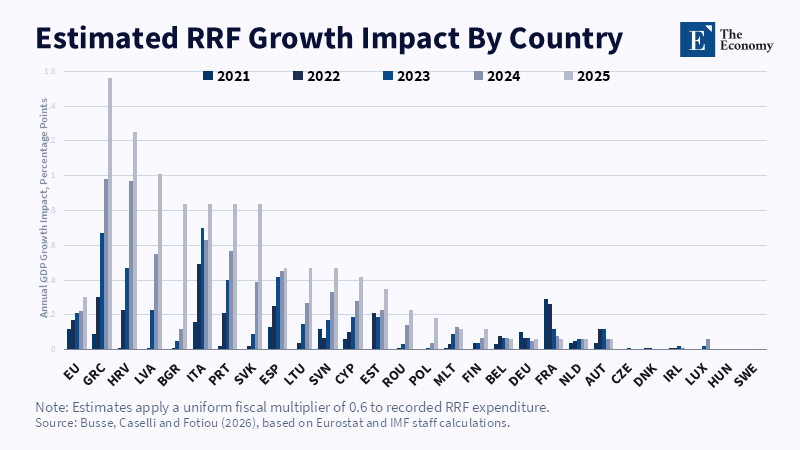
The pace also varied considerably. By the end of 2025, eight states had recorded grant-funded expenditure over 75 percent of their share. Seven states had less than half this amount. Plans required ministries to manage hundreds of tasks while towns handled tenders, permits and designs. Procurement delays, planning limitations, inflation and supply chain disruption slowed progress. A thriving construction sector drove up bids or produced no offers. States adjusted plans for shocks, new targets and REPowerEU. These revisions were frequently reasonable but added regulatory complexity, used some of the administratively scarce resources of staff time and stretched work into the final months. An agreed deadline can concentrate minds. It can also tend to favor small, simple and easily demonstrable measures over more ambitious projects providing longer-term benefits. This review of the Recovery and Resilience Facility therefore finds a tension in the drive for swift action amid crisis and for comprehensive reform.
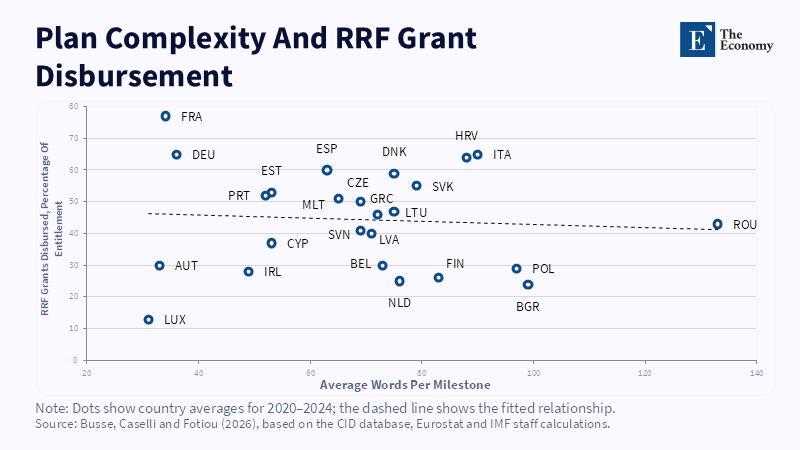
While controlling, the payment model still muddied things along. Member states wrote reforms, deadlines and evidence requirements before later claims. That clarified the delays and helped finance teams push for activity. The model also encouraged a box-ticking culture. Some country plans set 500-plus milestones and targets. Staff could waste time on proof rather than results. EU auditors found many indicators recorded output rather than results. Data on final recipients, costs and outcomes was thin. A law can pass but not work in practice. An order can arrive while a project remains stalled. A course can run in training without changes in skill. The problem is spurious precision. The scheme may confirm a step occurred, but not that it increased output, service quality or value into the future. A thorough piloting, experimenting and evaluating process should preserve conditions and set fewer and clearer hurdles linked to events and impacts.
The Fund Was Built to Hold the Union Together
A deeper motive was to prevent a common shock from deepening north-south divergences. The grant key used population, income, past joblessness and output loss. It targeted more funds at states with less empty space in their budget accounts or more damage. It was not a north-south charity. The profound slowdown in Italy, Spain or Greece would depress demand for goods from other EU countries. It might undermine supply chains and damage banks and firms throughout the single market. An increase in state borrowing costs could as well block the uniform transmission of ECB rate changes. Works in a state that received funds could increase demand for machines, components and skills elsewhere in Europe. Common support saved exporters, creditors and workers in wealthy states as well as those that had been hit hardest. The assessment by the Recovery and Resilience Facility considers convergence and risk sharing to have been essential objectives, not goals merely incidental. They shielded the trade, banking and monetary relationships on which the Union depends.
The next objective was to get a transient common fiscal capacity. The EU borrowed loans and grants. That enabled the EU budget to level a recession rather than shift money. Country programs attached cash to reform and EU audits checked usage. This was not the first move toward a fiscal union in Europe. The EU budget and cohesion money preceded it. So did the European Financial Stability Facility and European Stability Mechanism. The new addition was their combination on a wide scale: common debt, grants, advances, country plans and reform-related ones. The short statutory lifetime of the package eased its approval. The same limit came in the way of long-term plans and left bonds' three-year sales uncertain too. The five-year trial showed that joint fiscal authority is feasible. But it did not define rules for its appropriateness, minimum package characteristics, repayment procedures and creditor management.
The third target emerged after Russia's full-scale attack on Ukraine. Countries appended REPowerEU sections to their plans. They supported lower energy consumption, clean electricity, grids, storage, cleaner plants and new sources, distant from Russian fossil fuels. The new rules contributed 20 billion in grants, derived from emissions-trading revenues. They also allowed countries to tap other EU funds and preserve the RRF loans. In the course of time, all 27 plans included a chapter. The shift transformed the fund into a tool for energy security and EU industrial policy. However, it made a tough plan more difficult to implement. Grid projects, wind and solar sites, storage and plant upgrades encounter the same permit, tender and supply bottlenecks as in the first round of projects. Nonetheless, REPowerEU proved valid for joint funds after the initial crisis. Power interconnections across borders, clean-tech supply chains and reduced dependence on Russian fossil fuels bring benefits a state can always hold on to.
From a One-Off Fund to Shared Fiscal Rules
That left one more asset in the bond portfolio: a large EU presence in the debt markets. NextGenerationEU transformed the Commission into a regular bond issuer with auctions, bank sales and a complete yield curve. As of 2026, EU bonds formed the second-biggest pool of AAA-rated debt across the Union after German bonds. But even EU bonds are sovereign-style, not sovereign: servicing bonds depends on a separate EU budget and agreed revenues. They trade in a less deep and more short-lived market than state markets for the highest-rated debt, limiting their usefulness as a true EU safe asset. The infrastructure, systems and investor base are there. The question now is no longer whether the EU can borrow large volumes, but whether future debt will focus on funding clearly defined, shared needs - or simply protect member states from having to make difficult choices in their own budgets.
This examination should direct the next model. Common debt must support heavy joint shocks and goods with high cross-border gains. Power grids, defense supplies, climate shields and vital technology might pass that test. Future designs must have fewer points. Milestones must point to key institutional or construction steps. Targets must examine use, service level and extra capacity. States must publish final consumer and expense data in the same format. External appraisal must test if the EU funds imposed additional work and long-lasting gains. The Commission must verify staff and project capacity before endorsing. It must back assistance to tenders, permits and designs. Deadlines must stay firm, but major projects must employ phased safeguards rather than a single cliff. A future Recovery and Resilience Facility review must question not only if money moved or law passed, but if joint debt gained more than state action.
The €177 billion still owed in May 2026 did not make failure on its own. Nor did €400 billion paid make success. The gap makes the key point of this Recovery & Resilience Facility review: governing that shared fiscal capacity created by common borrowing helped to grow back in the wake of a global slump and the EU divide may not be the equal demand of steering that. The RRF did foster a rise, reduced the risk of north-south divergence from which the EU might emerge whole, financed strategic investment projects, authorized business projects and gave the EU an advantage in bond markets. It also carried complex rules, a late dash and tests that could lump a signed fix for the public good. Its greatest imprint is not the funds left unpaid or a principle of ever-firmer fiscal union. It's evidence that shared borrowing and restructuring states is possible when one blow endangers the single market. Its successor should not imitate the RRF. It should sustain common co-payments, question EU-wide worth and recognize advancements over time after the final milestone.
The views expressed in this article are those of the author(s) and do not necessarily reflect the official position of The Economy or its affiliates.
References
Bańkowski, K., Benalal, N., Bouabdallah, O., De Stefani, R., Huber, C., Jacquinot, P., Nerlich, C., Rodríguez-Vives, M., Szörfi, B., Zorell, N. and Zwick, C. (2024) ‘Four years into the Next Generation EU programme: an updated preliminary evaluation of its economic impact’, ECB Economic Bulletin, 8/2024.
Busse, M., Caselli, F. and Fotiou, A. (2026a) ‘The EU’s Recovery and Resilience Facility: Experience and lessons for the next multiannual financial framework’, VoxEU, 8 July.
Busse, M., Caselli, F. and Fotiou, A. (2026b) The EU’s Recovery and Resilience Facility: Experience and Lessons for the Next Multiannual Financial Framework. IMF Working Paper 2026/114. Washington, DC: International Monetary Fund.
Council of the European Union (2026) The Recovery and Resilience Facility. Brussels: Council of the European Union.
European Commission (2020) Questions and Answers on the Recovery and Resilience Facility. Brussels: European Commission.
European Commission (2024) Mid-Term Evaluation of the Recovery and Resilience Facility. European Economy Institutional Paper 269. Luxembourg: Publications Office of the European Union.
European Commission (2025) Recovery and Resilience Facility Annual Report 2025. Brussels: European Commission.
European Commission (2026) NextGenerationEU: EU Borrower and Investor Relations. Brussels: European Commission.
European Court of Auditors (2023) Special Report 26/2023: The Recovery and Resilience Facility’s Performance Monitoring Framework. Luxembourg: Publications Office of the European Union.
European Court of Auditors (2024) Special Report 13/2024: Absorption of Funds from the Recovery and Resilience Facility. Luxembourg: Publications Office of the European Union.
European Court of Auditors (2026) Special Report 14/2026: RRF Traceability and Transparency. Luxembourg: Publications Office of the European Union.
European Parliament and Council of the European Union (2021) ‘Regulation (EU) 2021/241 establishing the Recovery and Resilience Facility’, Official Journal of the European Union, L57, pp. 17–75.
European Parliament and Council of the European Union (2023) ‘Regulation (EU) 2023/435 concerning REPowerEU chapters in recovery and resilience plans’, Official Journal of the European Union, L63, pp. 1–27.
Eurostat (2026) Statistics Related to the Recovery and Resilience Facility. Luxembourg: Eurostat.
Working across research, policy, and data-driven analysis, the Editorial Board ensures that published pieces reflect a consistent institutional perspective grounded in quantitative reasoning and long-term structural assessment.