India Middle Power Realism Is the Only Route to Great-Power Status

Working across research, policy, and data-driven analysis, the Editorial Board ensures that published pieces reflect a consistent institutional perspective grounded in quantitative reasoning and long-term structural assessment.
Authored On
Modified
India’s size gives it influence, but not yet great-power depth
India middle power realism is not a weakness; it is the path to durable power
Asian middle powers need practical coalitions, not another great-power patron

Despite being the world’s most populous country, India's global power still looks thinner than its size suggests. India's population stood at 1.46 billion by 2025. Nominal output was heading towards 4.15 trillion dollars in 2026, with per capita output still somewhere around 2,800 dollars. Its defense budget is considerable, but still miles behind that of the U.S. and China. This is the harsh reality of India's middle power politics. India has scale, talent, a big army, a broad diaspora and a strategic position in the Indian Ocean. But size is not strength. A state becomes a major power when it translates people into productivity, cash into capacity and aspiration into dependable leadership. India's middle-power challenge is not to deny its middle-power status. It is to capitalize on it enough to transcend it.
India Middle Power Realism Starts with Scale, Not Pride
India should not treat 'middle power' as an insult. It should treat it as a diagnosis. For India, middle power realism identifies the gap between national ambition and national capacity; middle power realism does not mean accepting a marginal place in the world. It means realizing that the path to greater power runs through internal depth, not by a noisy global stance. India cannot talk itself into a great-power rank. It has to build the base that makes other states adjust their choices. That foundation includes industry, tax headroom, public services, machinery, hi-tech ports, functioning courts, reliable statistics and resilient metros. India has recorded substantial progress. It is growing faster than most large economies. Its logistics are improving. Major powers can no longer ignore it. But the crucial issue is not whether India matters. It does. The crucial issue is whether India will be able to influence the result outside her Zone of influence without wearing herself out.
This is important because the rules of the game are being rewritten. For too long, India has had its strategic mind confined to the domain of South Asian rivalry. Pakistan, Afghanistan and border problems consumed too much attention and energy. They still count, but no mature nation can regard them as unimportant. But as a country of India's size and position, it can no longer allow local rivalries to influence its global role. China's rise has altered the nature of the test. No longer is the question whether India can dominate South Asia; the question is whether India can help forge rules, corridors, supply chains and security habits in an Asia where not one power can be trusted to manage order alone. That calls for a less status language and a great deal more weight in delivery. India must act less like a state seeking applause for autonomy and more like a state that turns autonomy into useful public goods.
India’s numbers cut through the emotion. Its economy is large in total size, but still thin per person. That limits tax capacity, welfare space and military depth. It also makes it harder to fund infrastructure and military modernization at the same time. This does not dismiss India’s growth. It makes the growth question more serious. A lower-income country has less room for costly strategic mistakes than a rich state with deep capital markets and a mature industry. India’s strongest asset is not yet hard power. It is optionality. It can speak to the United States, Europe, Russia, Japan, the Gulf, ASEAN and much of the Global South without being fully absorbed by one camp. That is the real value of India's middle power strategy.
Hard Power Cannot Be Willed into Existence
Hard power is also more than soldiers, jets and missiles. It is the entire system behind them. It is the metal, the computer chips, the engines, the hulls, the logistics, the power provision, the software, the skilled engineers, the state funds and the quality of command. India has made some improvements on this score, but still has many years of effort that are likely to be needed. In 2024, its military expenditure was around $86 billion. That is high by international standards but small in comparison with the United States and China. This is a crucial difference because state-of-the-art deterrence is inherently expensive. It needs to employ air, sea, cyber and space elements. It needs drones, a secure logistics chain and a domestic industry. It remains in the top 10 of arms importers and that is after its share of imported weapons has declined in recent years. That shows progress and weakness at the same time. Buying weapons can fill gaps, but it cannot build a sovereign defense base on its own.
Manufacturing strengthens the tale. India's manufacturing share of output can stay low for a country that seeks first-rank power. Services may be able to boost income and make global firms. But they cannot fill the security vacuum. Defense equipment production, export power and supply chain dominance all rely on dense manufacturing. Logistics have improved; ports get faster. But a country seeking to lead Asia must move products with world-class velocity around its entire space, not just between a handful of thriving corridors. Here is where Indian middle power foreign policy should concentrate. In facts. Not in empty slogans. What counts is if a factory can expand, a ship can clear, a grid can sustain, a court can arbitrate and a worker can upgrade.
The social base of power also remains underbuilt. Female participation in the labor force remains only a quarter of that of men. This is not just a social concern. It is also a strategic one. No state can sustain a large, enduring major power without fully utilizing vast proportions of its human capital. And low workforce participation entails reduced household incomes, diminished revenues to the state and impoverished commodity and service markets. Just the same is true for access to graduate education, health and urban amenities. Such things are not luxuries for hard power, but its basics. India’s demography can become a strength only if it becomes a capability. Otherwise, the population becomes a pressure. Its choices within the next half-century will determine this outcome.
Asian Middle Powers Need Agency, Not Another Patron
India's shift in self-perception is reflective of an Asian trend. Japan, South Korea, Australia, Indonesia, Vietnam and others are likewise adjusting to a world where the US remains the dominant power but is less stable and China is meanwhile strong but relatively untrusted as a regional balancer alone. The shocks of 2025 and early 2026 made this more visible. The range of tariff rates undermined faith in the ideals of free markets in open trade. The war in Ukraine exposed how easily security obligations tend to become instruments of bargaining. The US-Iran confrontation and coercion in the Strait of Hormuz revealed how readily energy routes and oceanic pathways become flung into grand-power struggles. The middle powers of Asia have learned a hard lesson. Relying on a single friend is not a strategy. It is a risk.
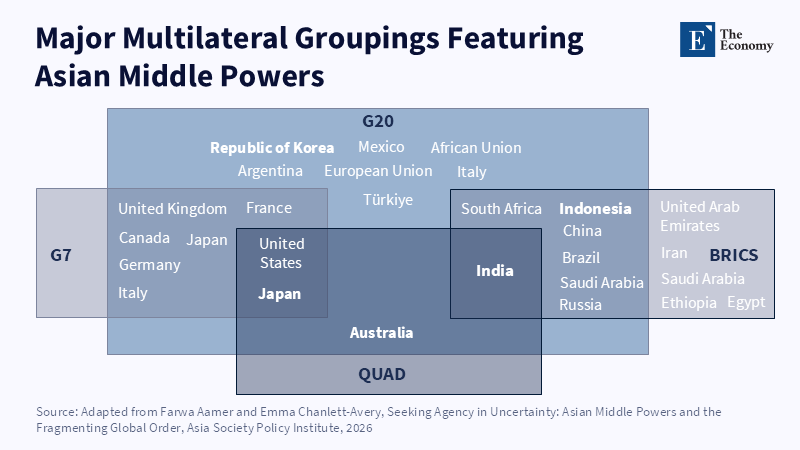
Asian middle powers are not ready to form a neat bloc. They are too different. Japan and Australia sit close to the US alliance system. India guards strategic autonomy. Indonesia and Vietnam each have its own history. South Korea must manage North Korea and China at once. Yet these states share one fear: being trapped inside someone else’s contest. That fear can become a practical agenda. The goal should not be a new Asian NATO. It would divide the region and fail. The goal should be practical cooperation in areas where middle powers can act without pretending to be superpowers: maritime awareness, critical minerals, supply-chain standards, disaster response, digital rules, energy security and defense-industrial links.”
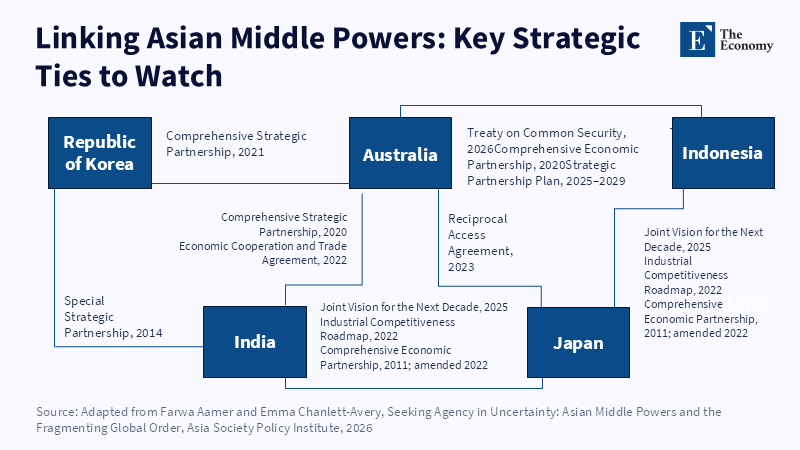
India may have a special role to play, not just another US ally. That's both India's strength and its weakness. Autonomy opens doors with partners who see through the Western-imposed framework. But autonomy may appear like an expedient when decisions are difficult. India's hope of middle power leadership will depend on others' perception of India as more dependable than independent. Dependability depends not on alliance discipline but on decency and commitments of delivery. Docks, training, vaccines, digital public goods, line of credits, maritime patrol support and resilient supply chains all count. They need to be delivered regularly. A middle power turns leader when smaller states find it useful, not by declaring itself to be so.
India's Long Road Runs Through Reform, Restraint and Coalitions
The policy conclusion is not a smaller India. It is a more serious one. The next phase should be based on three interconnected steps. One, India must accept domestic reform as a matter of power politics. Manufacturing, logistics, energy security, urban infrastructure, women's labor participation, judicial efficiency and data quality are not mere apparent domestic islands isolated from the external environment; they are the architectures of future power. An economy unable to utilize its human resources effectively will not sustain a large strategic role. An economy unable to move goods rapidly will not become a supply chain hub. An economy unable to measure itself reliably will not be able to sustain a long rise. For this reason, the most crucial sphere of India's middle power strategy is not the summit hall. It is the slow work of state capacity.
Second, time for India to tighten its strategic priorities. Local security concerns will not disappear, but they should not dominate domestic politics. Pakistan remains a matter of concern. Afghanistan affects Indian security. Border tensions have become chronic with China. However, the larger game concerns rules of the Asian order with appropriate redistribution, trade, technological controls, energy routes and maritime access. Over time, India needs to balance between concentrating on South Asia and projecting more elite attention on the Indo-Pacific, the Indian Ocean region, the Persian Gulf, Africa and Europe. But that does not imply aping the US or Chinese approach towards the global. Rather, to discover roles where the Indian foothold can work well. India can be a conduit for South Asia on finance and development. It can be a security intermediary in the Indian Ocean. It can enable Asian powers to diversify their dependence.
Third, India must break the practice of turning prudence into a shameful weakness. Accepting a middle-power position does not diminish national dignity. It requires it. The real shame is the loss of status that occurs when one's always unmet, grand visions far exceed actual attainments. Instead, the privilege lies in the progress realized from focusing on the desired rather than the best available alternatives. India can refuse dependency even while managing cooperation with others. It can build its grip on the crucial, complex and contentious area with the US without becoming an extension of the outsider. It can control Russia without relapsing into familiar paths. It can counter the economic power of China while eschewing the path of China. It can represent countries of the Global South while recognizing the unavoidable variation between their visions. This is the future version of strategic autonomy. It is neither the pressurized space to avoid decisions nor the mobile space to maximize possibilities. It is the open space to realize national potentialities.
India should create a middle-power doctrine for the coming decade and a major-power platform for the next fifty years. That doctrine would honestly acknowledge the gap between aspiration and capacity. It would unapologetically prioritize forward-looking measures such as improvements to India's logistics infrastructure, higher levels of defense manufacturing, more women engaged in paid work, accelerated delivery through the courts, improved urban infrastructure, cleaner live data, expanded maritime co-operation and credible alliances with other Asian middle-powers. The foundational facts remain clear: if India does not harness all its people, industry and institutional wealth, large as it is, it will remain strategically thin. But India can become considerably stronger by ceasing to mistake middle-power status for national capacity. Indian middle-power realism is not a limit. It is the beginning of durable power.
The views expressed in this article are those of the author(s) and do not necessarily reflect the official position of The Economy or its affiliates.
References
Aamer, F. and Chanlett-Avery, E. (2026) Seeking Agency in Uncertainty: Asian Middle Powers and the Fragmenting Global Order. New York: Asia Society Policy Institute.
International Monetary Fund (2026) World Economic Outlook Database: India. Washington, DC: International Monetary Fund.
Ollapally, D.M. (2026) ‘India’s limits as a middle power’, East Asia Forum, 8 June.
Priyadarshi, S. (2025) Constructing Middle Power Identity: India’s Strategic Playbook in Global Politics. New Delhi: Chintan Research Foundation.
SIPRI (2025) Trends in World Military Expenditure, 2024. Stockholm: Stockholm International Peace Research Institute.
SIPRI (2025) Trends in International Arms Transfers, 2024. Stockholm: Stockholm International Peace Research Institute.
UNFPA (2025) State of World Population 2025. New York: United Nations Population Fund.
World Bank (2023) Connecting to Compete 2023: Trade Logistics in an Uncertain Global Economy. Washington, DC: World Bank.
World Bank (2026) World Development Indicators: India. Washington, DC: World Bank.
World Bank (2026) India Development Update, April 2026. Washington, DC: World Bank.
Working across research, policy, and data-driven analysis, the Editorial Board ensures that published pieces reflect a consistent institutional perspective grounded in quantitative reasoning and long-term structural assessment.