AI Cognitive Stunting Is a Policy Failure, Not a Student Defect

Working across research, policy, and data-driven analysis, the Editorial Board ensures that published pieces reflect a consistent institutional perspective grounded in quantitative reasoning and long-term structural assessment.
Authored On
Modified
AI cognitive stunting is a governance problem, not a student failure
Schools must sequence AI use so learning comes before automation
Clear rules and better assessment can prevent AI from widening learning gaps

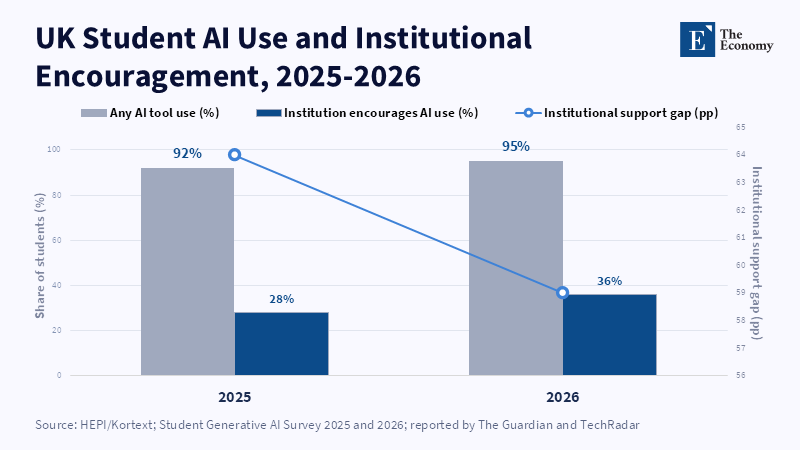
Ninety-five percent of British undergraduates are now using AI in some way and 94% are using generative AI to improve assessed work. That is not a risk for the future. That is the environment the average learner already faces. What is harder to grapple with is that only a fraction of them can say that their institution is actively promoting this use or providing the relevant tools. This is the beginning of AI cognitive stunting, not in the AI Chatbot, not in the feeble student, but where a school system designed to evaluate finished products finds itself facing a tool able to create those finished products before the learner has built the skill behind them. The true danger is not that students will cease to work, but that their institutions may continue to evaluate work as if traditional linkages between effort, output and understanding still apply. An approach that attempts only bans will fail to grasp the gravity of the situation; only one that attempts to surrender to it will make it worse.
AI Cognitive Stunting Is an Institutional Risk
The most comprehensive way to understand AI cognitive stunting is not as an argument that young people are inherently becoming less capable. That argument is simplistic and overly moralistic. The more accurate perspective is institutional. Generative AI has altered the hierarchy of learning tasks. A student once had to research, read, compare, draft, edit and justify a hypothesis. Now AI can do much of that research for the student and give the student an articulate answer before you begin the others. The screen displays completion. The learner does not necessarily have to have undergone a process of trial and error, long drafts, messy pencil notes, a tentative first draft, that leads to this completed text. Educators have counted on friction-a student making mistakes, taking a long time to write something, struggling to produce anything at all-as evidence of progress. Friction is part of the way people build skills. AI cognitive stunting refers to the failure to let these moments accumulate.
This does not imply that all uses of AI weaken learning. It only implies that when and why AI is used now becomes no less, but more important than merely the presence of the tool. Cognitive offloading is nothing new. Textbooks, calculators, search engines and notes have carried part of the mental load before. Now, generative AI could carry out the entire visible task. It could simulate the explanation, the structure, the example, the tone, even the very final answer. That makes it even more powerful than search, but also even more perilous for novices. An expert can employ AI to test a proposition. A novice can employ a similar tool to simulate that very same proposition. Policy should focus only on this distinction. The core question is neither: 'Is AI brought into education?'; but 'Does AI supplant deliberation?'
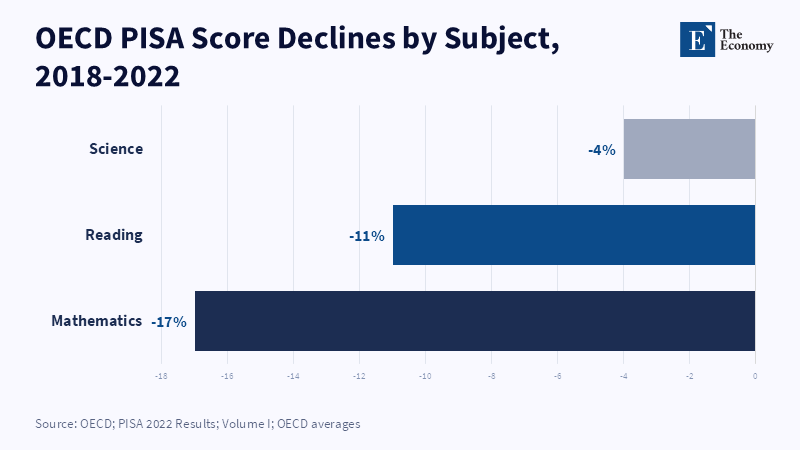
The baseline is also important. The AI era has not arrived on a high note in education. According to OECD data from PISA 2022, the OECD average scores in mathematics saw a record 15-point decline from 2018 to 2022 and the OECD reading scores were down 10 points. Prior to fully embedding in daily study, these were the large losses that had been accumulated. This means cognitive stunting should not be presented as the primary cause of low achievement. It is an accelerant. It disguises and consolidates current weaknesses. A weak reader can now write a perfect draft. A student with weak number sense can now inquire about a sample answer. The result is improved. The foundation remains thin. This is why policy needs to protect the unloved undertaking of learning.
Adoption Has Moved Faster Than Governance
The evidence now suggests that AI has crossed over from a novelty. Use among UK students increased from 66% in 2024 to 92% in 2025 and 95% in 2026. In the US, the share of teens who reported using ChatGPT to do schoolwork doubled from 13% in 2023 to 26% in 2024. By the end of 2025, Pew found that 54% of American teens had used chatbots for schoolwork. These numbers do not indicate a side habit. They indicate a new study infrastructure. Adoption is not waiting for the nod of approval from the school. Students use AI because it frees up their time, provides immediate assistance and turns vague prompts into polished answers. The policy issue is that such behavior is becoming normative before schools have decided what should be protected.
That mismatch is seen among teachers as well. RAND found that teachers in core subjects used AI to plan or deliver instruction during the 2023-24 school year, while more principals used AI than teachers, while only 18% of principals indicated that their schools or districts had provided guidance to staff, teachers, or students on the use of AI. There was a greater disparity at high-poverty schools where guidance was said to be less prevalent. That is the equity alert that is at the heart of AI-caused cognitive stunting. In a strong, well-funded school, AI potentially can be a tutor, coach, feedback loop and teacher time-saver, but in a weak one, it can be an unmanaged time-saver. Even the same tool can increase the divide between students who learn to take control of AI and students who are told to be under it.
That’s also why a simple access agenda isn't enough. Giving all kids a chatbot doesn't level the playing field if only some see detailed instructions, adult guidance and safe practice. In fact, access without facilitation may obscure inequality. A lower-achieving student might turn in a well-written piece, while still lacking the feedback loop of scaffolding and peer confidence building. A more advanced student might use the same capabilities to verify ideas, challenge assumptions and deepen understanding. The difference isn't the machine. It's the learning environment it sits in. AI cognitive stunting will be greatest where the machine becomes the private work of the individual student rather than a design question of public schooling. Schools can't farm that design out to private households, teachers, or commercial software developers.
The Answer Is Sequencing, Not Bans
The case against panic is powerful. AI can strengthen learning when designed and used thoughtfully. A 2025 randomized trial on a college physics class demonstrated that students who interacted with a custom AI tutor learned more in less time than students in a traditional active learning setting. The AI tutor was not an open-answer machine. It was rooted in proven pedagogy, guided by a suggested curriculum, providing real-time response and configured to serve carefully calibrated levels of guiding support. That detail was the entire message. AI helped because it guided effort rather than canceling it out. Other recent research suggests a similar hopeful conclusion. AI feedback can help learning, but the effects are contingent on the individual, the activity and how it is used. When learners use AI to "think with" the system, the intervention can be helpful. When learners use AI as "thinking for" the system, the same program can be harmful.
Thus, education policy should be built around sequencing. First, the learner tries to recall, attempt, draft, explain, or solve. Then AI can be built in for comparison, questioning, correcting, simplifying, or extending. This simple ordering completely redefines the classroom activity. A learner writes away without AI and then deploys AI to fill gaps. A maths student enters a first solution, then requests the tool to propose an alternative pathway. A historian compares two sources, then requests counterarguments. The intention is not to always use AI minimally. The intention is to always put it after the first act of thinking. AI mental stagnation is least likely when the answer is received first. Advanced AI learning is least likely when aid is presented after the user has a primitive output to provide.
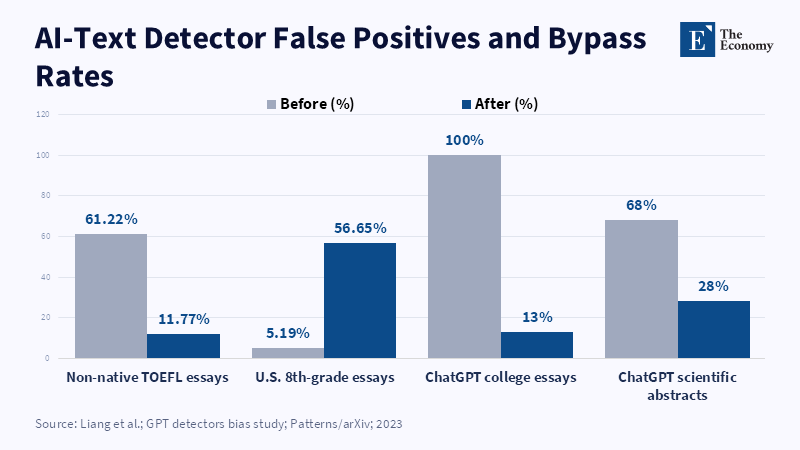
Assessment must change, too. Detection cannot carry the system. Even OpenAI has withdrawn its own AI-written text classifier because of poor accuracy. The initial tool was only able to accurately identify a small percentage of AI-written text and even then, it also flagged some human-created work. This is not a sustainable platform for discipline. It is also undesirable. Students writing in basic, formal, non-native English can be subjected to suspicion even where they have not done anything wrong. Schools need a better solution. Assessment should be directed toward draft work, live presentation, in-class activities, process notes, portfolios, local data sources, group work and reflective admissions. This is not a gentle assessment. It is an assessment where fabrication is harder and it is more in line with natural cognition. The intention is to gauge education as a methodology and not to have an expository essay on hand as evidence of prior achievement.
Clear rules would help. In all courses, students should be told whether AI is forbidden, limited, permitted with disclosure, or expected for any given task. These are not bureaucratic categories. They are a road map. For example, a biology laboratory report might permit the use of AI for editing the prose but not for interpretations. A short fiction essay could permit the use of AI tools for drawing counterexamples, after a rough draft. A code-writing course might permit AI-assisted debugging, with the caveat that students explain all changes they made. Sequencing makes the rules clear. Knowing that using AI counts as cheating is a barrier to honest work. Knowing that AI counts as homework helpers is a barrier to experimentation, even when the results seem promising. Instructors must prevent a tool from feeling like improvisation. Clear rules keep tools in the light.
Public Capacity Must Shape the AI Classroom
The problem cannot be limited to particular classrooms. UNESCO estimates that by the year 2030, there will be a worldwide shortfall of 44 million primary and secondary teachers. All of these points contribute to the attractiveness of AI. When systems become overloaded, so is the temptation to turn to AI for a cheap layer of support. Some of that support can be a boon. Instant explainers, translations, drills and feedback can short-circuit waiting for days to hear. But relying on a silver bullet to make up for a chronic and structural teachers' shortage should not lead policymakers to be softer on the human side of learning. AI can carry some of the typical stress of the classroom. But it will never carry the judgment and engagement of a nurturing teacher, who keeps pushing students uncomfortably beyond their comfort zones. If the only reason for new AI programs is to replace public investment, the result will be a policy-born preventable form of cognitive restriction.
That is also why public capacity counts. Schools need shared explicit guidelines, protected resources, teacher education and clear age-sensitive standards. Governments and districts should protect the core learning experience against private, do-it-yourself experimentation and against devolved and chaotic classroom improvisation. Picking a tool should matter if it fosters explanation, verification and effort. Teacher education should banish panic and plagiarism. It should bring designers out of the pit into hallways, exploring how tasks are designed where AI at work may be permitted, limited, or blocked according to clear logic. Students need training in how to identify outputs, traceability and units of explanation and what the tool did. School leaders need to give staff a common understanding of what they should do, not simply a list of banned tools. The straightforward criterion is this: what the tool makes the learner better at doing is reasoning on their own or just producing on command.
The labor market case exacerbates the global pressure. According to the IMF, 'roughly 60 percent of jobs in advanced economies are vulnerable to AI because they rely on cognitively demanding tasks'. This does not mean those jobs are necessarily going to vanish; it implies that the future work will unfairly compensate those people capable of functioning with and through and not in spite of, AI, rather than in acceptance of it. Reading, writing, corroborating sources, numerical logic and explanation would not be less relevant, but more, as the paradox at the core of AI cognitive stunting suggests, the rare abilities that spare people from utilizing the machine in an optimal fashion. Weaker schools, which will equate, as regards real human knowledge and explicit skill, with literate, trust schools that seek to diminish the leveraging of human variousness through AI upon delivering the weakest AI economy.
The call to arms is simple. Education systems need to stop framing AI as a cheater’s aid or a silver-bullet tutor. Neither of these positions holds true. Instead, AI acts as an effective mental aid that changes where effort takes place and where it can be faked. The design challenge is to reshape learning around that centerpiece. Curriculum must shield the early effort. Assessment must reveal the underlying process. AI instruction must be phased out, be transparent and be embedded. State policy should invest first in helping guide and equip the teachers of the most vulnerable schools. Finally, every education seller has read the startling opening line that shook them: AI is widespread, governance is not. While it may be impossible to protect against AI cognitive stunting will not be prevented by fear. It will happen instead through institutions that understand human thinking and construct learning environments that continually expect the student to build them.
This article is based on an original research article published by The Economy Research. For the original version, please refer to Generative AI and Cognitive Stunting: Why Education Must Redesign Learning.
The views expressed in this article are those of the author(s) and do not necessarily reflect the official position of The Economy or its affiliates.
References
Cazzaniga, M., Jaumotte, F., Li, L., Melina, G., Panton, A.J., Pizzinelli, C., Rockall, E. and Tavares, M.M. (2024) Gen-AI: Artificial Intelligence and the Future of Work. Washington, DC: International Monetary Fund.
Freeman, J. (2025) Student Generative AI Survey 2025. Oxford: Higher Education Policy Institute and Kortext.
Kaufman, J.H., Woo, A., Eagan, J., Lee, S. and Kassan, E.B. (2025) Uneven Adoption of Artificial Intelligence Tools Among U.S. Teachers and Principals in the 2023–2024 School Year. Santa Monica, CA: RAND Corporation.
Kestin, G., Miller, K., Klales, A., Milbourne, T. and Ponti, G. (2025) ‘AI tutoring outperforms in-class active learning: an RCT introducing a novel research-based design in an authentic educational setting’, Scientific Reports, 15, Article 17458.
Lee, H.-P., Sarkar, A., Tankelevitch, L., Drosos, I., Rintel, S., Banks, R. and Wilson, N. (2025) ‘The impact of generative AI on critical thinking: self-reported reductions in cognitive effort and confidence effects from a survey of knowledge workers’, Proceedings of the 2025 CHI Conference on Human Factors in Computing Systems, pp. 1–22.
McClain, C., Anderson, M., Sidoti, O. and Bishop, W. (2026) How Teens Use and View AI. Washington, DC: Pew Research Center.
OECD (2023) PISA 2022 Results, Volume I: The State of Learning and Equity in Education. Paris: OECD Publishing.
OpenAI (2023) ‘New AI classifier for indicating AI-written text’. San Francisco, CA: OpenAI.
Risko, E.F. and Gilbert, S.J. (2016) ‘Cognitive offloading’, Trends in Cognitive Sciences, 20(9), pp. 676–688.
Stephenson, R. and Armstrong, C. (2026) Student Generative Artificial Intelligence Survey 2026. Oxford: Higher Education Policy Institute and Kortext.
The Economy Research Editorial (2026) ‘Generative AI and Cognitive Stunting: Why Education Must Redesign Learning’, The Economy Research.
UNESCO, International Task Force on Teachers for Education 2030 and Fundación SM (2024) Global Report on Teachers: Addressing Teacher Shortages and Transforming the Profession. Paris: UNESCO.
Winthrop, R. (2026) ‘Is it time to measure cognitive stunting?’, Brookings Institution.
Working across research, policy, and data-driven analysis, the Editorial Board ensures that published pieces reflect a consistent institutional perspective grounded in quantitative reasoning and long-term structural assessment.