“Another Labeling Dispute” Chobani and Danone Head to Court Over Yogurt Protein Content Claims

Authored On
Modified
French food giant Danone sues U.S. dairy producer Chobani
Competition in the high-protein yogurt segment intensifies amid rising use of GLP-1 obesity drugs
Chobani, long hailed as an American Dream success story, faces another legal battle amid a history of labeling disputes
French multinational food and beverage company Danone and U.S. dairy producer Chobani have entered a legal dispute over the protein content claims of yogurt products. With demand for high-protein yogurt surging alongside the explosive growth of the obesity-treatment market, tensions between the two rivals appear to be deepening as competition intensifies. Market observers are also noting that Chobani, which has repeatedly faced lawsuits related to ingredient and labeling claims since the early 2010s, is once again confronting a dispute of a similar nature.
Danone-Chobani Legal Showdown Intensifies
According to a Reuters report on June 21, Danone filed a lawsuit in a U.S. court on June 15 alleging that Chobani overstated the protein content listed on its product labels. The central issue concerns the label on Chobani’s 32-ounce “20G Protein” Greek yogurt product. According to Danone’s complaint, Chobani lists a serving size of three-quarters of a cup, or 190 grams, for the product. Under U.S. Food and Drug Administration (FDA) standards, however, the appropriate serving size should be two-thirds of a cup, or approximately 168.9 grams. Based on that serving size, the protein content would calculate to 17.78 grams, meaning the label should state 18 grams rather than 20 grams, Danone argues.
Danone contends that this discrepancy distorts comparisons with its competing product, Oikos Pro. By using a serving size larger than FDA standards, Chobani’s 20G Protein yogurt is allegedly being perceived as a product comparable to Oikos Pro, which contains at least 20 grams of protein per serving. Danone argues that Chobani’s product more closely resembles its lower-protein, lower-priced Oikos Triple Zero line than Oikos Pro.
Danone’s position is that Chobani’s conduct constitutes false advertising, consumer deception, and unfair competition. The lawsuit seeks a permanent injunction preventing Chobani from marketing or labeling the 32-ounce product as “20G Protein” or as containing 20 grams of protein per serving, along with label revisions, monetary damages, and disgorgement of profits. Chobani did not immediately respond to Reuters’ request for comment at the time of publication, and no court ruling on the merits of the case or settlement agreement has been publicly confirmed.
Competitive Dynamics in the Yogurt Market
The lawsuit extends beyond a simple labeling dispute and reflects broader competitive pressures in the U.S. yogurt market. Danone is a longstanding major player with an established presence in the American yogurt sector. In North America, the company markets a wide range of yogurt products under brands including Danone, Oikos, and Activia, while also owning plant-based food and beverage brands such as Silk. Globally, the company operates businesses spanning bottled water brands including Evian as well as specialized nutrition products.
Among these brands, Oikos has become Danone’s flagship response to changing dynamics in the U.S. yogurt market. Consumers using GLP-1 (glucagon-like peptide-1) obesity treatments have increasingly sought higher protein intake to minimize muscle loss during rapid weight reduction. As a result, yogurt products positioned as high-protein meal replacements have become increasingly important. Chobani has emerged as one of the most prominent challengers to Danone in this segment.
Chobani founder Hamdi Ulukaya, an immigrant from Türkiye, launched the business in 2005 after acquiring a shuttered yogurt factory in upstate New York. Rather than producing conventional yogurt sold by established market leaders such as Yoplait and Danone, Ulukaya focused on authentic Greek yogurt. He developed recipes that delivered higher protein content with lower cholesterol and sugar levels. Chobani’s products quickly gained popularity among American consumers through their healthy image, and the company reached $1 billion in annual revenue within five years of its founding. Before Chobani’s emergence, Greek yogurt accounted for roughly 1% of the U.S. yogurt market. Today, its market share stands at around 50%.
Recurring Labeling and Ingredient Controversies
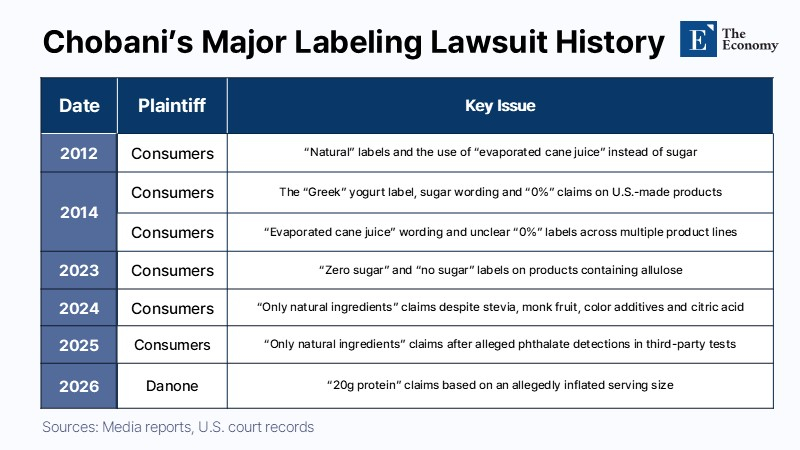
The company’s rapid growth, however, has been accompanied by recurring controversies. The healthy image Chobani promoted while expanding the Greek yogurt market became the foundation for a series of class-action lawsuits. One of the earliest disputes centered on the term “evaporated cane juice.” In 2012, consumers filed suit alleging that Chobani labeled added sugar in its yogurt as evaporated cane juice rather than sugar, making the product appear healthier. Plaintiffs further argued that products marketed as being made with natural ingredients actually contained artificial ingredients and color additives. A trial court dismissed the lawsuit in 2014, but an appeals court revived the case in 2016, citing the FDA’s ongoing review of both “natural” claims and the use of the term evaporated cane juice. The FDA later issued guidance stating that labeling cane-derived sweeteners as evaporated cane juice could mislead consumers and that such ingredients should be identified in a manner that clearly indicates they are sugar.
Similar allegations resurfaced in 2014. Consumers filed a separate class-action lawsuit targeting Chobani’s fruit yogurt products, blended yogurts, Simply 100, Flip products, and children’s products. The dispute once again focused on the use of the term evaporated cane juice. Plaintiffs argued that the wording concealed the presence of sugar and that the “0%” claims displayed on packaging were ambiguous. After being consolidated with other litigation, the case was voluntarily dismissed by the plaintiffs in 2016. More recently, the focus of controversy shifted from natural-ingredient claims to whether products could legitimately be labeled “zero sugar.” In a 2023 lawsuit involving Chobani’s zero-sugar products, consumers argued that labeling products as zero sugar despite containing allulose was misleading. The court ruled in Chobani’s favor last year, noting that FDA guidance allows allulose to be excluded from total sugar and added sugar declarations on nutrition labels.
Some litigation over natural-ingredient claims, however, remains unresolved. In a 2024 lawsuit, consumers alleged that Chobani’s zero-sugar products contained ingredients such as stevia leaf extract, monk fruit extract, certain color additives, and citric acid, making the company’s natural-ingredient claims inappropriate. The court dismissed some allegations related to artificial color additives last year but concluded that core claims involving processed sweetener ingredients remained viable. While records indicate certain individual settlements have occurred, no publicly disclosed resolution covering the entire proposed class has emerged. During the same year, a separate lawsuit was filed concerning allegations of phthalate contamination. Plaintiffs cited third-party testing that allegedly detected phthalates, a class of plastic-related chemicals, in certain Chobani plain Greek yogurt products and argued that the company’s claims of using only natural ingredients were misleading. The court dismissed some claims earlier this year but allowed key false-advertising allegations to proceed.
Similar Post