Japan’s Best Route to Strait of Malacca Security Is Not a Bigger Navy

Working across research, policy, and data-driven analysis, the Editorial Board ensures that published pieces reflect a consistent institutional perspective grounded in quantitative reasoning and long-term structural assessment.
Authored On
Modified
Most attacks were armed robberies; not piracy
Japan should back policing; not naval expansion
Regional cooperation can protect vital trade routes

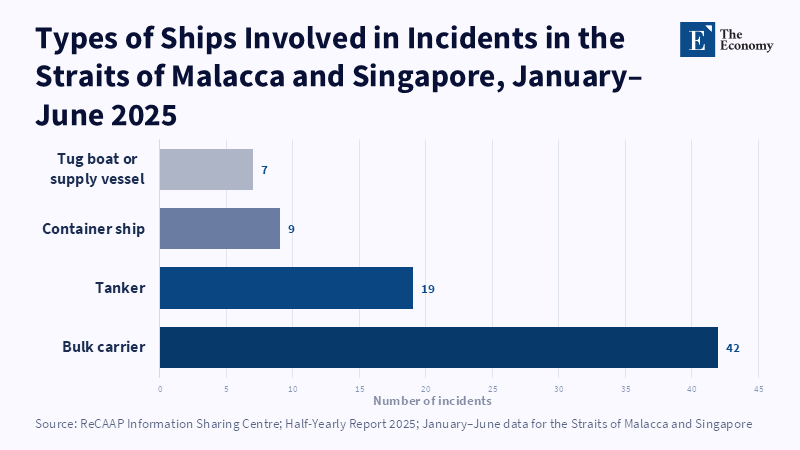
Authorities reported 80 attacks through the Malacca and Singapore straits in the first half of 2025. However, 79 were in the Singapore Straits and only one was in the Malacca Straits. This distinction is critical-it indicates how broad categories mask serious problems. Malacca piracy has the ring of a sweeping campaign against Asia's single most vital trading channel. In fact, the facts point towards something more limited: a series of armed robberies, often in the middle of the night, aboard slow ships passing through a handful of Indonesian waters. Though Malacca security remains crucial to Japan, Southeast Asia and vessels traveling to Europe and the Middle East, an erroneous diagnosis could lead to an ineffective cure. Japan should not turn petty maritime crime into a justification for naval expansion. The path to greater safety is in helping regional neighbors police their own waters, sharing information more quickly and eliminating the safe havens to which criminals have grown accustomed. Such policies ensure safe trade and prestige without rekindling extraregional fears.
Strait of Malacca Security Starts With the Right Threat
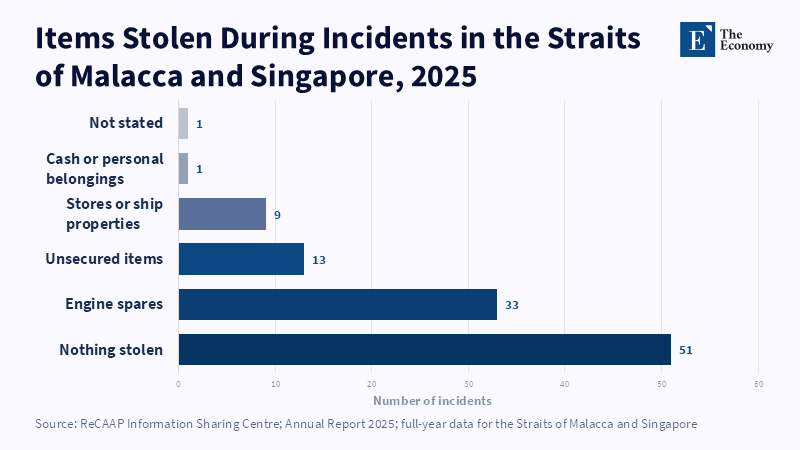
The first policy task is to identify the threat. The ReCAAP information center, which monitors piracy and armed robbery in Asia, reports 95 such events on Asian shipping in the first semester of 2025. This represents an 83 percent increase on the same period in 2024. Eighty of those events occurred in the waters comprising the historically interconnected Straits of Malacca and Singapore. The vast majority would be considered petty thefts by comparison with high-seas hijackings, but still carry the risk of injury to crew either through attack with a bladed weapon or by throwing objects in violence. In 50% of cases, nothing was stolen, even the weakest thefts with goods including engine and loose components. There is still a threat of violence and theft, but not a threat to sovereignty. The distinction in the Strait of Malacca, which is embodied here, is between high-seas piracy and robberies within the territorial waters of Indonesia, Malaysia and Singapore.
The year-to-date figures are even more revealing. In 2025, 132 incidents were reported in Asia, compared with 107 in 2024. Only two of these had the legal standards set for piracy on the high seas. The other 130 were armed robberies in the internal, archipelagic or territorial waters of coastal states. Of these, 108 took place in the Straits of Malacca and Singapore, the highest total in ReCAAP's 19-year series. This jump should be noted, but it is not evidence of a naval failure; it is evidence of a domestic issue that has weakened local law enforcement, reporting and punishment in a known trouble spot. The most definitive proof arrived later in the year. Several Indonesians were arrested during July and August. Incidents then declined with only 12 recorded in the fourth quarter. Across all of Asia, the police had achieved a speedier response than a fleet.
History also warns against treating piracy as an obvious model for foreign sea power. Piracy around the Strait flared for centuries. When colonial powers later suppressed much of it, their first inducement was conquest and forced submission and later, new claims to local waters. The piracy narrative served as justification for Europe's far-reaching grip. That episode cannot be a simple lesson for today. It helps account for why Indonesia, Malaysia and Singapore continue to remain nervous about any scheme that could diminish their sovereignty. It reveals why, in the historical heyday of piracy, these powers' strips of the sovereign right to the sea were never totally stifled. Piracy ebbed, evolved and re-emerged in tandem with a decline in enforcement or crumbling coastal realities. The solution to Malacca Strait security is not a downward spiral of suspected, anti-piracy fever, muscle-flexing and erosion. It relies on consistent institutions that can absorb a short period of intense media attention into stable long-term patterns.
Japan's leverage is civilian, local and discreet
Japan already has a strong foundation for such a policy. It, along with several other countries, was instrumental in establishing the Regional Cooperation Agreement on Combating Piracy and Armed Robbery against Ships in Asia, which came into effect in 2006. Its Information Sharing Center in Singapore now collects reports, issues warnings and runs training. Japan has contributed finance, personnel and coastguard skills. It has also invested in patrol ships, surveillance techniques and maritime law enforcement in the region. This record is significant because it accords with the political parameters of Southeast Asia. Japan gains access and credibility by assisting national authorities in carrying out their own functions. It does not require dominance of the waterway for its own security. The low-key approach converts strength into influence. It also makes security in the Strait of Malacca a common public good rather than a display of dominance by a foreign nation.
The activities of the Japan-Malaysia accords announced in June 2026 point in this direction, but also carry a peril. The two governments welcomed cooperation by signatories in the form of a memorandum of understanding by the Japan Coast Guard and the Malaysian Maritime Enforcement Agency and a willingness to continue exercises between the Japan Maritime Self-Defense Force and the Royal Malaysian Navy, to broaden security assistance and to deepen work on energy supply chains. Such tracks can reinforce each other, but should not converge. Coast guards and police provide rescue and search, gather evidence and promote safety. Navies aim at state war and compellence. When both missions are summed up under the analogous word of maritime security, a short-range anti-robbery campaign can be sucked into a much more consequential military rivalry. That would make cooperation on Japanese terms more difficult for governments wishing to avoid a diplomatic choice between Japan and China.
A clearer division of labor is emerging. Japan must underwrite the practical work supported by the new tools: fast sensors, shared radar imagery, open reporting channels, ruggedized cameras onboard ships that can transform a fuzzy warning into usable evidence. Participants should be trained to cooperate on boarding, chain of custody, the handling of digital evidence and the transfer across a border by the various agencies involved. Prosecutors and maritime police need to cooperate as intimately as naval officers do now. Cross-border reporting agreements should specify a quick handover when a border is crossed. While external partners can provide technology and training, the coastal states will have to take command of the process. That is a challenging but worthwhile projection in statecraft; it will ingrain durable ties and discreet know-how-credentialed networks that the agencies of maritime commerce covet.
Do not cannibalize the mission in the name of Energy Security
Specifically, in a practical sense, Japan's problem is that its rate of energy self-sufficiency never rose above 15.3 percent in the year 2023, which was the lowest within the G7. It obtains more than 90 percent of its crude oil imports from the Middle East. Tankers with the oil transit through a series of exposed waters. The Strait of Malacca, the South China Sea and waters near Taiwan area form another point of exposure.. A single blockade would push up the prices of fuel and affect industrial expenses and the people's confidence. The stability of the Malacca Strait is an issue of vital interest to the Japanese national economy. The same route also matters to countries such as South Korea, China and many others.
This does not mean every risk calls for a military solution. The 2025 attacks did not halt oil flows nor did they close the shipping route. They represented mainly small groups making slow approaches in order to seize portable material. A destroyer may be an expensive and often inappropriate response to that pattern. Warships provide coverage over large areas but cannot replace local investigators, courts or police networks on nearby islands. Nor can they address under-reporting, inadequate night-time watches or markets for stolen parts. The greatest protection effort may be an awkward one: improved lighting, specialist observers, drill procedures, 24-hour notifications and rapidly deployable police units. That is what the data suggest.
Much more difficult is the possibility that Japan will use anti-piracy work to win a greater naval role. That is credible. Tokyo is expanding defense relations elsewhere in Southeast Asia as pressure from China mounts in the Taiwan Strait and the South China Sea. Malaysia is also willing to consider deeper exercise and armament cooperation. Yet a maritime strategy must be clear-cut. Japan already commands an effective Maritime Self-Defense Force. It is not building a new navy from scratch after its defeat in 1945. The basic issue is how far and by what criteria its regional involvement should proceed. Incorporating armed robbery at sea, a Taiwan episode and a Sino-American confrontation under the same unspecific rubric would tend to weaken public scrutiny. These various dangers have distinct legal bases, scales and remedies. Malaccan Strait security will win support only if it stays anchored to the maritime crime actually occurring that an international audience actually witnesses.
Create a Maritime Compact, Not a Naval Sphere
What should follow is an even narrower maritime compact led by the coastal states, supported by Japan. Focused on five related tasks, it would do most to avoid new military arrangements. A shared umbrella cover for the highest-risk channels; ship-to-shore real-time reports; sharing of evidence to support arrests and prosecutions; providing tangible safety support for crews and ports; and targeted work in coastal communities where illegal markets conscript labor. None of these asks Japan to patrol as a dominant outside force. All could help Japan channel money, tech and specialist expertise into where they will do the most good. It could sit alongside ReCAAP rather than supersede it, completing the network and addressing local failings revealed in 2025.
Success should be tracked simply. Reports should be delivered to the right coastal agency within minutes; suspects should be arrested and prosecuted, not just brushed aside from a vessel; repeat hotspots should occupy several quarters, not just one quick patrol spike; crew injuries and stolen equipment should decline. Shipping companies could bear some of that burden as well- a vessel that leaves its cameras turned off, holds off data delivery until the next port, or doesn't lock down its access points increases the risk to every ship following. If governments can establish minimum security and reporting standards by way of port regulations and insurance requirements, well-founded data would enable policymakers to identify whether an increased level of threat existed or merely an increase in reporting, making penetration of the Strait less reactive and more credible.
Japan would also realize three strategic advantages. It would safeguard one of the critical channels for its fuel supplies. It would deepen its reach into ASEAN with valued coastal services. It would reinforce a rules-based maritime order without compelling the region to accept the security hierarchy of Japan as an offshore hegemon. Such advantages last longer than a symbolic new warship and they satisfy the strongest argument against a civilian-based strategy: that it is too weak for a more hostile neighborhood. Civilian cooperation is not-and cannot be-a substitute for naval power when faced with the use of military force. But it is a means of keeping the different kinds of assaults-by state and by lawless individuals-strictly where they belong. Strengthening the coast guard and police is not timid; it is strategic physics.
Of 80 recorded incidents in 2025, 79 occurred in the Singapore Strait, not the Malacca Strait. Narrow in timing and political grouping, most incidents were conducted under coastal jurisdictions, not high-seas piracy. The surge was real, but the ensuing retreat was just as real following Indonesian arrests. Japan must capitalize on those facts. Japan must approach Strait of Malacca security by establishing whether regional power can be cultivated through local institutions instead of imposing foreign power. The success of the June 2026 agreements with Malaysia will depend on maintaining close coast guard cooperation and ensuring energy security and navy planning are reflected by factual accountability. The route from the Middle East to Japan cannot be kept vague. Lasting security advantage will depend upon faster reporting, stronger law enforcement and regionally trusted regional rules. Japan's most effective naval strategy will be to make those mechanisms function day after day.
The views expressed in this article are those of the author(s) and do not necessarily reflect the official position of The Economy or its affiliates.
References
Agency for Natural Resources and Energy (2025) Energy White Paper 2025. Tokyo: Ministry of Economy, Trade and Industry.
Amirell, S.E. (2019) Pirates of Empire: Colonisation and Maritime Violence in Southeast Asia. Cambridge: Cambridge University Press.
East Asia Forum (2026) ‘Japan’s maritime strategy quietly reshapes Southeast Asia’s security’, 18 June.
Hogan, L. (2025) ‘Pirate attacks and sea robberies surge in key South-East Asian shipping lane’, ABC News, 21 September.
Kok, X. (2025) ‘Ship piracy, robberies rise 83% in Southeast Asia in Jan–June, anti-piracy group says’, Reuters, 10 July.
Kyodo News (2026) ‘Japan-Malaysia leaders agree to boost energy, maritime security cooperation’, Japan Today, 10 June.
Ministry of Foreign Affairs of Japan (2026a) ‘Japan–Malaysia Summit Meeting and Luncheon Meeting’, 10 June. Tokyo: Ministry of Foreign Affairs.
Ministry of Foreign Affairs of Japan (2026b) Japan–Malaysia Joint Statement. Tokyo: Ministry of Foreign Affairs.
ReCAAP Information Sharing Centre (2025) Half-Yearly Report 2025: Piracy and Armed Robbery Against Ships in Asia. Singapore: ReCAAP Information Sharing Centre.
ReCAAP Information Sharing Centre (2026) Annual Report 2025: Piracy and Armed Robbery Against Ships in Asia. Singapore: ReCAAP Information Sharing Centre.
The Japan Times (2026) ‘Japan and Malaysia pledge to bolster energy supplies and maritime ties’, 10 June.
Working across research, policy, and data-driven analysis, the Editorial Board ensures that published pieces reflect a consistent institutional perspective grounded in quantitative reasoning and long-term structural assessment.