Middle-Power Trade Network: Europe’s Treaty Model for a Fragmented Trade Order

Working across research, policy, and data-driven analysis, the Editorial Board ensures that published pieces reflect a consistent institutional perspective grounded in quantitative reasoning and long-term structural assessment.
Authored On
Modified
Europe built trade through linked treaties
Middle powers can adapt that model
Deeper access should depend on verified compliance

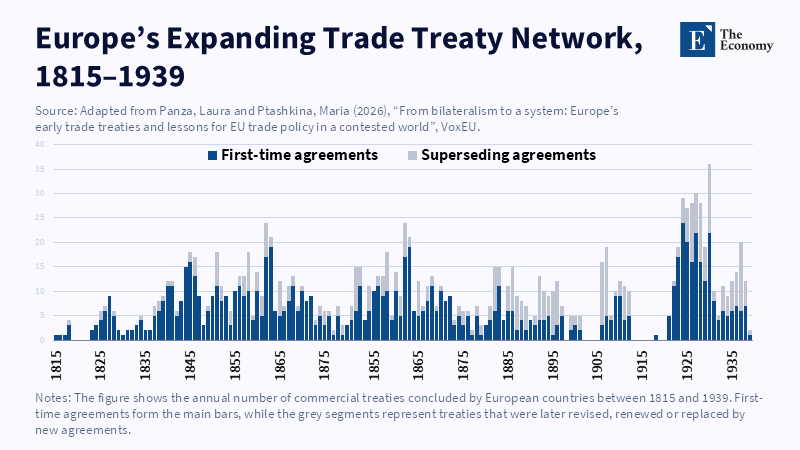
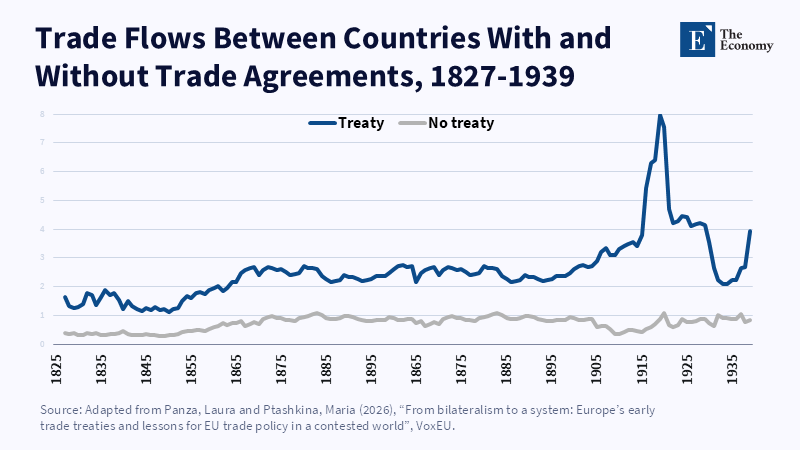
Almost 900 trade agreements connected the nations of Europe from 1815 to 1919. Recent scholarship shows that these agreements boosted trade among signatories by roughly 14 percent. That history matters now. Europe lacked a global trade court, a binding regulator and a common state. It had rival powers, weak national governments and turbulent policies. But a web of agreements turned many two-country arrangements into a new trade network. The trick was not trusting one another blindly. It was the repetition of agreements under a framework that spread gains more broadly than a single pact. An international trade network of emerging powers can apply that lesson today. It can preserve markets when rules and norms weaken. But that suggestion is far less useful for reshaping trade with China. China is able to agree to treaties. The real question is whether China's partners can observe and constrain the state's influence on Chinese firms, capital flows, resource prices, land rights and manufacturing?
Europe Built Trade Through Rules That Spread
Europe’s early trade regime did not begin at the top. It developed through bilateral deals, one by one. Small states sought access to neighboring ports and markets. Larger powers desired more stable routes, lower tariffs and greater influence over their neighbors. Many of the one-on-one treaties liberalized a handful of tariffs, abolished barriers and maintained open transit routes. Most-favored-nation clauses extended concessions granted to one partner to other treaty partners. Each agreement increased the value of the others. This was a network effect. The 1860 Cobden-Chevalier Treaty of Britain and France reinforced this, but it did not initiate it. By that time, many earlier treaties had formed the legal basis. Two-country tariffs became a system because the terms could be passed on and because states anticipated future cooperation.
By today's measures, the system was thin. It lacked an effective court or central authority that could fine a member state. The system depended on customary commitments, repeated negotiations and the threat that another participant could withdraw a concession. Such an arrangement frequently functioned because each state was enmeshed in a wider network of relationships. An offender in one union could be deprived of confidence in others, as the cost of misconduct increased with the expanded network. The record was quite mixed indeed. European powers used force, dominated the colonies and made severe demands on other weaker regimes. But the network did link access to markets with conduct that could be observed by others. Rules created confidence and the confidence, in turn, created room for new rules. A middle-power trade network should operate in a similar manner: first create a core group of narrowly scoped, easily observable commitments, then expand its scope across a broader group, rather than chasing after a new overarching global agreement. Such a model is optimal when applied to states that can see the same tests and that pay a high cost for ignoring them.
China Is Not Another European Treaty State
There is a real gap between China and Europe, but the link should not become a simplified argument about fixed culture. Imperial China did not develop in the same context as small states. Much of its old regional orders placed China centrally. Court titles, tributary relationships, rituals and access to Asian trade were often combined. But smaller neighbors kept operating and their relationships with China varied in time. Historians point out that the Chinese tribute system was not uniform for 2000 years, ranging from war and gifts to border trades and local arrangements. But its basic structure was generally more hierarchical than the treaty web established among European states. Procedurally, trade privileges normally emanated from a diplomatic relationship with the center. But this legacy does not determine current policy; it still corroborates that the shared global path was not the one historically charted by China, nor its learning through a closely fed web of 6-8 states with a capacity to collectively blockade China.
China today has learned how to negotiate very effectively. It has been a member of the WTO, is deeply embedded in the RCEP and had by early 2025 signed 23 free trade pacts with 30 countries, regions and areas. No one doubts China is an experienced trader. The dilemma is where the state ends and the market begins and how trading partners can police the boundary. WTO 2024 review on domestic support found that the state firms still retained sizable shares of assets and profit in basic industries. WTO members also cited the lack of a clear framing rule to put private and state firms on equal footing. The OECD document echoes the same gap. State firms have been given more generous financial preferential treatment than their private rivals. Financial support can also originate from state-owned banks, cheap electricity, public buyers, or state ownership funds. A tariff treaty can reduce the tariff on a border, but cannot isolate the full benefits of a low interest rate, cheap land, or a secret state guarantee.
This is where the old "emperor" idea has some relevance, not as a predictor, but as a cautionary tale about form. A central State can control access to its vast market and the tools it uses are multiple. From one rule made by a dedicated ministry, to one by a money-center bank, to one by a local licensing body and from link to subsidized local partner any single tariff clause will be unable to cover that breadth. The danger here is not that the Chinese authorities will reject all bargains out of hand, but that their terms will remain flexible and arbitrated within China, outside markets and so impose radically different costs that thinly offered words are not as binding as they seem. Europe's web of treaties grew in part because one tariff reduction, replicated several times by links to other areas, could be felt everywhere. China's ever-present state can redirect aid through channels that turn out to be unpredictable to outsiders, only when the market share has shifted.
Currency allegations demonstrate why solid evidence counts. In 2024, the IMF, risk-averse, claimed that China's external position was far stronger than its economy and policy would suggest. It estimated a current-account surplus of 2.3% of GDP and found that its model produced a material real-exchange-rate gap. But rather than denote a charge of single-minded currency cheating, the IMF also attributed the weaker real rate to either Chinese home prices, soft demand, capital flight, or policy. The European Union adopted a narrower legal approach in its electric-car probe, concluding that the country had provided subsidies in the supply chain for battery-powered autos and levying additional tariffs of between 7.8% to 35.3%. The message is narrower. Allegations need data, identified forms of aid and a precise indication of damage. Historical context can define the danger. It cannot substitute for evidence.
A Middle-Power Trade Network Can Use the European Lesson
A middle-power trade network is the best environment to try the old European logic. The EU already has 45 trade agreements with 80 different partners. The CPTPP connects 12 countries from five continents and encompasses around 15 percent of world output. These frameworks are different from the old European web, but they show that extensive trade rules can be based on networked deals. The next phase is to bring more of those networks together. The EU, Britain, Canada, Japan, South Korea, Australia, India, the UAE and other willing states do not hold one worldview. They hold one common concern. None of them wants to depend on one superpower. None of them benefits from a complete retreat behind high national barriers. Each of them gains more leverage when access to its market also means access to a broader community.
The network should begin with a few basic rules. All members should compile a single series of the largest forms of state aid. They should integrate tariff reductions on set schedules and common service standards throughout the network. They should rely on test results from approved laboratories and streamline customs inspections for companies with clean histories. They should liberalize the agreed state purchasing sectors under identical conditions. They should share documentation of sharp import spikes and apply a unified test prior to a short-term protection measure. None of these would compel each country to imitate all of the others. India would retain its own farm policy. The U.A.E. could preserve its own state-client nexus. Canada and Europe would uphold their own social norms. The objective is not similarity. The objective is a network of compatible links. A negotiating gain in one crosscut should be trivial to carry throughout the Middle Power Trade Network.
Trade officials would need better tools. Most have yet to look beyond tariffs and quotas, or the text of a deal. A modern pact would also record loans and tax concessions, land and power, state buying and aid transiting a company half-owned by the state. That requires shared data and joint case teams. If one government identified a loan scheme another might have the customs data. A third might know how firms looked before they entered the supply chain. Shared proof would reduce the expense for small states and stop a giant from doing each one on its own. It would also give firms a clearer way of sounding the alarm. The network should publish its findings and listen. An open process would make each step more difficult to dismiss as protectionism in disguise.
State support is the hardest test. A complete squeeze will not work. China, the US, Europe and many others now give more help for chips, clean power, cars and other key products. OECD data show the measure of industry help topped $ 108bn in 2023, the highest funding figure since the hit from the global financial crisis. Some help can remedy a market failure, help a new technology, or save a critical skill. Other help simply shifts market share to companies that are not generally more productive. A viable middle-power trading system should value the shape and degree of help, not the country badge on the firm. No low-cost research support should be regarded in the same way as a cheap loan aimed at export expansion. Aid recipients should reveal who benefits and for how long it is given and how it is intended to enhance trade. A country lacking serious support should lose part of its network benefit until the facts are disclosed.
Keep China in the System, but Base Trust on Proof
China should remain in the broad trade regime. Its great size makes an outright break expensive. Its factories have reduced the costs of millions of products from mobile phones to solar equipment. China also stands to lose a great deal from closed camps. But more trade alone will not be enough to bring China's state-led economy closer to Western market discipline. More than 20 years in the WTO have brought real reforms and huge benefits. They did not eliminate the state's central role in finance, land, public procurement and long-range industrial planning. The most practical approach is layered. WTO rules should still be at the global minimum. Negotiations with China should remain open on autos, steel, solar products, state procurement, currency data and aid reports. More advanced benefits should follow demonstration of performance. When China can fulfill the same conditions as other states, it could join selected sections of a middle-powered trading system. That does not mean exclusion. It means open access upon clear conditions.
Critics will say the network would pit the world against itself. This might be if an entrant were judged on its political character. Less so if rules appeared to favor no one, if entry remained open and every case came down to the facts. The network must not demand that members agree on a single foreign policy. But it can demand facts, treat members equally and set an impartial, independent judge for any dispute. The nearly 900 treaties signed in Europe mattered precisely because each added one more link in an order that no single capital totally commanded. This insight can help G7 nations and regional powers in keeping their trade systems open now. It cannot resolve the deeper battle over market rule versus China's autocratic, party-directed economy. Policies must stop assuming that one old lesson suits every new partner. Create the middle-power trade network where reciprocity can be observed, verified and upheld. Keep the door open to China. Trust should follow conduct that can be observed, verified and enforced.
The views expressed in this article are those of the author(s) and do not necessarily reflect the official position of The Economy or its affiliates.
References
Accominotti, O. and Flandreau, M. (2008) ‘Bilateral treaties and the most-favoured-nation clause: The myth of trade liberalisation in the nineteenth century’, World Politics, 60(2), pp. 147–188.
European Commission (2024) Commission Implementing Regulation (EU) 2024/2754 of 29 October 2024 Imposing Definitive Countervailing Duties on Imports of New Battery Electric Vehicles Designed for the Transport of Persons Originating in the People’s Republic of China. Brussels: European Commission.
European Commission (2025) Implementing and Enforcing EU Trade Agreements. Brussels: Directorate-General for Trade.
Fouquin, M. and Hugot, J. (2016) ‘Two centuries of bilateral trade and gravity data: 1827–2014’, CEPII Working Paper, No. 2016-14. Paris: Centre d’Études Prospectives et d’Informations Internationales.
Giglio, J.M. (2018) ‘No doubt about it, China doesn’t play fair on trade’, JMGshortcuts, 14 July.
International Monetary Fund (2025) 2025 External Sector Report: Global Imbalances in a Shifting World. Washington, DC: International Monetary Fund.
Kang, D.C. (2020) ‘International order in historical East Asia: Tribute and hierarchy beyond Sinocentrism and Eurocentrism’, International Organization, 74(1), pp. 65–93.
Lampe, M. (2009) ‘Effects of bilateralism and the most-favoured-nation clause on international trade: Evidence for the Cobden–Chevalier network, 1860–1875’, The Journal of Economic History, 69(4), pp. 1012–1040.
Matsumoto, Y., Papazian, C. and Sauvage, J. (2024) Quantifying the Role of State Enterprises in Industrial Subsidies. OECD Trade Policy Paper No. 282. Paris: OECD Publishing.
Ministry of Commerce of the People’s Republic of China (2025) ‘MOFCOM regular press conference’, 9 January. Beijing: Ministry of Commerce of the People’s Republic of China.
Panza, L. and Ptashkina, M. (2026) ‘From bilateralism to a system: Europe’s early trade treaties and lessons for EU trade policy in a contested world’, VoxEU, 19 June.
Parry, C. (ed.) (1969–1980) The Consolidated Treaty Series. Dobbs Ferry, NY: Oceana Publications.
Perdue, P.C. (2015) ‘The tenacious tributary system’, Journal of Contemporary China, 24(96), pp. 1002–1014.
United Kingdom Department for Business and Trade (2024) UK Counting Down to CPTPP Entry into Force. London: Department for Business and Trade.
United Nations (n.d.) United Nations Treaty Collection. New York: United Nations.
World Trade Organization (2024) Trade Policy Review: China—Report by the Secretariat. WT/TPR/S/458. Geneva: World Trade Organization.
Working across research, policy, and data-driven analysis, the Editorial Board ensures that published pieces reflect a consistent institutional perspective grounded in quantitative reasoning and long-term structural assessment.