The Guarantee Switzerland Never Had to Cash

Working across research, policy, and data-driven analysis, the Editorial Board ensures that published pieces reflect a consistent institutional perspective grounded in quantitative reasoning and long-term structural assessment.
Authored On
Modified
Credit Suisse weakened bail-in credibility
Switzerland also protected its banking brand
The precedent applies mainly to small financial centres

Switzerland once made up to CHF 109 billion available over a single weekend to save a bank. Not a single franc of the CHF 9 billion loss guarantee covering UBS's losses was ever paid. By August 2023, UBS had returned the guarantee after paying a flat fee of CHF 40 million. The bank that needed saving, Credit Suisse, had one class of bondholders wiped out to the last franc, while a whole layer of debt just above them, designed precisely for this, was left untouched. The result was an unused guarantee and a loss-absorbing bond class that was never forced to absorb losses. This is not simply a story of a bank running out of money. It is a story of a government buying insurance for something else: its reputation. That purchase and what it now costs everyone watching is the real story of Credit Suisse.
A Guarantee Nobody Cashed
Start with the raw numbers. On 19 March 2023, Bern approved a CHF 100 billion default guarantee to the Swiss National Bank to keep Credit Suisse afloat with emergency liquidity. This accompanied a CHF 9 billion loss guarantee to UBS for a portfolio of assets that neither bank really wanted. UBS acquired Credit Suisse for CHF 3 billion, a tiny fraction of what the bank was worth the week before. The riskiest bonds Credit Suisse held, the bank's Additional Tier 1 debt, worth around CHF 16 billion, were written down to zero. The bail-in bonds just above them, which a decade of reform had designed to absorb losses next, were not touched at all. Investors had been factoring in losses on both classes in the days before the merger, but then it was one class that imploded and the other snapped back.
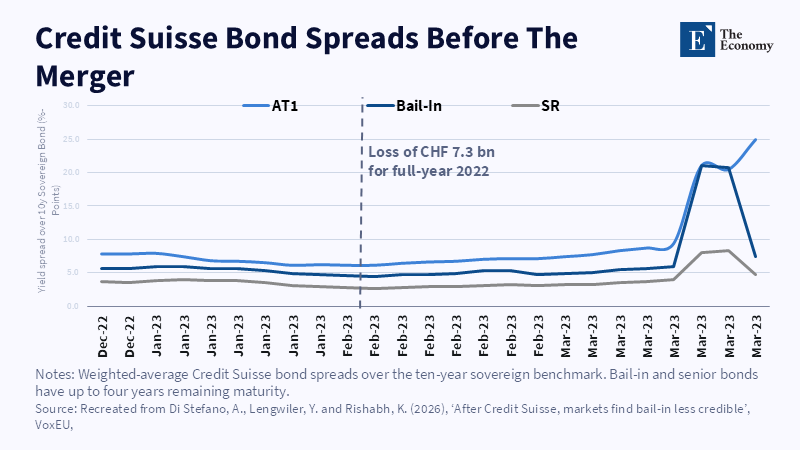
What happened next remains an enigma. The CHF 100 billion liquidity facility was drawn and the fully secured loans were repaid by Credit Suisse by the end of May 2023. The CHF 9 billion loss guarantee was terminated unused within five months. Governments rarely provide guarantees measured in billions against a fire that is not subsequently doused. If Bern indeed suspected UBS would face major losses on the covered assets, the loss guarantee should have been drawn heavily. It was not. Something else was being protected that weekend but it was not the bank's solvency in any technical sense. Consider also the test: who paid and who escaped? Shareholders, after all, lost almost everything, selling out at a knockdown price and without a vote. Holders of AT1 lost everything. Senior creditors and depositors were made whole. Bail-in bondholders, at the center of the post-2008 reform effort, were waved through, as if the crisis ended precisely one rung above them. That is not what a rulebook applied under pressure commonly produces. This is what a rescue produces when the priority is speed and appearance, not a strict loss order.
Another natural objection. Perhaps Credit Suisse was simply too complex for a normal bail-in and the guarantees were prudent safeguards. Yet Europe already had a clear precedent of a sale of exactly this sort. When Spain's authorities sold Banco Popular to Santander in 2017, bail-in creditors took a full hit and the sale still went through without a hitch, within a weekend, without chaos and without a nine-figure state guarantee. Credit Suisse was bigger and more complex, certainly. The difference in treatment reflected a choice about which creditors to save, not a technical necessity imposed by the size of the balance-sheet hole. Banco Popular showed that a bail-in sale could proceed cleanly. Switzerland did not choose to do so.
The Insurance Was the Brand, Not the Balance Sheet
By most common standards, Switzerland's banking sector is small. The sector employs around 100,000 people and has a gross domestic product share of just under 5 percent. That small size masks its wider importance. Swiss banks manage trillions of dollars of cross-border assets because clients believe that Swiss banks are safer, better supervised and more discreet than anywhere else. That reputation is the product being sold. It is not restored in the same way that capital buffers can be replenished - through retained earnings. Once lost, such trust may take decades to regain. When Credit Suisse faltered, Bern's main concern was not an empty treasury. The greatest threat was that a messy, textbook bail-in, used on a bank of this magnitude for the first time in history, would signal to the world that Swiss banks are no safer than anyone else's.
A seamless handover to a stronger domestic rival, backed by public commitments that sounded huge but ultimately cost little, preserved that story. It maintained the image even though it set aside the rulebook meant to govern moments like this. That also accounts for one important detail. The largest remaining bank, UBS, is no longer a run-of-the-mill problem. After absorbing Credit Suisse, UBS now holds assets equal to about 167% of Swiss GDP, according to the IMF's 2025 review of Swiss financial stability. No national bidder could have saved UBS the way it saved Credit Suisse. There is no second UBS standing by. Swiss authorities have since proposed requiring UBS to meet higher capital standards, a proposal UBS has called an overreaction. Only once the March 2023 rescue is properly understood can this battle be understood. Shareholders were being required to surrender control less because the numbers required it than because the country demanded a quick, transparent, credible, image-preserving outcome, no matter what happened behind the scenes.
What the Market Actually Learned About Bail-In Credibility
Markets rarely care whether authorities were justified in doing what they did. They care whether authorities will act and how. After the Credit Suisse deal was completed, investors repriced bail-in bonds for some 90 banks in over 20 countries. Swiss bail-in debt saw spreads decline around 6 percent; the AT1 tier, now riskier than before, saw spreads rise. In the Euro Area and the United Kingdom, bail-in spreads declined around 13 to 14 percent. A BIS working paper, which examined bond prices before and after the merger, found that senior spreads barely moved. That last number is the most telling because it suggests investors had not begun to factor in a diminished likelihood of bank failure but rather a more generous underwriting of big bank collapses in their wake: in the event that a bank is too large to let fail, authorities will shore up the layer just above the riskiest debt rather than let the rulebook take its course.
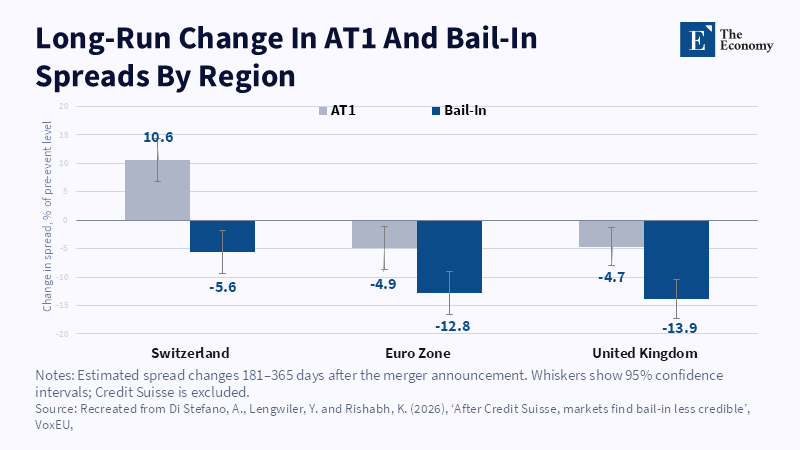
The weakest banks benefited the most from this change, which is where a credible bail-in threat should bite. Earnings announcements also moved bail-in bond prices roughly one-third less than before the rescue, a decisive signal that markets were monitoring bank fundamentals less closely as they had in the past and did not now believe they would matter when it came to who pays when trouble comes. Discipline that had taken a decade to establish had been weakened in a weekend. It is also where the story of Credit Suisse ceases to be only Swiss and spreads across the globe. The reforms agreed after the 2008 crisis had rested on a simple pledge. Shareholders and designated bondholders, not taxpayers, were supposed to absorb losses first. Analysis of the top US banks had suggested that the pledge was becoming more credible by the year, with the funding advantage linked to expected rescue steadily diminishing. Credit Suisse's rescue reversed part of that progress in a weekend and the undoing was not confined to Swiss shores. Credit Suisse's rescue was reflected in bond markets in some 20 other nations, markets that in every case could draw a line from Zurich to its own banks.
Why the Lesson Travels to Very Few Addresses
Here is the boundary that gets drowned out in the clamor. What happened in Switzerland was feasible because Switzerland is small, unusually wealthy and its financial standing carries more weight than its economic size would suggest. A government ready to back guarantees of up to CHF 109 billion, to support a business that by direct output is nowhere near that big but by reputation is everything, is a particular type of actor. Other financial centers have both features. Providing guarantees to support a small economy with a major, globally trusted banking or wealth industry is the same calculation. Singapore's banking reputation weighs heavily against the size of its economy. Liechtenstein's financial identity hinges on trusted private banking. In such places, a Swiss rescue is a plausible response, because the reputational stakes are potentially greater than the fiscal costs.
For most other countries, the calculations simply do not transfer. A sizeable, varied economy has a multitude of banks, a national consumer base and a national identity that never depended on one bank being kept afloat. Its government faces real fiscal exposure if it has even partially covered a mega-bank's shortfalls, without a matching reputational gain to throw the risk into perspective, because its global standing was never built mainly on banking. Switzerland's response to the Credit Suisse saga can be understood as an illustration of what a small state that is dominant in international banking may do under pressure. It is not a template that every supervisor should expect every government to follow. Treating it as one is exactly what markets seem to be doing.
Regulators and bond investors elsewhere should ask a sharper question than the markets appear to be doing by default. Is the jurisdiction one that would swap rulebook discipline for reputational insurance, as Switzerland did? Can it cope with a messier but saner outcome, without putting the same reputation at risk? At the very least, supervisors and rating agencies pricing bail-in debt outside Switzerland should stop treating March 2023 as a universal guide to bank failures today. It is one data point from one peculiar country, not a new global standard, carved into bond spreads. The unused guarantee Switzerland never had to draw on only looked cheap because Credit Suisse's story was, in the end, contained within months. The next test may occur elsewhere and may be less forgiving. It may confront a country with a very different balance between the value of its financial sector and the cost of protecting its reputation.
Policymakers who believe they can borrow Switzerland's handbook, without Switzerland's reputation or Switzerland's fiscal room, are relying on a promise they may not be able to keep.
The views expressed in this article are those of the author(s) and do not necessarily reflect the official position of The Economy or its affiliates.
References
Berndt, A., Duffie, D. and Zhu, Y. (2025) ‘The decline of too big to fail’, American Economic Review, 115(3), pp. 945–974.
Di Stefano, A., Lengwiler, Y. and Rishabh, K. (2026a) ‘After Credit Suisse, markets find bail-in less credible’, VoxEU, 16 July.
Di Stefano, A., Lengwiler, Y. and Rishabh, K. (2026b) ‘Guest view: Credit Suisse hit bail-in credibility’, Reuters Breakingviews, 9 July.
Di Stefano, A., Lengwiler, Y. and Rishabh, K. (2026c) The credibility of bail-in. BIS Working Papers No. 1356. Basel: Bank for International Settlements.
Expert Group on Banking Stability (2023) The need for reform after the demise of Credit Suisse. Bern: Federal Department of Finance.
Federal Council (2023) ‘Credit Suisse/UBS: all federal guarantees terminated’. Bern: Swiss Confederation, 11 August.
Federal Department of Finance (2024) UBS takeover of Credit Suisse. Bern: Swiss Confederation.
Financial Stability Board (2023) 2023 bank failures: Preliminary lessons learnt for resolution. Basel: Financial Stability Board.
FINMA (2023a) ‘FINMA approves merger of UBS and Credit Suisse’. Bern: Swiss Financial Market Supervisory Authority, 19 March.
FINMA (2023b) ‘FINMA provides information about the basis for writing down AT1 capital instruments’. Bern: Swiss Financial Market Supervisory Authority, 23 March.
Government of the Principality of Liechtenstein (n.d.) Financial Centre Strategy: Innovation and Stability. Vaduz: Government of the Principality of Liechtenstein.
International Monetary Fund, Monetary and Capital Markets Department (2025a) Switzerland: Financial System Stability Assessment. IMF Country Report No. 25/266. Washington, DC: International Monetary Fund.
International Monetary Fund, Monetary and Capital Markets Department (2025b) Switzerland: Financial Sector Assessment Program—Technical Note on Financial Safety Net and Crisis Management Arrangements. IMF Country Report No. 25/297. Washington, DC: International Monetary Fund.
Ministry of Trade and Industry Singapore (2025) Economic Survey of Singapore 2024. Singapore: Ministry of Trade and Industry.
Single Resolution Board (2017) ‘The Single Resolution Board adopts resolution decision for Banco Popular’. Brussels: Single Resolution Board, 7 June.
UBS Group AG (2023) ‘UBS Group AG voluntarily terminates Loss Protection Agreement and Public Liquidity Backstop guaranteed by Swiss government and Credit Suisse AG fully repaid ELA+ loan’. Zurich: UBS Group AG, 11 August.
Working across research, policy, and data-driven analysis, the Editorial Board ensures that published pieces reflect a consistent institutional perspective grounded in quantitative reasoning and long-term structural assessment.