GLP-1 Healthcare Coverage: Why Public Systems Should Fund It and Bargain Hard

Working across research, policy, and data-driven analysis, the Editorial Board ensures that published pieces reflect a consistent institutional perspective grounded in quantitative reasoning and long-term structural assessment.
Authored On
Modified
GLP-1 treatment cuts long sickness absence and creates wider public savings
Public coverage works best when governments negotiate prices and target clinical need
Competition and changing diets are widening the economic effects of obesity drugs

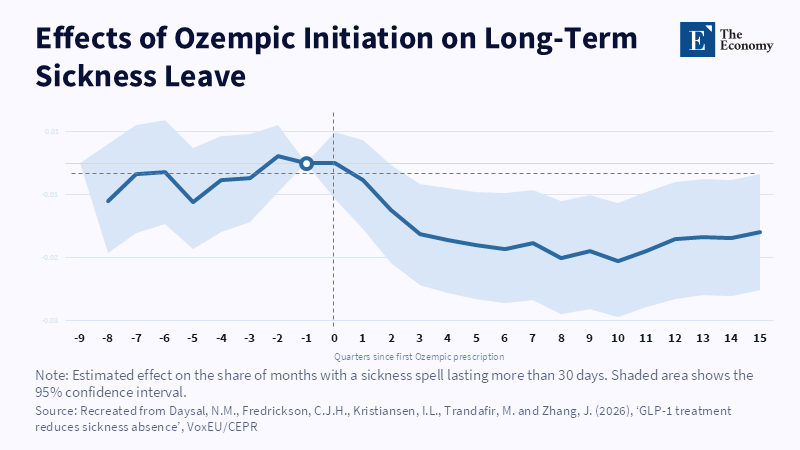
A 17.3 percent drop in long-term sickness absence makes the GLP-1 healthcare coverage debate harder to keep inside the pharmacy budget. In Danish register data, people who began Ozempic earlier had fewer long sickness spells over the next four years. They were compared with closely matched patients who started later. Employment and income barely moved.. It The clearer effect was fewer long absences from work, which matters to employers and municipalities.. That distinction matters. Public debate still treats drugs such as Ozempic, Wegovy and Mounjaro mainly as expensive medicines that help people lose weight. Their value is wider. They can affect cardiovascular risk, kidney disease, pain, food demand and work capacity. Public healthcare should therefore consider broader GLP-1 healthcare coverage. The case is strong, but it depends on strict pricing, clear clinical rules and support that helps patients stay healthy while they lose weight.
GLP-1 Healthcare Coverage Needs a Wider Ledger
Public funding looks more reasonable when the ledger includes illnesses that treatment may prevent or delay. In the SELECT trial, 17,604 adults with overweight or obesity, existing cardiovascular disease and no diabetes were followed for about 40 months. Major cardiovascular events occurred in 6.5 percent of those given semaglutide and 8.0 percent of those given placebo. That is a 20percent relative reduction, with an absolute difference of 1.5 percentage points. The FLOW trial studied people with type 2 diabetes and chronic kidney disease. Semaglutide cut the risk of a major kidney outcome or death from kidney or cardiovascular causes by 24 percent. These are outcomes that matter to public budgets because heart attacks, strokes and kidney failure create long treatment pathways. Preventing even part of that burden matters more to a health system than the weight figure alone.
Some of the value is less dramatic. People can move with less pain. In the 2024 STEP 9 trial, 407 adults with obesity and moderate-to-severe knee osteoarthritis were treated for 68 weeks. Those receiving semaglutide lost 13.7 percent of body weight on average, compared with 3.2 percent with placebo. Their knee pain scores also improved more and physical-function scores rose further. The trial supports a broader view of value rather than a replacement for standard osteoarthritis care. A narrow obesity budget can miss part of the return. Better mobility can affect independence, use of pain services, demand for joint care and the ability to keep working. Similar spillovers may appear across several weight-related conditions. A public payer does not need to assign a cash value to every one of them before acting. It does need to count them when comparing the cost of treatment with the cost of leaving severe obesity untreated.
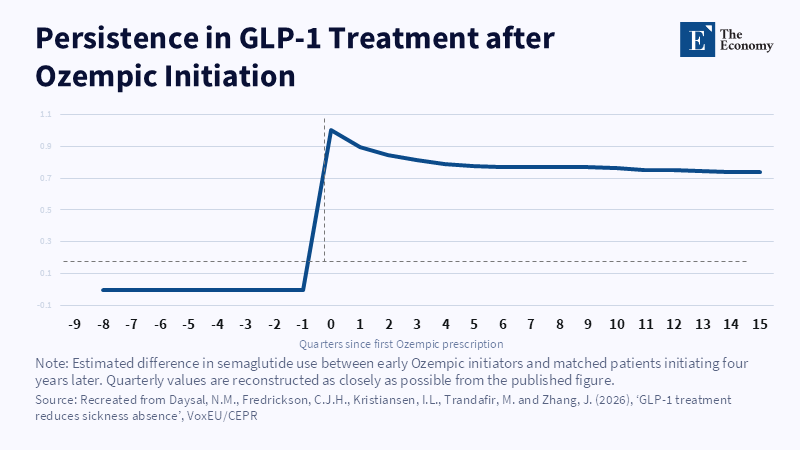
The labor effect points in the same direction, but it also sets a useful limit on the argument. The Danish study compared 7,011 early Ozempic users with 7,011 similar later users. Long-term sickness leave fell by 0.95 percentage points on average, equal to 17.3 percent of the pre-treatment level. The estimated saving was DKK 4,766 per employed treated person each year. Yet the researchers found no meaningful rise in employment, labor-force participation or income over four years. The sample was also heavily weighted toward people with diabetes; 84 percent had evidence of diabetes before treatment. The evidence does not yet support claims of ten or twenty extra working years.Public policy can rest on firmer ground: fewer long absences, lower cardiovascular risk and fewer serious complications already create a credible social return. The case for coverage is strong enough without stretching the evidence.
Public Funding Makes Sense Only If Price Falls
The main objection is cost. A good treatment can still be unaffordable at national scale.. That concern is real. A 2025 US cost-effectiveness analysis found larger lifetime health gains from semaglutide and tirzepatide than from older obesity drugs. Neither was cost-effective at the estimated net prices used in the model. At a threshold of $100,000 per quality-adjusted life-year, semaglutide needed an extra price cut of about 82 percent from its estimated net price. Tirzepatide needed a cut of about 31 percent. The same model projected fewer future cases of diabetes and cardiovascular disease. The estimated price simply overwhelmed much of that value. That is the central policy lesson for GLP-1 healthcare coverage. Public systems should not confuse a strong case for access with a weak case for accepting current prices. Public buyers have another advantage: they can attach conditions to coverage. It can require price reviews as rivals arrive and steer prescribing toward cheaper options when clinical differences are small.
A separate 2025 fiscal analysis reached a similar conclusion for Medicare. Under its base assumptions, about three million people would receive treatment over ten years. Drug spending was projected at $65.9 billion, while lower spending on obesity-related care would offset about $18.2 billion. Net public spending still rose by $47.7 billion. Those figures are modeled estimates, not a forecast that will unfold exactly as written and prices are already moving. Price cuts change the budget twice. They lower the cost per patient and let public systems treat more high-risk people without crowding out other care. The figures are still useful because they show why a broad subsidy needs purchasing power behind it. National health systems should use tendering, price negotiation, volume agreements and clear switching rules as the market becomes more crowded. Coverage should also target patients with the strongest expected health gains first, then widen as prices fall. Public funding can be justified without claiming that every prescription pays for itself. Many valuable health services do not. The test is whether the health gain is worth the net cost after a public buyer has used its full bargaining power.
Competition Can Change the Budget Equation
The fear of handing a permanent windfall to a few drugmakers now looks less convincing. It has not disappeared. Semaglutide patent protection expired in India in March 2026, opening a large market to generic competition. Other markets follow different timelines. Europe and the United States retain relevant protection for several more years, so 2026 is not a single worldwide patent cliff. Still, the direction of travel matters. Generic semaglutide in major emerging markets, new oral products, new dosing formats and rival molecules are putting pressure on a market that has been dominated by a small number of manufacturers. Public buyers should plan around that shift rather than lock themselves into long contracts that assume today’s market power will last. The timing matters because procurement rules written now may shape spending for years.
Price is only one part of the new competition. In the 2025 SURMOUNT-5 head-to-head trial, adults with obesity but no diabetes were treated for 72 weeks. Average weight loss was 20.2 percent with tirzepatide and 13.7 percent with semaglutide. New oral drugs could make treatment easier to manufacture, store and take. Multi-pathway drugs are also being developed to improve weight loss or target related metabolic problems. This matters for public procurement because the question will soon be wider than whether to cover one famous brand. Health systems will be choosing among several treatments with different prices, effects, side-effect profiles and delivery methods. That gives payers leverage. A sensible GLP-1 healthcare coverage policy should be designed to move patients toward the best-value option when evidence supports switching. Public procurement should make manufacturers compete for access to large patient populations.
The Lifestyle Effect Is Part of the Public Return
Some of the clearest changes are already visible outside clinics. Recent household purchase data show that food demand changes after treatment starts. In a large US consumer study, households with at least one GLP-1 user cut grocery spending by 5.3 percent within six months. Spending at fast-food chains, coffee shops and other limited-service restaurants fell by 8.0 percent. Savory snack spending fell by about 10 percent, while a small number of categories such as yogurt moved upward. These figures do not prove that every user adopts a healthier diet and household spending is not the same as nutrient intake. They do show that appetite treatment can change daily behavior at a scale large enough to affect retailers and food companies. That is one reason the social impact of these drugs feels larger than that of a normal prescription. They alter the setting in which health choices are made every day.
That shift creates a practical problem for health systems. Lower appetite can make it easier to reduce excess calories. It can also worsen poor nutrition if patients simply eat less of the same food. Rapid weight loss can include lean tissue and gastrointestinal side effects can drive people to stop treatment. Continued treatment matters because withdrawal studies show substantial weight regain. In SURMOUNT-4, participants lost about 20.9 percent of their weight during an initial 36 weeks on tirzepatide. Those switched to placebo then regained 14.0 percent from week 36 to week 88, while those who stayed on treatment lost another 5.5 percent. Public coverage should therefore include more than the medicine itself. Basic nutrition support, resistance exercise advice, follow-up and monitoring can protect the value of the drug and reduce avoidable harm. Public coverage should treat obesity as a chronic condition and support durable care rather than a short weight-loss episode.
A wider view also answers the fairness concern. If effective treatment remains largely private-pay, access will tend to follow the ability to pay. Wealthier patients will be better placed to buy long-term therapy, manage side effects and switch products when one drug does not suit them. People with fewer resources face a higher risk of delayed or interrupted access. That pattern matters when obesity and type 2 diabetes already produce large and unequal health burdens. Public coverage can narrow that gap, but only if eligibility is based on clinical need and treatment is monitored. It should not become an open-ended subsidy for cosmetic use. Priority should go to patients with obesity and major weight-related risk. That includes diabetes, cardiovascular disease, kidney disease and severe limits on daily function. Access can widen as supply expands and prices fall. This approach matches public money with the patients most likely to benefit while preserving room for wider coverage later.
The 17.3 percent fall in long sickness absence is useful because it shows what a narrow drug budget misses. GLP-1 treatment can reduce costs and risks that appear in other accounts, years after the prescription is written. The evidence is not strong enough to promise decades of extra work or to say the drugs will pay for themselves at current prices. It is strong enough to change the default policy question. Governments should stop treating today’s price as fixed. The better question is what price, eligibility rules and care package would make broad GLP-1 healthcare coverage good value. Competition is increasing. Health benefits are widening. Consumer behavior is already shifting. Public systems should use that moment to negotiate hard, cover patients with clear need and build the support needed for long-term treatment. Coverage rules should also be able to tighten or expand as evidence and prices change. Leaving access to the private market would mean many of those gains arrive late, or not at all.
This article reflects the analytical judgment of The Economy Editorial Board and does not constitute policy advice or the official position of any affiliated institution.
References
Aronne, L.J., Sattar, N., Horn, D.B., Kushner, R.F., Greenway, F.L., Khalid, U., Akinlade, B., Zhang, S., Bunck, M.C. and Ahmad, N.N. (2024) ‘Continued treatment with tirzepatide for maintenance of weight reduction in adults with obesity: The SURMOUNT-4 randomized clinical trial’, JAMA, 331(1), pp. 38–48.
Aronne, L.J., Bade Horn, D., le Roux, C.W., Ho, W., Falcon, B.L., Gomez Valderas, E., Das, S., Lee, C.J., Glass, L.C., Senyucel, C. and Dunn, J.P. (2025) ‘Tirzepatide as compared with semaglutide for the treatment of obesity’, New England Journal of Medicine, 393(1), pp. 26–36.
Bliddal, H., Bays, H., Czernichow, S., Uddén Hemmingsson, J., Hjelmesæth, J., Hoffmann Morville, T., Koroleva, A., Skov Neergaard, J., Vélez Sánchez, P., Wharton, S., Wizert, A. and Kristensen, L.E. (2024) ‘Once-weekly semaglutide in persons with obesity and knee osteoarthritis’, New England Journal of Medicine, 391(17), pp. 1573–1583.
Daysal, M., Fredrickson, C., Kristiansen, I.L., Trandafir, M. and Zhang, J. (2026) ‘GLP-1 treatment reduces sickness absence’, VoxEU, 6 August.
Griffin, O. (2026) ‘[GLP-1] Eating less, spending more on health: How obesity drugs are redrawing the consumer landscape’, The Economy, 5 June.
Hristakeva, S., Liaukonytė, J. and Feler, L. (2026) ‘The No-Hunger Games: How GLP-1 medication adoption is changing consumer food demand’, Journal of Marketing Research, 63(3).
Hwang, J.H., Laiteerapong, N., Huang, E.S. and Kim, D.D. (2025a) ‘Lifetime health effects and cost-effectiveness of tirzepatide and semaglutide in US adults’, JAMA Health Forum, 6(3), e245586.
Hwang, J.H., Laiteerapong, N., Huang, E.S., Mozaffarian, D., Fendrick, A.M. and Kim, D.D. (2025b) ‘Fiscal impact of expanded Medicare coverage for GLP-1 receptor agonists to treat obesity’, JAMA Health Forum, 6(4), e250905.
Keller, A. (2026) ‘Rewiring appetite: How multi-pathway obesity drugs redefine clinical and educational priorities’, Swiss Institute of Artificial Intelligence, February.
Lincoff, A.M., Brown-Frandsen, K., Colhoun, H.M., Deanfield, J., Emerson, S.S., Esbjerg, S., Hardt-Lindberg, S., Hovingh, G.K., Kahn, S.E., Kushner, R.F., Lingvay, I., Oral, T.K., Michelsen, M.M., Plutzky, J., Tornøe, C.W. and Ryan, D.H. (2023) ‘Semaglutide and cardiovascular outcomes in obesity without diabetes’, New England Journal of Medicine, 389(24), pp. 2221–2232.
Nicholson, A.-M. (2026) ‘[GLP-1] “2026 marks the first year of mass adoption for obesity drugs”: The obesity drug market shifts to pills as Big Pharma competition intensifies’, The Economy, 16 March.
Pearson, S.D., Whaley, C.M. and Emond, S.K. (2025) ‘Affordable access to GLP-1 obesity medications: Strategies to guide market action and policy solutions in the US’, Journal of Comparative Effectiveness Research, 14(9), e250083.
Perkovic, V., Tuttle, K.R., Rossing, P., Mahaffey, K.W., Mann, J.F.E., Bakris, G., Baeres, F.M.M., Idorn, T., Bosch-Traberg, H., Lausvig, N.L. and Pratley, R. (2024) ‘Effects of semaglutide on chronic kidney disease in patients with type 2 diabetes’, New England Journal of Medicine, 391(2), pp. 109–121.
Reddie & Grose (2026) ‘Changes in the Ozempic patent landscape’, 9 February.
Reuter, M. (2026a) ‘[GLP-1] “Obesity drugs redraw America’s consumption landscape”: Appetite-suppressed Americans cut dining out and shift toward nutrition management’, The Economy, 15 May.
Reuter, M. (2026b) ‘[GLP-1] The expanding reach of obesity drugs, reshaping industries and society beyond the dinner table’.
Sadam, R. and Tandon, K. (2026) ‘India’s Dr Reddy’s says semaglutide shipping disruption to last until at least late October’, Reuters, 9 July.
Working across research, policy, and data-driven analysis, the Editorial Board ensures that published pieces reflect a consistent institutional perspective grounded in quantitative reasoning and long-term structural assessment.