Automation and Labor Share: Why Jobs Can Disappear While Labor Income Holds Up

Working across research, policy, and data-driven analysis, the Editorial Board ensures that published pieces reflect a consistent institutional perspective grounded in quantitative reasoning and long-term structural assessment.
Authored On
Modified
Routine jobs can disappear while labor’s aggregate income share stays stable
AI may raise output while concentrating wages among fewer workers
Policy should track headcount, pay and productivity alongside labour share

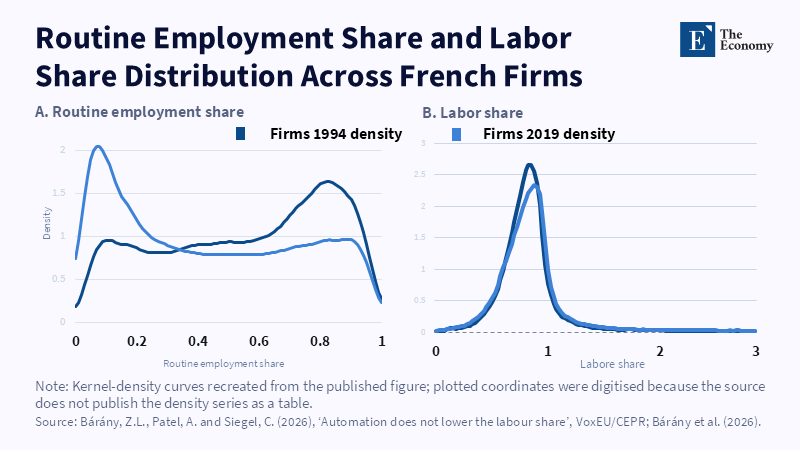
France offers a warning about one of the safest-looking measures in the automation debate. Between 1994 and 2019, the share of routine employment fell by 12.5 percentage points, while the aggregate labor share fell by only 2.6 points. At the median firm, routine employment dropped from roughly 60 percent of jobs to below 40 percent, yet the labor share barely moved. That finding weakens the simple claim that automation must push labor income down. It also leaves a more important question open. A stable labor share can hide a large change in who still receives wages. A firm can remove routine roles, raise output and pay a smaller group of engineers, managers, technicians, sales staff or expert operators much more. Total labor compensation may then hold up even as access to paid work narrows. As large language models raise output per worker, the right test for automation and labor share is therefore wider: how many workers receive the income, which workers receive it and how closely their pay follows the value they now produce.
Why Automation and Labor Share Can Move Together
Labor share is an aggregate ratio. It divides labor compensation by value added. That ratio says little about the number of people receiving the compensation. Consider a firm with €100 million in value added and a €60 million wage bill. Its labor share is 60 percent. Suppose automation lets the firm produce €150 million of value added with half as many workers. If the wage bill rises to €90 million, the labor share is still 60 percent. Average compensation per remaining worker has tripled. Half the jobs may have disappeared, yet the headline measure looks unchanged. If the wage bill rises above €90 million, the labor share rises. A higher labor share can therefore sit beside lower employment when the workers who remain are more productive, more specialized or better paid. The ratio can describe the split between labor and capital while missing a large shift inside labor itself.
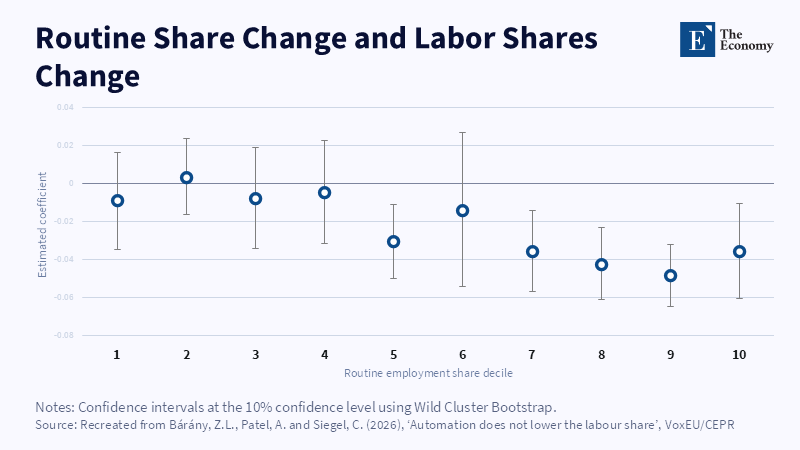
That distinction matters for the French evidence on automation and labor share. The fall in routine work is clear and broad. The lack of a matching fall in the labor share is also clear. Together, those facts reject a mechanical rule in which every reduction in routine employment must reduce labor compensation at the same rate. They do not show where the wage bill went. The missing decomposition is central. Did firms replace routine staff with roughly equal numbers of engineers, technicians and managers? Did they keep a much smaller workforce and raise pay for the workers who became more valuable? Did expanding firms increase output without rebuilding routine headcount? Each route can produce a similar labor-share result while creating a very different labor market. The aggregate ratio cannot separate them.
Evidence from robot adoption shows why that worker-level view is needed. A study of Dutch firms using employer-employee data found that robot adopters raised output by about 14.9 percent and hours worked by 4.3 percent. At the same time, their labor share fell by 4.6 percentage points relative to comparable firms. The gains were uneven inside the workforce. Workers in routine or replaceable roles faced weaker earnings and employment outcomes, while workers less directly exposed to replacement gained. The French pattern and the Dutch pattern are therefore less contradictory than they first appear. Automation can raise firm output, change the mix of jobs and redistribute pay across workers. The sign of the labor-share change depends on how those forces add up. A single firm-level ratio cannot tell policymakers which group paid the adjustment cost.
A Smaller Workforce Can Support a Larger Wage Bill
Productivity makes the arithmetic more important. France is a useful case because national productivity growth has been weak for years. OECD analysis found that growth in GDP per hour worked had trended down since 2000, with a particularly sharp slowdown in manufacturing. By the second quarter of 2023, productivity per capita was estimated to be 8.5 percentage points below its pre-pandemic trend. Eurostat also recorded only modest EU-wide labor productivity growth in 2024. These figures make one point clear: a stable national productivity trend does not rule out large productivity gains inside selected firms, teams or occupations. Aggregate figures mix fast and slow firms, expanding and shrinking sectors and workers with very different tasks.
Cross-country productivity gaps also need care. Faster productivity growth in parts of Central and Eastern Europe may reflect routine production moving across borders but it does not prove that French routine work was transferred east. Offshoring, automation, firm entry, sector mix, capital investment and catch-up growth can all move the same national indicators. The stronger claim needs matched evidence on occupations, firms and trade links. For the labor-share debate, that causal claim is not even required. A French firm can keep national productivity almost unchanged while a small set of highly productive firms or workers pull away from the average. Wage bills can become more concentrated even when the country-wide productivity line looks flat.
The real accounting question for automation and labor share is how much of the productivity gain reaches the remaining workers. Suppose a worker assisted by software can produce ten times as much value as before. If pay also rises tenfold, the labor share attached to that work can remain broadly stable, assuming other costs and prices do not change much. If pay only doubles while output rises tenfold, labor compensation per unit of value falls to one-fifth of its previous level. The firm captures most of the gain through profit, lower prices, investment or payments to other inputs. A third outcome is also possible. The firm may need far fewer workers, yet pay the retained group enough that the total wage bill stays flat or rises. In that case, labor share can look healthy while employment becomes thinner. The missing variable is the link between productivity per worker and compensation per worker.
LLMs Raise the Stakes for Automation and Labor Share
Early evidence from large language models already shows how fast that link can change, although current gains are far below the tenfold example. In a 2025 study of 5,172 customer-support agents, access to a generative AI assistant raised issues resolved per hour by 15 percent on average. The largest gains went to less experienced and lower-skilled workers. A separate experiment with professional writing tasks found that ChatGPT cut completion time by 40 percent and raised output quality by 18 percent. In a field experiment with 758 consultants, workers using GPT-4 completed 12.2 percent more tasks and worked 25.1 percent faster on tasks inside the model’s effective range. They also produced higher-quality work. These are large task-level gains. Whole-job productivity will usually rise by less because many tasks remain outside the model’s reach. An OECD modeling exercise in 2024 estimated that AI could add about 0.4 to 0.9 percentage points to annual labor-productivity growth over a ten-year horizon. That estimate is uncertain, yet it helps set the scale. The tenfold case is a stress test for distribution, not a description of the average workplace today.
The direction still matters. LLMs can turn one worker into the producer of more usable output in the same hour. That worker may be a senior specialist but early studies also show strong gains for less experienced staff. This complicates the idea that AI will create a small elite of “superhuman” workers. Some tools spread expert practices down the skill ladder. Yet the business response can still reduce labor demand. A firm that needs 100 people to process a given volume of work today may need fewer people after a 15 percent, 25 percent or 40 percent task-level gain, especially when demand for its product does not grow at the same speed. The productivity gain can help workers and still reduce the number of workers required.
New labor-market evidence makes that risk harder to dismiss. A 2025 Stanford working paper using payroll data found a relative employment decline among workers aged 22 to 25 in occupations with high AI exposure, after controlling for firm-level shocks. The decline was concentrated where AI use looked more automating than augmenting, while employment for more experienced workers was more stable. The estimates remain early and cannot settle the long-run effect of generative AI. They do, however, point toward the exact blind spot in the labor-share measure. Adjustment may appear first in hiring and headcount rather than in pay. If senior workers remain, use AI to produce more and keep or improve their compensation, a firm’s labor share could remain stable even while the entry route into that occupation shrinks.
There is another reason for caution. AI exposure can reduce demand for specific tasks while higher firm productivity raises demand elsewhere. Research using U.S. worker and firm data through 2023 finds both effects at once. More exposed tasks face weaker labor demand but productivity gains at adopting firms can partly offset the loss. Those offsetting effects temper forecasts of automatic mass unemployment. They also strengthen the case for better measurement. The same technology can replace one task, raise the value of another, increase firm output and change hiring at the same time. Automation and labor share will reflect the net result. Workers experience each component separately.
Policy Needs a Worker-Level Automation Scorecard
Policymakers should stop treating labor share as a sufficient test of whether automation is labor-friendly. It remains useful but it needs a worker-level scorecard beside it. Large-firm and industry data should connect labor share with headcount, total payroll, median pay, pay at different points of the wage distribution, value added per worker, hours worked and occupational mix. The most revealing comparison is simple: when value added per worker rises after automation, how much does compensation per worker rise and what happens to the number of workers? That pair of measures would expose the difference between broad productivity sharing and concentrated productivity sharing. It would also show whether a stable labor share rests on wider gains across the workforce or on higher pay for a shrinking set of retained workers.
The same approach should shape AI policy. Public support for AI adoption is often justified by productivity. Productivity alone cannot be the endpoint. Governments should also track whether adoption expands output through higher wages and new jobs or through a smaller workforce carrying a larger load. Firms receiving large public incentives for digital investment could report changes in payroll and employment by broad job family. Statistical agencies could publish labor-share data alongside wage concentration and employment changes within firms. Worker transition policy should also respond to the actual pattern. Where automation mainly raises productivity inside existing jobs, training can spread the gain. Where it removes entry-level or routine roles, wage insurance, stronger placement support and portable training rights become more important. Profit-sharing and collective wage-setting can also help keep compensation closer to productivity when bargaining power is weak.
The opening French numbers deserve to be read again with that wider lens. Routine employment fell by 12.5 percentage points while labor share fell by only 2.6. The result strongly challenges a simple theory in which automation automatically drains income from labor. It is weaker evidence about whether workers as a group were protected. A rising or stable labor share can be carried by fewer people earning much more. LLMs make that distinction more urgent because they can raise the output of the workers who remain while also changing how many workers a firm needs. The next generation of automation policy should therefore judge distribution with three linked questions: what happened to labor’s share, what happened to headcount and what happened to pay relative to productivity. Until those three move into the same dashboard a healthy labor share can still hide a labor market that is becoming narrower.
This article reflects the analytical judgment of The Economy Editorial Board and does not constitute policy advice or the official position of any affiliated institution.
References
Acemoglu, D., Koster, H.R.A. and Ozgen, C. (2023) ‘Robots and Workers: Evidence from the Netherlands’, NBER Working Paper No. 31009. Cambridge, MA: National Bureau of Economic Research.
Bárány, Z.L., Patel, A. and Siegel, C. (2026a) ‘Automation does not lower the labour share’, VoxEU, 5 August.
Bárány, Z.L., Patel, A. and Siegel, C. (2026b) ‘Does Automation Lower the Labor Share?’, CEPR Discussion Paper No. 21700. Paris and London: Centre for Economic Policy Research.
Brynjolfsson, E., Chandar, B. and Chen, R. (2025) ‘Canaries in the Coal Mine? Six Facts about the Recent Employment Effects of Artificial Intelligence’, Stanford Institute for Economic Policy Research Working Paper. Stanford, CA: Stanford University.
Brynjolfsson, E., Li, D. and Raymond, L. (2025) ‘Generative AI at Work’, The Quarterly Journal of Economics, 140(2), pp. 889–942.
Corselli-Nordblad, L. (2025) ‘Productivity trends using key national accounts indicators’, Eurostat Statistics Explained. Luxembourg: European Commission.
Dell’Acqua, F., McFowland III, E., Mollick, E., Lifshitz-Assaf, H., Kellogg, K.C., Rajendran, S., Krayer, L., Candelon, F. and Lakhani, K.R. (2023) ‘Navigating the Jagged Technological Frontier: Field Experimental Evidence of the Effects of Artificial Intelligence on Knowledge Worker Productivity and Quality’, Harvard Business School Working Paper No. 24-013. Boston, MA: Harvard Business School.
Filippucci, F., Gal, P. and Schief, M. (2024) ‘Miracle or Myth? Assessing the Macroeconomic Productivity Gains from Artificial Intelligence’, OECD Artificial Intelligence Papers, No. 29. Paris: OECD Publishing.
Hampole, M., Papanikolaou, D., Schmidt, L.D.W. and Seegmiller, B. (2025) ‘Artificial Intelligence and the Labor Market’, NBER Working Paper No. 33509. Cambridge, MA: National Bureau of Economic Research.
Noy, S. and Zhang, W. (2023) ‘Experimental evidence on the productivity effects of generative artificial intelligence’, Science, 381(6654), pp. 187–192.
OECD (2026) OECD Insights on Productivity: France. Paris: OECD Publishing.
Pluyaud, B. and Kergozou, N. (2024) ‘Boosting productivity growth and employment’, in OECD Economic Surveys: France 2024. Paris: OECD Publishing.
Working across research, policy, and data-driven analysis, the Editorial Board ensures that published pieces reflect a consistent institutional perspective grounded in quantitative reasoning and long-term structural assessment.