Immigration Inflation Was the Wrong Fear

Working across research, policy, and data-driven analysis, the Editorial Board ensures that published pieces reflect a consistent institutional perspective grounded in quantitative reasoning and long-term structural assessment.
Authored On
Modified
Immigration inflation was far smaller than the politics around it
Poor new arrivals added limited private demand but meaningful labor supply
The smarter policy is faster legal work, wage protection, and local fiscal support

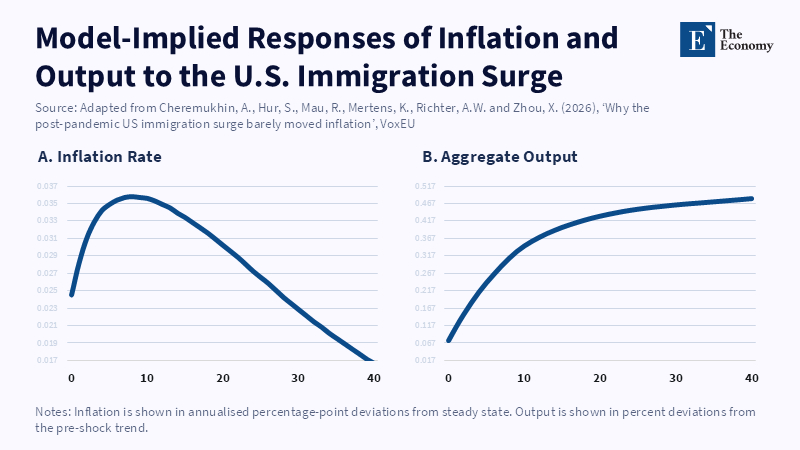
The most significant figure in the immigration debate in the post-pandemic world is slightly too tiny to hold the politics it pushes, the equivalent of about one basis point a year. That is roughly how modest a contribution to inflation is projected to be made by immigration growth in one of the main budget projections in the coming ten years. A basis point is 0.01 percent. It is a margin of error compared to the price shock Americans experienced post-2021. The lesson is not that immigration has no economic cost. It is that immigration inflation was the wrong fear. An influx of people does put a demand increase into the system. But demand itself is more than the phrase 'headcount.' It's the income, the savings, the credit, the work permits, the rent contracts and the time it takes the new families to reach normal markets. It is the employment that they add before their purchases have overwhelmed the marketplace."
Immigration inflation needs a better demand test
The path of adjustment in the face of large inflows is shaped by limits to the ability of immigrant arrivals to generate demand. The basic economics of the simple story-an increase in demand without an offsetting increase in supply puts upward pressure on prices-is not wrong, but it is incomplete. The pertinent question is not just how many arrived, but the degree to which they were able to generate private demand at first. A good fraction of the recent Latin and Caribbean inflows had relatively little cushion, weak access to credit, uncertainty about de jure status, minimal prior earnings to support consumption; their initial spending was concentrated on essentials and sustained by source-country remittances, informal and government aid and informal networks of support and transportation, rather than on expansive retail consumption.
Therefore, the migration inflation was not like the crude "double consumers, fixed supply" model. Head-to-mouth households impacted the relative prices of nondurable consumer goods and places with high inflows experienced some added burden on public infrastructure and housing. However, private "demand" is materially different from broad demand. Hand-to-mouth households do not create the additional savings, mortgage, auto loan and other durable goods that push broad inflation higher. Meanwhile, the national price index did not "see" the public element at all. An influx that increased shelter and public service burden could still only have a limited impact on household prices and therefore on the CPI. It is the distinction between the fact that a large migration flow increases fiscal burdens but may not easily create inflation.
The mix of the immigration surge is as important as the size of the surge. 2023 saw an all-time high in undocumented immigrants with substantial upward shifts from South America, Central America and the Caribbean. However, many of these numbers are asylum seekers, parolees, or persons with temporary and tenuous protection. That status affects economic behavior, postponing normal employment, restricting access to formal credit, encouraging caution among families and sometimes forcing people into overcrowded housing or the informal economy. These facts flatten demand impact in the straightforward model that otherwise might apply. A high-skilled migrant with savings, a job contract and fast access to credit nudges the demand for housing, vehicles and investment goods. Poorer migrants waiting for work permission have a different overall economic path.
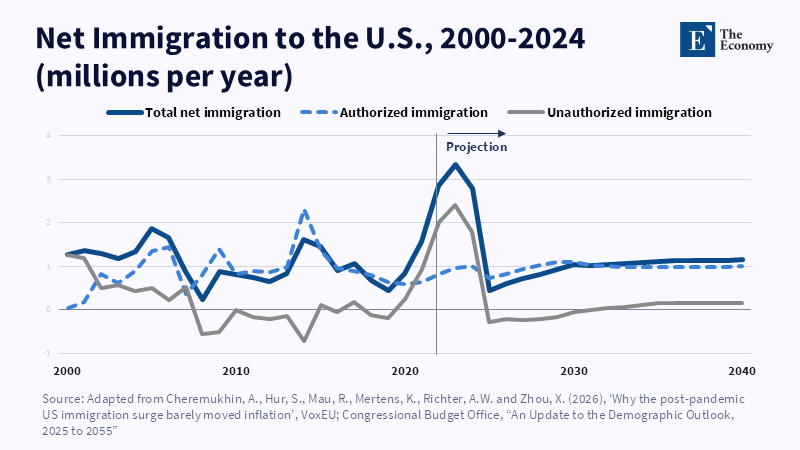
Timing matters as well. An influx of high-income workers can push up prices well before the supply has responded. An inflow of lower-income workers may take considerably longer -- e.g., months of government and office delay -- before production and demand for services peak. During such a lag, governments and local public providers take up much of the extra local burden. Once work begins, the wage/price and supply response dominate. For these reasons, immigration can be inflationary in some local markets, neutrally priced in the national average and even reduce costs for other service industries. A sensible test for immigration pressure on prices isn't, after all, more people mean there must be an increase in demand. It is whether the newly arriving population provides enough private purchasing power, quickly enough, to compensate for the additional workers and output they require.
The wage channel could have kept prices low
The second half of the story is even more relevant for policy. Immigration-induced inflation may have been subdued not simply because migrants ate so little, but also because they increased supply precisely in those sectors where shortages have been part of what has driven up prices in the first place. Food services, construction, cleaning, home care, farming, manufacturing, warehousing and the hotel and restaurant trade-these are not just marginally related to the cost of retail, but also constitute the core of the price of everyday life. These industries depend to a large extent on immigrant labor. When their employers are able to fill shifts, build residential units, process fresh food and keep restaurants solvent, the economy gains supply- and that supply does not appear in a narrative about inflation; it appears as a narrower gap in the beginning of projects, a less delayed schedule, a less costly distribution channel and a less urgent necessity to increase wages simply to hold basic businesses afloat.
This is not to say that immigrants are "beating" inflation by expanding labor supply a reading that would be both naive and dangerous. An alternative and more accurate way of stating the facts is to say that changes in the availability of labor exert a downward pressure on prices. When there is a shortage of labor, employers tend to pay higher wages, produce less, wait to deliver their services and increase their prices to the consumer. While some wage growth is much needed, in particular for workers on the lowest pay, a propensity for wage growth induced by, among other things, a key shortage of workers (by comparison with output per worker), can turn into a threat of inflation. Data on the size and composition of the recent growth of the labor force from official sources suggest that the contributions of foreign-born workers to employment growth is heavily concentrated in service, construction, maintenance, production, transportation and material moving jobs, characteristically labor-intensive jobs which are highly responsive to price signals and where additional employment might hold a key in avoiding a supply constraint from developing into a symptom of inflation.
The impact is not constant. A relatively unskilled immigrant workforce could potentially push back the wages of certain cohorts of similarly skilled workers in the near term. That risk should not be dismissed. On the other hand, the same employees could increase demand for a host of jobs that include but go far beyond "employee": supervisors, artisans, shippers, retailers and more. Consider the construction crew: it does not employ only laborers. It employs, among other things, electrical engineers, deliverymen, project managers, suppliers, inspectors and desk attendants, all of whom are affected by a lean or hefty crew. Removing that labor can also weaken linked jobs It is for just this reason that the claim that removing labor from a given industry automatically benefits natives is too restrictive a statement of the facts-people are "housed" in many industries.
The policy conclusion is straightforward. If the dampening effect of immigration on inflation occurred because increased labor supply held down costs of production, then bringing down work approvals can cause price rises. Several recent studies of more restrictive immigration policies point in this direction. Re-allocating labor from agriculture, construction, hospitality and manufacturing to other economic activities can push up producer prices while contracting output. One estimate illustrates how policies that cut work permits, sends away thousands of immigrants and bring down legal permissions can increase the annual cost of living for many thousands of dollar by the end of the decade. The figures rest on many assumptions but the mere example makes a convincing point. A country cannot send millions of workers away from sectors with high labor input and not expect prices to rise as a result of decreased consumer demand. It is the supply that can drop more quickly than the demand.
The local strains are real but not identical to inflation
A heavy national inflation cannot hide from a serious argument. The fact that immigration inflation was small doesn't convert the boom into a breeze for cities, schools, hospitals, shelters, or the local taxpayer. Poor movement directed costs into public and charity institutions first and only afterward laid a block on private income. That is why mayors, local managers and service agencies can still face real strain if the national heading index hardly moves. A shelter bed, a school seat, a clinic visit, a backlogged court case and a welfare food case are not some broad macro statistic. They are just budgets. And they are not all arriving simultaneously. One model ignores the other: a national inflation index says the effect was small, whereas a city agency reports a big service turbulence; both are right.
This distinction is important for teachers and employers. Economics teachers should teach this episode as a mixed case-a real-world example, not a simple battle between good and bad slogans about immigration. The demand curve did not disappear. It was undermined by destitution, administrative hurdles and low consumption possibilities. The supply curve did not leap out of its old limits. It moved out where migrants can work and where employers can employ their labor. However, that does not make immigration training policy. It makes labor-market integration a price policy.
For policymakers, the key task is to disentangle three issues that too often seem to be conflated. The first one is border management. Who arrives, via what route and under which legal framework? The second question is about fiscal capacity. Which governments pick up the tab for shelter, schooling, health services and legal processing where arrivals are concentrated? The third question concerns the economy-wide inflationary impact. Do new arrivals exert more than a neutral pressure on demand relative to supply? A large inflow may be disruptive at the border, an added burden for local resources and still be close to zero for national inflation Good policy needs to enable this trilogy of facts.
The most obvious critic would be to say that this is, in effect, a justification for a broken system. It isn't. A channel for labor that reduces downward price pressure isn't a reason to accept more chaos, exploitation and weeks or months of legal limbo. In fact, the legal chaos reduces the supply effect that helped contain price pressure in the first place to help with the immigration inflation. If people are unable to work, unable to move, or afraid of public agencies, their economic unit is effectively closed. They will still have to be supported, but will be less able to generate value, be less useful to the community and that is a dire situation for public budgets. Accelerated case processing, legal work permit processing, intelligent compensation rules and improved local resource allocation are not technocratic luxuries for the benefit of policy – they are the underlying system that allows labor to be a fiscal no-brainer rather than a crisis.
Improved policy question: What occurs if the laborers depart?
But the greatest test of the immigration inflation story is not the entry of poor migrants, it is the departure of existing workers who have long been brought into the economy. Removing workers via deportation or from their work permits strips not just consumers, but workers and incomes, taxes, output and family glue as well. For an economy packed with millions of workers in food, construction, care, hospitality, transport and manufacturing, such a supply-side shock could do exactly what inflation theorists say rising demand does-push prices up. It could also cut employment for Americans by shutting down those very sectors. This is why the "if you take people away, prices go down" mantra is ultimately so weak; it examines demand alone. It neglects supply.
Recent labor market statistics already highlight the danger. Immigrants comprise roughly one-fifth of the nonmilitary workforce; in fact, the labor participation rate among foreign-born personnel is higher than the native-born one, especially in the case of men. They still had lower median hourly earnings than native-born. A substantial reduction of foreign-born labor would therefore affect supply before it ever achieved steady relief to prices. Native workers with the mean level of skills will have occupied some vacancies.
The policy response should not be to wield immigration as an anti-wage cudgel. A rational policy responds to labor market distortions by safeguarding wages and protecting supply. Means of doing so include: faster work visa administration, sector-focused job sorting programs, intensive enforcement to prevent wage theft, portable legal status and local funding associated with actual arrivals. A rational policy includes: adult language, safety and credential programs that help workers break into higher-labor-output jobs. Cut back the period of public-support dependence, increase legal employment and end the use of legal vulnerability to force down bottom-line wages, less inflationary than wholesale exclusion and a truer description of the economy the United States already has.
The post-pandemic lesson, then, is even sharper than the typical site of immigration discussion. It was not that poor migrants created the great inflation. Their own private demand was too weak and too delayed. Yet at the margin, their cheap labor held down wages and supply-side push that was further raising the value of daily services. Immigration inflation was modest because the two effects offset one another. Demand rose, but not as much as the population size implied, while supply increased above the level needed to fill jobs. The danger at present is to learn the wrong lesson. If a nation views its immigrants as only consumers, it will over-emphasize the inflation potential; if it regards them only as underpaid groups of workers, it will tolerate the abuse. The best approach is the harder one: border control, local injection of coming pressures, work permits to allow immigrant labor to work and a wages-first focus. This is how regulated labor-market integration turn into a threshold of worker supply rather than a tide of rising prices.
The views expressed in this article are those of the author(s) and do not necessarily reflect the official position of The Economy or its affiliates.
References
Andara, K. and Estep, S. (2026) ‘Immigrants Make the Labor Market Great’, Center for American Progress, 6 March.
Brookings Institution should be cited under the authors: Edelberg, W., Veuger, S. and Watson, T. (2026) ‘Macroeconomic Implications of Immigration Flows in 2025 and 2026: January 2026 Update’, Brookings Institution, 13 January.
Bureau of Labor Statistics (2026) Foreign-Born Workers: Labor Force Characteristics — 2025. Washington, DC: U.S. Department of Labor, 19 May.
Cheremukhin, A., Hur, S., Mau, R., Mertens, K., Richter, A.W. and Zhou, X. (2024) The Postpandemic U.S. Immigration Surge: New Facts and Inflationary Implications. Federal Reserve Bank of Dallas Working Paper No. 2407.
Cheremukhin, A., Hur, S., Mau, R., Mertens, K., Richter, A.W. and Zhou, X. (2026) ‘Why the post-pandemic US immigration surge barely moved inflation’, VoxEU, Centre for Economic Policy Research, 3 June.
Congressional Budget Office (2024) Effects of the Immigration Surge on the Federal Budget and the Economy. Washington, DC: Congressional Budget Office, July.
Congressional Budget Office (2025) An Update to the Demographic Outlook, 2025 to 2055. Washington, DC: Congressional Budget Office, 10 September.
Crumley, B. (2026) ‘Trump’s Immigration Crackdown Has Cost the U.S. Economy 668,000 Jobs, Studies Show’, Inc., June.
FWD.us Research Team (2026) ‘New Immigration Policies Will Increase Prices for Americans’, FWD.us, 20 May.
Passel, J.S. and Krogstad, J.M. (2025) U.S. Unauthorized Immigrant Population Reached a Record 14 Million in 2023. Washington, DC: Pew Research Center, 21 August.
Payan, T. and Rodríguez-Sánchez, J.I. (2025) ‘Social and Economic Effects of Expanded Deportation Measures’, Rice University’s Baker Institute for Public Policy, 26 March.
Working across research, policy, and data-driven analysis, the Editorial Board ensures that published pieces reflect a consistent institutional perspective grounded in quantitative reasoning and long-term structural assessment.