Power Writes the Rules of the Great-Power Order

Working across research, policy, and data-driven analysis, the Editorial Board ensures that published pieces reflect a consistent institutional perspective grounded in quantitative reasoning and long-term structural assessment.
Authored On
Modified
Great powers built the old order, and they are now rewriting it
Middle powers can stabilize rules, but they cannot enforce them alone
The new global order will be shaped by leverage, not nostalgia
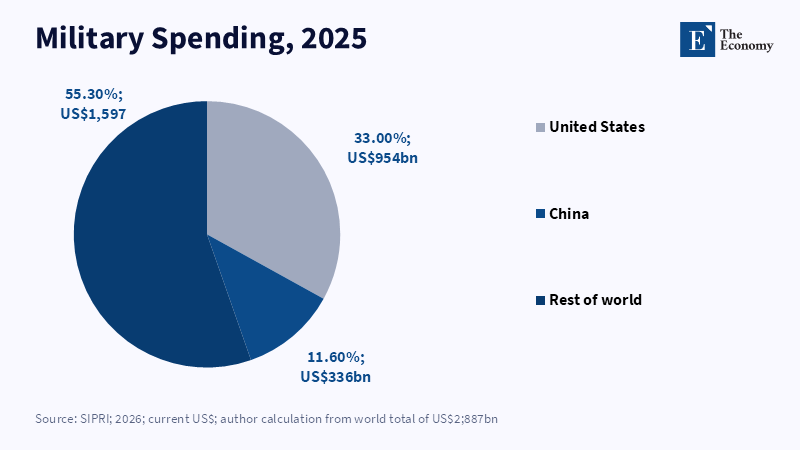
Meanwhile, the United States and China, by far the world's two biggest industrial economies, together spent about $1.29 trillion on military budgets in 2025. This represented nearly 45 percent of global military spending. This is the stark reality behind the new order among the world's great powers. All else being equal, rules matter. Institutions matter. Middle powers matter. All this is true. But rules do not bring themselves into existence and great powers do not create and sustain institutions that exist from themselves alone. They do so from their ability to pay, to arm, to veto, to punish, to subsidize and to defend-and they do so from their willingness. The old order did not crumble because diplomats and policymakers stopped cooperating; it eroded because the world's two dominant powers stopped sharing enough of the same set of goals in order to share the same rulebook. The proper question is not whether middle powers will initiate a recovery of the old order, but to what extent the order can be refounded when the great powers that caused the upheaval now interpret this system as a battleground rather than as a shared legacy.
The Great-Power Order Was Never Neutral
The post-1945 system is often called a rules system. This is true, but not enough. The rules system was constructed in the aftermath of war by the states that had won the war, commanded the biggest armies, held the most substantial financial resources and sat in the center of security. International organizations appeared universal, but the Security Council insisted that a veto on decisions rested permanently with five states. The Bretton Woods system appeared technical, yet it depended on the financial power of one state. The free trading system appears liberal but was built within a security order led by one state. This does not make the system illegitimate. It makes it historical. The system was an alliance of power, legitimacy, markets and law. However, the system was never separate from the power to defend it.
A similar pattern can be observed further in the past. The Concert of Europe was not created because states collectively agreed on everything and balanced fairly. It was created by the dominant anti-Napoleonic powers, especially Britain, Austria, Russia and Prussia, which later co-opted France. Formations of great powers often set the rules after each establishes a new world order; other states are only able to reshape, counteract, or directly rely on it. Middle powers might have a say in the design when big countries usually need their authority, skills, financial resources, or regional assistance. However, they rarely write the initial draft. That should make the modern world order of today more predictable. The traditional great power system was not a no-hierarchy era but a system of hierarchy, which one could find beneficial and whose inequality became easier to accept because the system delivered benefits.
The Great-Power Order Now Has Two Rulebooks
This is not just an ordinary dispute within the old order. It is a power struggle over the right to structure the order. China has not merely joined existing institutions and respected their constraints; it has wielded state finance, industrial policy, market scale, export power and military hard power to change the terms of competition. OECD data on industrial subsidies explains why this is no trivial technical matter. In 2024, subsidy flows in 15 strategically vital industrial sectors peaked at $108 billion - the highest level seen since the global financial crisis. Chinese companies gained far more from it than companies elsewhere and around 60% of their expansion in global market share can be attributed to subsidies. It's not just a dispute about trade; it's power sailing through firms, prices, ports and supply chains.
The US has responded in kind, just in a different way. Tariffs, export restrictions, industrial supports, sanctions, investment checks and alliance tech protocols are now at the core of American strategy. The WTO’s most-favored-nation principle has already lost ground. In 2025, the share of global trade under WTO treatment fell from close to 80% to 72%. That isn't a collapse, but it is a stark warning. The old legally binding rule book is still there, but the major powers are constraining themselves to exceptions. The order of great powers is becoming less like a constitution and more akin to a dynamic contest of readiness to keep the costs of rule-breaking to a minimum. Law remains, but it is no longer used to rule on the whole playing field. Instead, the playing field is determined by circumstance, timing and how much you can absorb retaliation.
Middle Powers Cannot Enforce the Great-Power Order Alone
The middle-power case hits on one weakness. Middle powers are able to coordinate, but are unable to coerce the US or China at scale: Japan and the Republic of Korea are powerful states with large economies and significant military capability of their own. In 2024, Japan allocated US$55.3 billion for defense, South Korea US$ 47.6 billion, still a tiny share of less than 8 percent of the combined Chinese and American military budget of that year. Their importance in regional balance is immense; they cannot force the two dominant powers to forge a global settlement. The same is true in diplomacy: they can set terms and demand cooperation, apply pressure and shape outcomes, but cannot challenge a longtime permanent member, or pressure the superpower into accepting an International Court of Justice ruling when a core interest hangs in the balance.
Economic weight tells the same story. According to the World Bank for the year 2024, the United States' current GDP was calculated at $28.8 trillion and China's at $18.7 trillion. They combined to create a bigger economy than that of the European Union and vastly surpassed any coalition of middle powers in Asia. Middle powers can deny legitimacy, delay arrangements, add diversity to supply chains and form coalitions on the basis of standards, to name but a few. They can lift the costs of coercion and 'fundamentally alter the calculus of coercion. However, they cannot force a great power to comply with a rule it no longer abides by. With no enforcement of the rule, it is reduced to a preference, which, if shared by many states, does not automatically entail order without the backing of power. This does not mean that middle powers are weak. It only indicates that the scope of their strength is a much narrower one.
Their best recipe is then not heroic reconstruction but disciplined damage-limitation. A coalition of middle powers can harden supply chains, bankroll collective stocks, establish reliable data standards and keep communication lines open when the great powers lose contact with each other. It can also preclude small states from being starved out one by one. And these are not trivial achievements; they are modest achievements. In a more brutal great-power sequence of events, modest achievements may be the difference between managed competition and open coercion. But the mistake is to mistake that stabilizing function for a system command. Middle powers can keep parts of the house standing. They can slow down the fire, create exits and preserve useful tools. They cannot restore the foundations even as the majority owners hold the title.
The Great-Power Order Is Moving From Law to Leverage
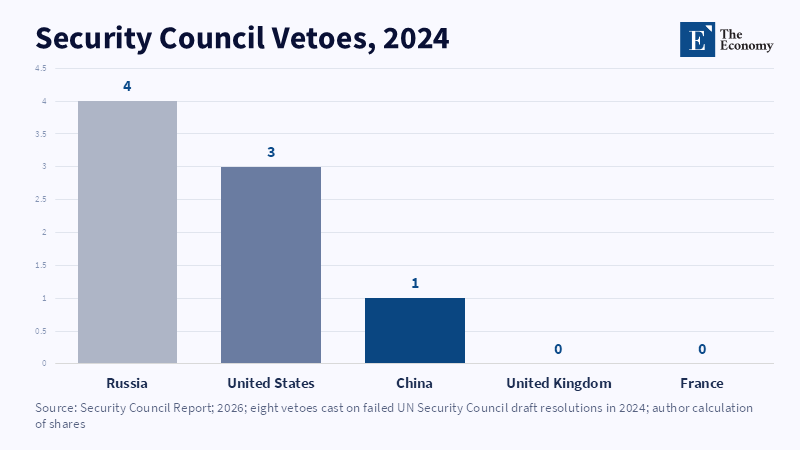
The change is also apparent in trade, security, technology and finance. The proposed solution for trade disputes held that conflicts should be transferred from the realm of politics into law, but this route proved too fragile. The threat of cumulative trade policy uncertainty and reciprocal tariffs may cause the value of world merchandise trade to fall, as warned by the WTO in 2025. The pattern is similar in security. Whereas the Security Council can still authorize action when great-power interests align, the veto halts the process when they conflict. In 2024, eight vetoes were cast on failed draft resolutions, with Russia, the United States and China all exercising the right. This is not an accident in the design. It is the design at its most uncompromising. The powerful states remained within the system that offered them a safe exit.
This is not the death of international law. It is just the death of international law that works well where the biggest players are not really hostile to each other. But that is a smaller field. Climate finance, debt forgiveness, critical minerals, sanctions, shipping lanes, AI chips and export controls are all moving into spaces where law and leverage flow together. The policy impact of this is more partial orders in the world. There will still be a dollar order, a China-connected production order, a sanctions order, a climate-club order and several regional security orders. Some will intersect; others will compete. The old great-power order gave everyone one main avenue; the new order will resemble a chart of guarded corridors: access depends on alliances, risk and bargaining power.
What the Great-Power Order Requires Now
Step one is to stop treating restoration as a strategy. Restoring the old order will require one of three things: a new American supremacy, Chinese acceptance of constraints it perceives as unfair, or an actual accommodation between Washington and Beijing. None is visible now. A more achievable goal is guarded competition. That would involve fewer broad promises and tougher bargaining. The need is to establish benchmarks for military engagement, crisis hotlines, transparency of debt and finance, limited criteria for subsidization and red lines on cyber warfare, maritime traffic and key infrastructure. Those are modest targets. They are also more achievable than sweeping promises to restore the entire system. A narrow but credible safeguard is better than a sweeping but flawed rule in the first crisis. This is not a threat to order. It is a first step toward a survivable order.
Middle powers do have a critical role, but it must be carefully defined. They can no longer be system builders in the old way but must be system stabilizers, investing in issue-based coalitions where the great powers need partners, not just moral suasion. They must also build in resilience to the shocks at home-ports, energy, military-industrial base, digital infrastructure, research base and supply chain transparency. Policy schools and public-administration programs should be clear-it is the great-power bargain that's critical, not the rules machine. Policymakers are not likely to be loyal to old language, but to the rule-preserving capability that such language embodies under even more difficult power conditions.
The biggest criticisms of this are that it sounds fatalistic. If the great powers sculpt the system, then the middle powers may seem corralled. But that critique gets it backward. Fatalism says nothing can be done. Realism says states should act at the right scale. In moments of great-power stress, middle powers preserved trade openness, propelled climate negotiations, underwrote development finance and kept regional talks alive. Those actions are in play when the problem is focused. Fisheries subsidies can be negotiated. Semiconductor supply chains can be diversified. Debt terms can be better. Maritime behavior can be upheld. They are serious accomplishments. They are actually doing the work of order in a fragmented world. The aim is not to supplant the great powers. It is to prevent their rivalry from monopolizing all shared rules.
The far more subtle peril is nostalgia. The old system came about because, in the past, power and rules were close enough in substance to seem natural. That unity has been lost. China is too strong for a quiet absorption into a framework it did not want to create. The United States is too reluctant to hold on to rules it conceives to be strong enough to benefit not only itself but its main rival for hegemony. Middle powers are too vulnerable to choose total neutrality, yet too small to govern the new order alone. The new order will not be achieved by nostalgic pleading. It can be established by realistic self-restraint, by real diplomatic pressure, by purposeful cooperation and by forthright teaching about power. The task now is clear: protect the existing rules, revise and redefine those that no longer automatically serve and end the illusion that nostalgia is how order comes about.
The views expressed in this article are those of the author(s) and do not necessarily reflect the official position of The Economy or its affiliates.
References
Gilpin, R. (1981) War and Change in World Politics. Cambridge: Cambridge University Press.
Ikenberry, G.J. (2011) Liberal Leviathan: The Origins, Crisis, and Transformation of the American World Order. Princeton: Princeton University Press.
Kennedy, P. (1987) The Rise and Fall of the Great Powers. New York: Random House.
Kissinger, H. (1957) A World Restored: Metternich, Castlereagh and the Problems of Peace, 1812–22. Boston: Houghton Mifflin.
Le Poidevin, O. and Farge, E. (2025) ‘Tariffs cause “unprecedented” disruption to global trade rules, WTO chief says’, Reuters, 2 September.
Liang, X., Tian, N., Lopes da Silva, D., Scarazzato, L., Karim, Z.A. and Guiberteau Ricard, J. (2025) Trends in World Military Expenditure, 2024. Stockholm: Stockholm International Peace Research Institute.
Liang, X., Tian, N., Lopes da Silva, D., Scarazzato, L., Karim, Z.A. and Guiberteau Ricard, J. (2026) Trends in World Military Expenditure, 2025. Stockholm: Stockholm International Peace Research Institute.
Mazower, M. (2012) Governing the World: The History of an Idea. New York: Penguin Press.
Mearsheimer, J.J. (2014) The Tragedy of Great Power Politics. Updated edn. New York: W.W. Norton.
OECD (2026) OECD MAGIC Database of Industrial Subsidies. Paris: OECD Publishing.
Schroeder, P.W. (1994) The Transformation of European Politics 1763–1848. Oxford: Clarendon Press.
Security Council Report (2026) Living with the Veto. New York: Security Council Report.
Tiberghien, Y. (2026) ‘How to rebuild what the great powers broke’, East Asia Forum, 2 June.
World Bank (2025) World Development Indicators. Washington, DC: World Bank.
World Trade Organization (2025) Global Trade Outlook and Statistics: April 2025. Geneva: WTO.
Working across research, policy, and data-driven analysis, the Editorial Board ensures that published pieces reflect a consistent institutional perspective grounded in quantitative reasoning and long-term structural assessment.