US Asia Trust Is Now a Test of Power

Working across research, policy, and data-driven analysis, the Editorial Board ensures that published pieces reflect a consistent institutional perspective grounded in quantitative reasoning and long-term structural assessment.
Authored On
Modified
US-Asia trust is weakening
AUKUS has exposed a delivery gap
Asian powers are building options
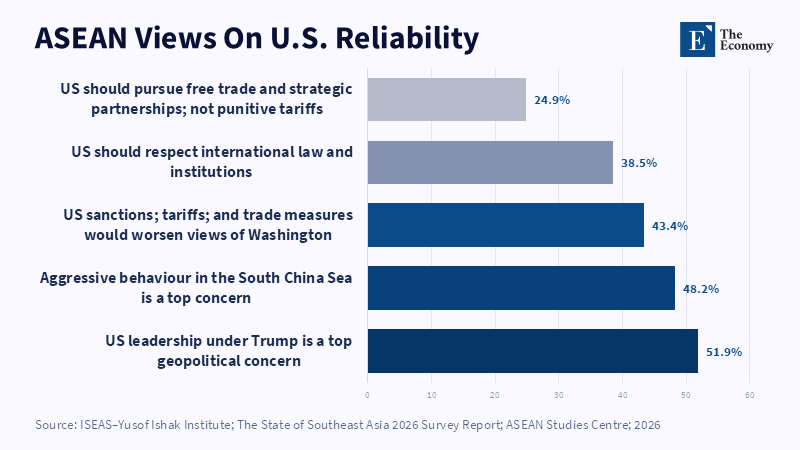
The most revealing number in Asia this year is not a ship count or a tariff rate, or even a defense budget. It's 51.9 percent. That is the share of Southeast Asian policy elites who identified U.S. leadership under Donald Trump as a primary geopolitical concern, slightly ahead of aggressive behavior in the South China Sea. That's the key message. The U.S. Asia policy reputation is no longer just determined by treaty readings and the number of aircraft carriers. It's now being tested on whether Washington can maintain its actions, bear the associated costs and provide what it promises. Can a country remain one of the world's most prosperous, armed and showy despite losing the trust that makes its influence work? That's what loss in Asia now spells out. Partners are not leaving the US. They've calculated the potential risk of the U.S. being late, reneging, or demanding a penalty at the moment of need.
Why U.S. Asia Trust Has Become a Capacity Test
The old debate pondered whether Asian states would line up with Washington or with Beijing. That bit of framing is too limited. The more pressing question is whether the United States can continue to turn power into trust. U.S. - Asian trust depends upon simultaneous political credibility (partners must be able to assume that an American security commitment is a completed agreement, not an open-ended contract readjusted with every American electoral cycle) and material power (any commitment has to be instantiated in ports, shipyards, munitions, parts-flows and budgets). Both of these are weakening at once and the longer they do so, the more rapidly trust fades, while treaty, exercise and conduct can follow. The doubt remains and begins to lead administrations, ministries and agencies to do their crisis planning.
All this is why the day-to-day now seems more serious than a typical argument about burden sharing. Asian friends have seen tough deals before. They have seen U.S. elections that have ups and downs in style and substance. What is different is the combination of transactional politics and palpable delivery deficit. Tariffs are a clear sign to friends that market access can be bargained as a constituent part of the deal. Base-cost pressure tells them that protection can be priced as a service. AUKUS speaks to them that even the most important defense projects may encounter hard industrial limits. Collectively, these sorts of messages mean that U.S. - Asian trust ceases to be merely a diplomatic feeling and becomes a certainty of planning. Governments now face a question not just of whether Washington wants to lead, but whether it can.
The trouble with the base issue is that it alters the narrative that allies present to their own publics. U.S. bases in Japan, South Korea, Australia and the Philippines are not symbiotic. They assist Washington in projecting force, collecting intelligence and providing quick responses along the first island chain. When suddenly asked to pay a little more, or more humbling still, to pay at all, their patron/client relationship is de-familiarized. The public case for the alliance has less to say about shared security and more to explain about rent, rates and (persuasion) pressure. This speaks to the growth of US-Asia trust as it is a variable dependent on alliance legitimacy, not just political strategy. A leader may be willing to sign an arrangement for burden sharing, but the public's forbearance, in the eyes of the partner, will erode over time if the latter is seen less as guarantor and more as landlord.
Tariffs Turn Allies Into Risk Managers
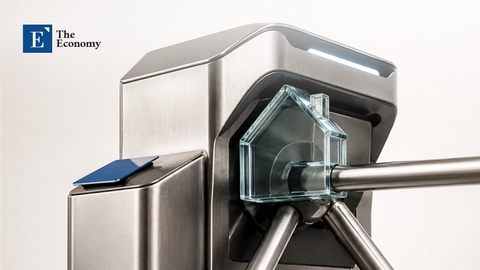
The tariff shock did most of this early damage for the simple reason that by targeting allies where trust is easiest to gauge- trade-it struck at the very foundation of the alliance. Japan and South Korea are not distant economies outside the U.S. order. They host large U.S. military presences, buy U.S. arms and sit near the core theatres of any Indo–Pacific showdown. In 2025, however, both faced daunting threats of punitive tariffs. Taiwan, the Philippines, Thailand, Vietnam, Cambodia, Laos, Malaysia and other countries encountered intense pressure as well. The message was straightforward. Alliance value did not imply economic refuge. The strategic relevance did not mean an exemption. For many Asian ambassadors, this undermined longstanding beliefs that Washington spared special compassion for states that bore frontline risks in an alliance-oriented crisis.
This is important because the Asian strategy is a function of its mixed dependence. Many states have both U.S. security relations and heavy dependence on Chinese demand, Chinese supply chains, or Chinese investment. That role has always been awkward but acceptable when the U.S. was treated as a stable security anchor and reliable economic actor. When Washington imposes tariffs on friends, they cut back their exposure. Some will seek additional trade with China as it continues to be proximate, large and difficult to substitute. Others will deepen their relations with India, Japan, South Korea, the Gulf, Australia and Europe. Still others may preserve narrow links to Russia, where energy, arms, or food security makes it useful. This is not treason; it is risk management. U.S. - Asian trust diminishes when allies believe that loyalty does not necessarily reduce uncertainty.
The most obvious is that tariffs are transitory and security treaties are durable. That is only partly right. Markets can adapt more rapidly than alliances, but the political memory is slow. The 2026 South East Asia survey found that 43.4 percent of those respondents whose outlook on Washington was expected to worsen cited U.S. sanctions, tariffs and other trade instruments as the primary reason these would serve to lower their outlook.38.5 percent of the respondents preferred that the United States respect the laws of international institutions; 24.9 percent of respondents preferred free trade and strategic partnerships rather than punitive tariffs. These aren't theoretical preferences. They are requests for predictable reliability. To Asian governments, reliability isn't earned by forcing them to pick sides; it's earned by making the U.S. side less expensive to stand close to.
AUKUS Makes Capacity Visible
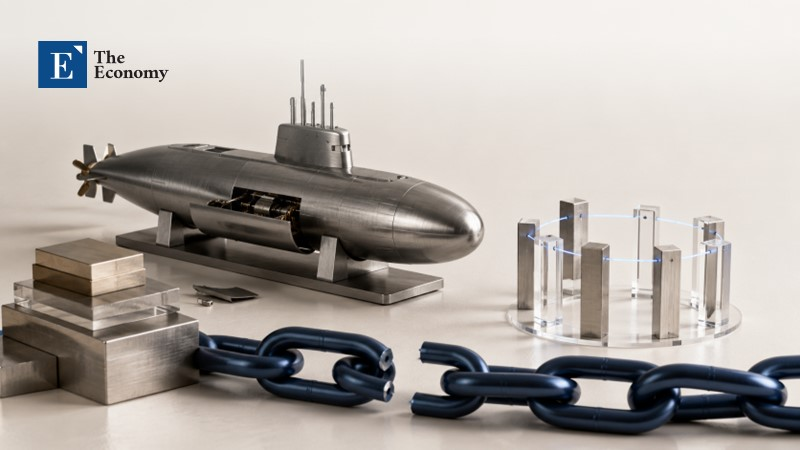
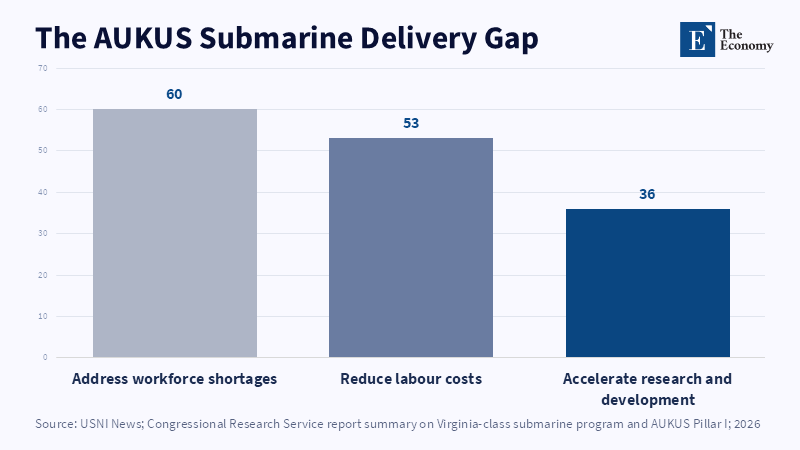
AUKUS has demonstrated the second challenge: delivery. The submarine was supposed to demonstrate that the U.S.-UK-Australia partnership could produce a more powerful deterrent in the western Pacific than a regional nuclear buildup alone would sustain. Instead, it is demonstrating the industrial pressures of delivering such new arrangements. Between building Virginia-class submarines for the U.S. Navy and the AUKUS provision of boats to Australia, U.S. Shipyards have been delivering about 1.1-1.2 boats per year since 2022 - far short of the target two-per-year level for U.S. Needs alone and nowhere close to the 2.33 boats per year needed for the AUKUS pathway itself. Since then, Australia has moved to secondhand boats rather than the earlier expectation of a mix including at least one new submarine. This reassessment could deliver cost savings, but it would also shift the political implications of the deal.
The problem is not that AUKUS has failed in a single, limited technical sense. The problem is that this deal raises a broader question. If the United States cannot deliver and deploy a critical defense agreement for Australia, one of its most strategic and trusted allies, what should a Taiwan or Philippine leader expect during a rapid crisis response? Taiwan does not have the benefit of decades of post-industrial recovery as a hedge. The Philippines is under Chinese pressure every day in the South China Sea and is looking for credible assurance in the event of a crisis test. Australia has money, time and capacity. Taiwan and the Philippines do not. This is why AUKUS now defines US-Asia confidence beyond Canberra. It raises the question whether American deterrence is a stock of real capabilities or a set of long-promised contracts reaching too many target theaters.
Another fair counterargument. Production is a pain point everywhere. Nuclear submarines are among the most complicated machines ever built. Delays alone do not signal decay. They also do not give China free rein to take risks. The United States still has unparalleled submarine experience, satellite intelligence, strategic ports and extensive alliances. But confidence is not based on perfection. Confidence is based on demand in the next crisis. If promises continue to outpace production, regional allies will hedge. Japan will increase its investments. South Korea will bolster its industry. Australia will seek alternative options. India will maintain strategic independence. ASEAN will free itself from U.S. dependence in the plan. When viewed in this light, AUKUS strain is not only about submarines but about the limits of American reach.
Regional Security Will Not Wait for Washington
The answer is not is a neat Asian pivot to China. That would oversimplify it. Southeast Asian elites are still split. Given a forced choice, 52.0 percent of the sample chose China and 48.0 percent chose the United States. Confidence in the United States as a strategic partner and provider of regional security still outstripped distrust, with 42.7 percent expressing confidence or strong confidence and 32.3 percent expressing little or no confidence. Japan remained the most trusted major power among ASEAN respondents. These figures reveal a more difficult truth: The region is not substituting China for the United States; it is enhancing its options because no single power can meet all Asia’s needs. U.S. - Asian trust is slipping, but trust in China, whilst growing, is still not strong enough to be a complete alternative. This is occurring at the same time that military expenditures in Asia and Oceania increased by 8.1 percent in 2025, indicating that action is increasingly becoming substantive rather than simply rhetorical.
This creates more room for Asian middle powers. Japan, South Korea, Australia, India and the leading ASEAN states are already thinking more outside their old hub-and-spoke boxes. Their cooperation will not resemble an Asian version of NATO. The region is too heterogeneous, too trade-oriented, too suspicious of rigid alliances. It will look much more pragmatic. Defense technology deals, coast guard cooperation, joint production, cyber-security links, supply-chain financing, clubs of access to critical minerals, missile-defense arrangements and an array of other minilateral exercises. Some of this will include the U.S., some will not. This change of tack is nuanced and subtle, but definitely critical. The U.S. will still remain at the center of the regional ordering system, but it will no longer be a solo agent.
This also makes the administrators and officials who manage economic security in traditional economic security-trade, technology and the military, more than ever, need to stop treating trade, technology and defense as seperate files. The same doubt will now keep company in all three. A tariff risk can stymie security confidence. A shipyard delay can affect trade choices. A thoughtless public demand for higher host-nation payments can cut access to bases. State, Treasury and other U.S. agencies need deeper and more integrated planning at the regional level, not just more speeches about defense. The U.S. does, too. If one agency pleads to allies for preparations for a China crisis while another cuts its exports, the alliance's credibility shatters. U.S. Asian confidence will not recover until economic policies and security policies no longer undermine one another, publicly and secretly.
For Washington's policy-makers, the message is clear: trust needs to be restored. It cannot be rebuilt by delivering the rhetoric of leadership while your allies are seen as tariff victims, cost-centers or late payers. America needs fewer words and more follow-through. That means predictable market access to treaty allies. It means defense industrial programs that deliver on alliance commitments. It means munitions, ship repair and logistics capacity that can be moved to crisis locations. It also means acknowledging regional sovereignty. Asians don't want a patron who relies on pressuring them one week and sends them an invoice the next. They want one whose strength makes their choices more, rather than less, secure and whose demands do not undermine the coalition they rely on to protect them in a crisis.
The first statistic should thus be read as a warning, not a verdict. The US-Asia trust has not failed. It has become conditional. The U.S. remains a superpower by count, connection and reach. But in Asia, superpower merit is becoming trust by poise in the storm. If Washington fails to safeguard supporters from its own economic coercion and cannot muster the material particulars behind its security remarks, the area will adjust pre-emptively. The United States may still remain central to the Asian order may still be a center. But it is not a provision that the power of individual nations is built into. It is the provision by those who travel, weigh claims and uphold bargains when a crisis begins, not after it has already passed.
The views expressed in this article are those of the author(s) and do not necessarily reflect the official position of The Economy or its affiliates.
References
Aamer, F. and Chanlett-Avery, E. (2026) ‘Seeking Agency in Uncertainty: Asian Middle Powers and the Fragmenting Global Order’, Asia Society Policy Institute, 2 April.
Liang, X., Tian, N., Lopes da Silva, D., Scarazzato, L., Karim, Z.A. and Guiberteau Ricard, J. (2026) Trends in World Military Expenditure, 2025. Stockholm: Stockholm International Peace Research Institute.
Lin, J. (2026) ‘When US Leadership Loses Its Sheen’, Fulcrum, 8 April.
Lin, J., Martinus, M., Fong, K., Pham Thi Phuong Thao, Aridati, I.Z. and Gauri, S. (2026) The State of Southeast Asia: 2026 Survey Report. Singapore: ISEAS–Yusof Ishak Institute.
Mason, J., Meijer, B.H. and Brunnstrom, D. (2025) ‘Japan, South Korea Face 25% Tariffs as Trump Ramps Up Trade War in Letters to 14 Nations’, Reuters, 7 July.
McIlroy, T. and Doherty, B. (2026) ‘Major AUKUS Switch to Buy Only Secondhand Subs from US Means “Significant” Cost Savings, Marles Says’, The Guardian, 31 May.
McIlroy, T. and Doherty, B. (2026) ‘“Not the Deal Promised”: Labor’s Ed Husic Questions AUKUS Pact That Will Deliver Secondhand Subs’, The Guardian, 2 June.
Quéru, A. (2026) ‘Washington Pays the Price for Losing Asia’s Trust’, East Asia Forum, 2 June.
The Jakarta Post (2026) ‘Andong’s Alliance: When Tokyo and Seoul Defy Beijing’, The Jakarta Post, 30 May.
Tricontinental: Institute for Social Research (2026) East Asia’s Double Bind: Contradictions and Possibilities in the New Cold War. Dossier no. 101. Buenos Aires: Tricontinental Institute for Social Research.
U.S. Naval Institute Staff (2026) ‘Report to Congress on the Virginia-Class Submarine Program and AUKUS Pillar I’, USNI News, 27 January.
Working across research, policy, and data-driven analysis, the Editorial Board ensures that published pieces reflect a consistent institutional perspective grounded in quantitative reasoning and long-term structural assessment.