“Revenue Later, Costs Now”: Oracle’s Aggressive AI Infrastructure Bet Brings Financial, Credit, and Collateral Pressure

Authored On
Modified
Oracle required to provide substantial collateral for Wisconsin data center power infrastructure
Heavy upfront cloud investment placing growing pressure on cash flow and creditworthiness
Rising US opposition to data centers threatening to delay Oracle’s path to profitability

US software company Oracle may be required to provide billions of dollars in collateral for a hyperscale artificial intelligence data center under construction in Wisconsin. The company’s financial burden and credit risk have risen sharply as it relies on extensive borrowing and capital expenditure to secure an early position in the AI infrastructure market, prompting local regulators to establish clearly who would bear the cost if the project failed.
Market observers warn that Oracle’s exposure to this form of “upfront investment risk” could increase further as opposition to data center development spreads across the United States and threatens to delay the commercialization of the capacity the company is racing to build.
Oracle’s Data Center Project Encounters Obstacles
The Financial Times reported on July 21 that the Wisconsin Public Service Commission had upheld a We Energies rule requiring Oracle to provide approximately $7 billion in collateral. The decision concerns a planned 1-gigawatt data center in Port Washington, Wisconsin, which is expected to serve as a key facility for fulfilling Oracle’s $300 billion computing-capacity agreement with OpenAI.
We Energies requires large electricity consumers with an S&P Global credit rating below A- to provide cash or letters of credit covering the cost of constructing the power plants and transmission infrastructure needed to serve them. The requirement is intended to prevent ordinary residential electricity customers from being forced to absorb grid-development costs generated by the recent AI data center boom and to protect the utility against the possibility that a facility could later become a stranded asset. A stranded asset is an investment whose economic value falls sharply because of changing market conditions, technological developments, or tighter regulation, forcing it to be abandoned or written down before the end of its expected useful life.
Oracle held an S&P credit rating of BBB when the rule was introduced, and its rating has since been downgraded further to BBB-, the lowest level within the investment-grade category. Because Oracle does not satisfy the credit threshold established by We Energies, the company filed a legal challenge arguing that the requirement would discourage investment and job creation. The Wisconsin Public Service Commission rejected that argument by allowing the rule to remain in force. Oracle may consequently have to deposit substantial collateral while incurring more than $100 million in additional annual financing costs. The company has said it will continue its legal challenge while offering financial guarantees intended to ensure that Wisconsin residents do not ultimately bear the project’s costs.
Oracle’s Cloud Infrastructure Gamble
Oracle’s declining credit rating reflects the extent to which its recent aggressive investment strategy has returned as a source of financial pressure. The company has raised large amounts of external capital to fulfill major cloud agreements signed with AI businesses, including corporate bond offerings of $18 billion in September 2025 and $25 billion in February 2026. Oracle historically generated relatively stable cash flow through enterprise software licenses and maintenance services, but it is now restructuring its business around AI infrastructure, a sector that requires enormous investment before meaningful revenue can be realized. The initial cost burden associated with that transition has become increasingly visible.
AI infrastructure providers must secure graphics processing units, power connections, cooling systems, high-speed networks, and other essential equipment in advance if they wish to establish an early position in the market. Conventional cloud businesses can often expand server capacity gradually in response to customer demand, but hyperscale AI infrastructure requires operators to commit large amounts of capital before utilization and revenue reach sufficient levels. Interest expenses, depreciation, rent, and operating costs therefore begin accumulating long before the facilities generate their expected returns.
Oracle’s fiscal year 2026 results illustrate the risks created by this timing mismatch. The company reported total revenue of $67.4 billion and cloud revenue of $34 billion, both higher than a year earlier, while operating cash flow remained comparatively strong at $32 billion. The problem was that capital expenditure substantially exceeded the cash generated through ordinary operations. Oracle’s fiscal year 2026 capital spending rose by approximately 163% to $55.7 billion from $21.2 billion the previous year, pushing free cash flow to a deficit of $23.7 billion.
Oracle’s credit-risk indicators have deteriorated alongside this trend. Bloomberg reported on July 20, citing data from Intercontinental Exchange, that the spread on Oracle’s five-year credit default swaps had risen to 203 basis points. A credit default swap is a derivative that compensates an investor for losses if a bond issuer defaults or fails to meet its debt obligations, and its price generally rises as the perceived probability of default increases. The risk premium on Oracle’s corporate bonds has also widened. According to transaction data from the Financial Industry Regulatory Authority’s TRACE system, the spread between Oracle bonds maturing in 2056 and comparable US Treasury securities reached 263 basis points on the same day. Investors were therefore demanding a yield 2.63 percentage points higher than the return available on US government debt of a similar maturity.
Clouds Gather Over the US Data Center Market
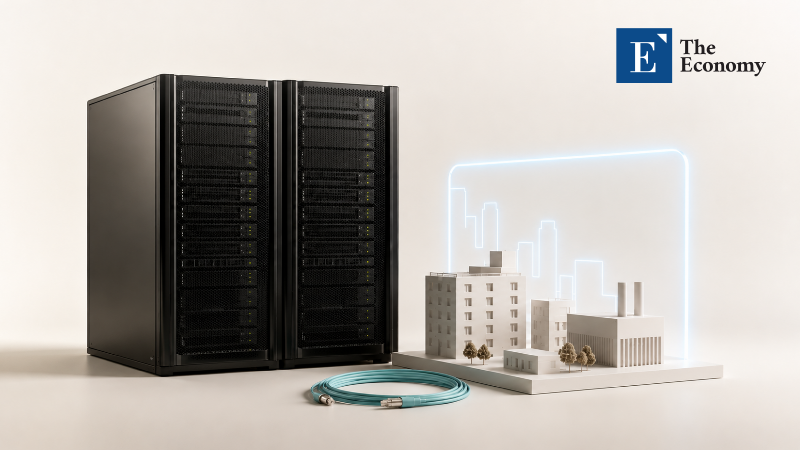
Market observers warn that Oracle’s upfront investment exposure could intensify as negative public sentiment toward new data center construction spreads across the United States. Much of the opposition is being driven by a local “not in my backyard,” or NIMBY, response. According to a Gallup survey conducted in May, 71% of Americans said they would somewhat or strongly oppose the construction of a data center near their home. Data Center Watch estimated that at least 75 US data center projects were suspended or delayed because of resident opposition during the first quarter of 2026, representing approximately $130 billion in planned investment.
The resistance reflects the burden that large data centers can place on local infrastructure and living conditions. Hyperscale facilities consume enormous amounts of electricity continuously, creating a risk that they will reduce the reliability of nearby power supplies and increase electricity bills for other customers. Cooling servers can also require substantial volumes of water, while residents frequently express concern about broader environmental disruption. Cooling equipment, ventilation fans, transformers, and backup generators may operate around the clock and generate persistent noise. Testing and operating diesel or gas generators during outages can release nitrogen oxides, particulate matter, and other air pollutants, while the development of large sites may result in the destruction of farmland and green space.
Opposition has recently expanded beyond local residents, with state governments beginning to impose direct restrictions. New York Governor Kathy Hochul signed an executive order on July 14 suspending the construction of new large data centers in the state for one year. In a video posted on X, formerly Twitter, Hochul said that the scale and speed of data center development were placing unprecedented pressure on electricity and water resources and risked increasing utility costs for New York residents. She argued that safeguards were needed before the burden became more severe. Under the order, applications for new data centers with capacity of at least 50 megawatts will be suspended for one year, while permit reviews already underway will also be temporarily halted. Existing operational data centers are excluded from the restriction.
For Oracle, this growing regulatory and political resistance creates a risk that infrastructure spending will continue to occur well before the corresponding revenue becomes available. The company has already borrowed heavily, expanded capital expenditure, weakened its free cash flow, and accepted greater credit-market scrutiny in anticipation of future AI demand. If power constraints, collateral requirements, permit delays, and community opposition prevent new facilities from opening on schedule or operating at full capacity, the interval between expenditure and revenue could lengthen further. Oracle’s attempt to secure an early advantage in AI infrastructure could therefore become a test of whether even a large and established software company can withstand the financial strain of building capacity years before its ultimate profitability is assured.
Similar Post