“Power Supply Cannot Keep Up”: US AI Data Center Expansion Hits Limits as Construction Delays and Local Restrictions Intensify

Authored On
Modified
US electricity market increasingly strained by surging data center demand
State and local governments moving to block or delay new facilities
Data center projects stalling before construction or remaining idle after completion

The US electricity market is confronting a serious imbalance between supply and demand. As power consumption from artificial intelligence data centers rises rapidly, the expansion of generation, transmission, and distribution infrastructure has failed to keep pace, making the threat of electricity shortages increasingly visible. The growing strain is disrupting corporate plans to construct and operate new data centers, while state and local governments are accelerating regulatory measures intended to limit additional facilities and protect residents from rising electricity costs, water consumption, and infrastructure burdens.
US Power Grid Approaches Its Limits
Citing a Bank of America report, US energy and power-grid publication Utility Dive reported on July 17 that the country could face an electricity shortfall exceeding 100 gigawatts between 2026 and 2030. US electricity demand is expected to grow at an average annual rate of 4.1% over the period, requiring approximately 230GW of new generation capacity. Of that amount, an estimated 125GW would be associated with the expansion of data center infrastructure. Despite the explosive increase in consumption, Bank of America concluded that US utilities would be able to secure only about 93GW of practical additional supply capacity, leaving a substantial gap between projected demand and the power actually available to the market.
Other institutions and companies have issued similar warnings. According to a recent Korea Electric Power Corporation Management Research Institute report titled “The Impact of Rapid US AI Data Center Growth and Response Strategies,” American data center electricity demand is expected to reach 426 terawatt-hours by 2030, nearly double the 2025 level. The report concluded that US power infrastructure is failing to expand at a sufficient pace because shortages of transformers, cables, and other essential equipment are combining with a lack of skilled workers and declining public acceptance of new transmission projects. These constraints have intensified grid bottlenecks throughout the country. Only about 20% of US generation projects that apply for grid connection ultimately proceed to commercial operation, illustrating the difficulty of converting planned capacity into power that can actually be delivered.
Calvin Butler, chief executive of Exelon, the largest US electricity utility, recently warned that some parts of the country could experience actual blackouts as early as 2027 because the spread of AI is worsening shortages of generation capacity in the Northeast and Midwest. Butler said the grid had come close during the previous winter to a situation in which electricity supply would have had to be restricted for approximately 400,000 customers. He also indicated that electricity-rate increases would be unavoidable if utilities were to absorb both the rapid growth in demand and the cost of building the necessary infrastructure. Data center-related price pressure is already visible in several regions. In the capacity market operated by PJM, the regional transmission organization serving 13 eastern and Midwestern states and Washington, DC, prices increased by approximately 833%, from $28.92 per megawatt-day for the 2024–2025 delivery year to $269.92 for 2025–2026.
State and Local Restrictions Spread
As the limitations of the electricity grid become more apparent, state and local governments across the United States are increasingly moving to block additional data center construction. On July 14, New York Governor Kathy Hochul signed an executive order suspending the construction of new large-scale data centers in the state for one year. In a video posted on X, formerly Twitter, Hochul said the scale and speed of data center development were placing unprecedented pressure on electricity and water resources and risked increasing utility bills for New York residents. She argued that safeguards had to be established before the burden became more severe. Under the order, applications for new data centers with capacity exceeding 50MW will be suspended for one year, while permit reviews already in progress will also be temporarily halted. Existing operational facilities are not subject to the restriction.
Local governments that directly control land use and access to electricity and water are also strengthening their own restrictions. The Seattle City Council in Washington state passed an emergency ordinance in June suspending applications for large new data centers for one year, while the Spokane City Council introduced a similar moratorium immediately halting the receipt, review, and approval of new construction permits. County-level restrictions have spread particularly widely in Indiana, where at least 17 counties had temporarily suspended data center development during the first half of 2026. Marshall County and Cass County adopted especially restrictive measures that effectively prohibit new facilities.
Development restrictions have also begun to emerge in Texas, one of the country’s largest data center markets. The San Marcos City Council amended its land-use rules in June to prohibit new data center construction in all zoning districts, choosing a permanent planning restriction rather than a temporary permitting pause. In Florida, meanwhile, local authorities have increasingly blocked individual hyperscale projects during the review process. On July 15, the Palm Beach County Commission rejected by a vote of five to one a proposal to transform the Central Park Commerce Center industrial and logistics development into a large AI data center complex under a plan known as Project Tango. Commissioners cited the project’s enormous electricity and water requirements, its burden on local infrastructure, and its proximity to residential neighborhoods and schools. More than 20 other Florida municipalities have reportedly rejected, delayed, or prolonged reviews of data center proposals.
Construction Disruptions Continue
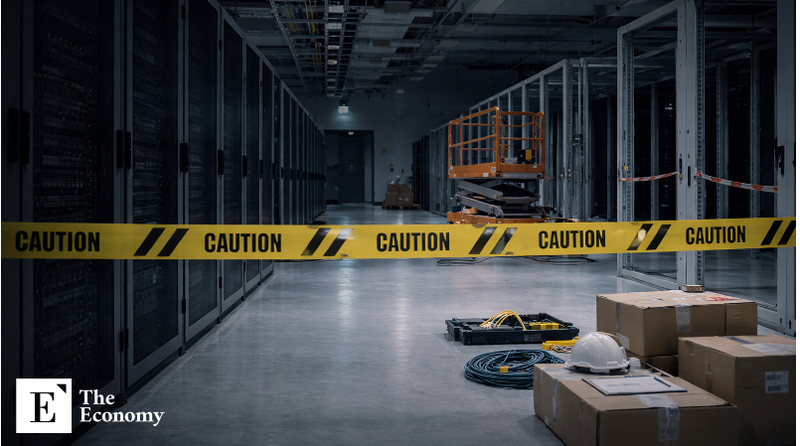
Disruption is also spreading across active and planned construction sites. According to The Wall Street Journal, citing an analysis by JPMorgan, more than 60% of the US hyperscale data center power capacity scheduled for completion in 2027 has yet to begin construction. Approximately 7% of planned capacity has already experienced completion delays, while some finished facilities have been unable to start operating because the surrounding grid cannot provide sufficient power. In Santa Clara, California, a 430,000-square-foot data center developed by Digital Realty since 2019 and a separate 48MW facility operated by Stack Infrastructure remain idle even after construction was completed. Expansion of the transmission and distribution network managed by local utility Silicon Valley Power has fallen behind schedule, and the required grid upgrades are not expected to be completed until 2028. The developers therefore face the prospect of earning no rental revenue for several years despite having invested hundreds of millions of dollars in completed buildings.
Strong community opposition has become another major project risk. Climate and energy publication Heatmap estimated that at least 20 US data center plans were canceled during the first quarter of 2026 after encountering local resistance. Data Center Watch, which tracks opposition to such developments, calculated that at least 75 projects were canceled, blocked, or delayed during the same period because of community objections. In March, the borough of Archbald, Pennsylvania, unanimously rejected the zoning application for Project Scott, a proposed large data center campus, after considering the costs that the development would impose on the local community. The developer of the New Hill Digital Campus in North Carolina also withdrew its plan amid resident opposition and increasingly strict scrutiny from local authorities.
With the expansion of US AI infrastructure facing increasingly serious constraints, major technology companies are attempting to secure electricity directly in order to reduce project delays and limit the burden imposed on local communities. Microsoft has agreed to purchase power for 20 years from the previously closed Three Mile Island nuclear facility, while Amazon signed a 1.9GW power purchase agreement with Talen Energy. Google is working with Kairos Power to obtain as much as 500MW of electricity from small modular reactors by 2035. Meta has also signed agreements with companies including Vistra and Oklo to secure as much as 6.6GW of nuclear power. These arrangements indicate that access to electricity is becoming as important as chips, models, and data in determining how quickly the next phase of AI infrastructure can be built.
Similar Post