Frontier Compute, Export Controls, and Strategic Substitution in U.S.–China AI Competition
Published
The Economy Research Editorial*
*The Economy Research, 71 Lower Baggot Street, Dublin 2, Co. Dublin, D02 P593, Ireland

The debate over U.S. restrictions on exports of advanced AI chips to China has been portrayed as a choice between commercial openness and technological containment. This article argues that this framing overlooks the strategic significance of frontier computing capacity. While China’s position in model performance, research output, patenting and indigenous accelerator manufacturing has strengthened substantially, the United States still retains a major advantage in advanced computing, high-bandwidth memory, chip design tools, hyperscale investment and allied manufacturing networks. Lifting restrictions on frontier US chips broadly would thus endanger one of the limited remaining technological constraints on Chinese strategic progress. At the same time, the article opposes indiscriminate technological decoupling. Export controls can be costly for U.S. firms, pushing Chinese firms toward substitution, increasing incentives for smuggling and complicating relations with key partners. Thus, export restrictions must be narrowly tailored, predictable, enforceable and establish a conditional link between their use and explicitly identified national-security goals. The most likely outcome will not be renewed technological integration, but a partially bifurcated AI order with rival hardware ecosystems, standards, supply chains and tools of economic coercion. To keep the U.S. in the top echelon of global technological innovation, export controls will have to do much more than impose a golden cage, relying also on domestic innovation capacity, investment in research and development, manufacturing, skills and continued allied coordination.
1. Introduction - Frontier Compute as the Central Strategic Chokepoint
The strongest argument for easing U.S. frontier-chip restrictions on China now rests less on optimism than on resignation. A recent Brookings article argues that the commercial competition in China is over for most U.S.-based AI chipmakers, that Beijing itself no longer sees U.S. providers as reliable and therefore that Washington should steer clear of further steps that would disconnect U.S. companies from the rest of the world while trying to contain China technologically.[1] Nvidia's own recent guidance would seem to support this view: the company stated that it would not include China data-center compute revenue in its fiscal forecast and Reuters has said it will not be including China in this forecast after the new restrictions led to billions of dollars in lost sales.[2] If the Chinese market is already politically closed, loosening restrictions might appear commercially attractive in exchange for recovering some of the sales already lost.
That logic is commercially plausible, but strategically incomplete. It confuses market share with power. The real issue is not whether Nvidia will recover a larger share of Chinese revenue over the next several quarters. The question is whether legal access to frontier U.S. chips could shorten the time required to reach Chinese parity in a tech stack that both states are now considering fundamental to military dominance, signals, industrial upgrading, cyberwar and rule-setting. The 2024 national security memorandum on artificial intelligence directs federal agencies to strengthen access to advanced computing and accelerate the secure adoption of AI for national security purposes.[3] Concurrently, the Bureau of Industry and Security has identified high-bandwidth memory as vital to AI training and inference at scale.[4] Viewed in these terms, sending frontier U.S. chips to a major strategic competitor is different from ordinary trade in high-technology equipment.
This raises the issue of reciprocity, but not in an intrinsically moral manner as critics contend. Power balancing has not always been predicated upon reciprocity and the U.S. has backed trade sanctions on crucial security interests in its history. The sharper issue is whether cyber espionage, covert technology transfer and market-distorting industrial policy change the strategic consequences of commercial access. If a major strategic competitor uses a hybrid combination of lawful research investment, illicit acquisition, coercive market intervention and subsidies, then gaining access to U.S. frontier-scale computing is not just normal business. It would amplify an already asymmetric competition. The 2024 USTR review found that China had introduced some formal restrictions on forced technology transfer but that cyber-enabled technology acquisition and other problematic practices continued.[5]
The view in the chip debate is therefore incomplete in two respects. It assumes these AI chips are just tradable inputs into a single market and it assumes the Chinese catch-up remains primarily a matter of limited lawful competition. Both assumptions are increasingly difficult to sustain. According to Stanford’s 2025 AI index, although the U.S. retains an advantage over Chinese frontier models and private AI investment, Chinese model performance has moved closer to that of the U.S. on several key benchmarks.[6] Likewise, Reuters wrote that Chinese frontier labs had now released open source systems that performed comparably to state-of-the-art U.S. models and were being adapted to operate on Huawei chips despite broad export controls.[7] In essence, the U.S. still maintains a lead, but this has been more concentrated in the computing, capital, design tools, allied manufacturing relations and cutting-edge memory equipment sectors.
This article challenges the increasingly prevalent argument that liberalized U.S. exports to China or a broad opening of the frontier to Chinese buyers is the most realistic response to the existing controls. In fact, the reverse is more convincing. The United States should not reopen broad access to its most advanced AI chips to Chinese buyers, should not liberalize export controls and should adhere to a policy of narrow, enforceable controls at the technological frontier, where liberalization will materially empower Chinese frontier model training or sovereign compute aggregation. The United States should also avoid the complementary policy mistake of overextending controls to the point of alienating allies and reducing access to global markets, which U.S. companies still need. This is not a case for maximalist decoupling but for narrow controls combined with stronger domestic competition, energy capacity, technical talent and allied market access.
The argument rests on three propositions. First, the U.S. strategic advantage over China does exist, but is less pronounced than generally reported; however, policy can influence the real component of it, an advantage concentrated in advanced computing infrastructure. Second, despite China's ongoing strategy of rule-bending over the years, the strategic implications of access to chips are significantly different. Third, the most probable outcome will not be a re-escalation of global interconnection, but a deepening bilateral segregation of the AI stack, producing Cold War-style systemic tensions, but likely more in the cyber, technological, proxy and economic space as opposed to the immediate kinetic.
2. How Narrow Is the U.S. AI Lead Over China?
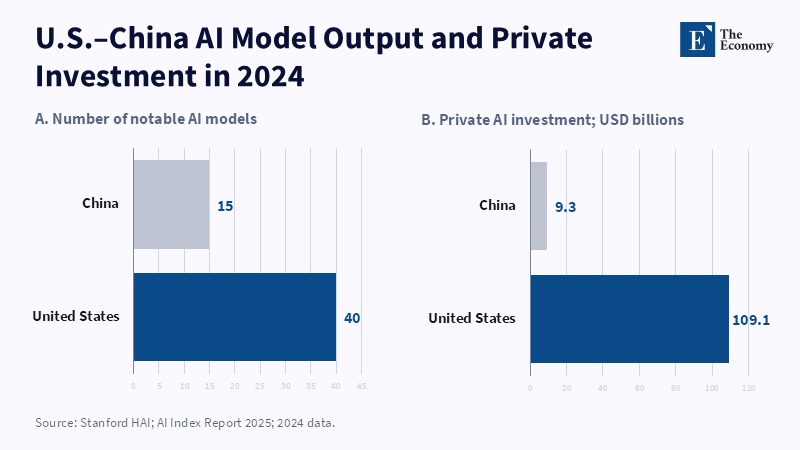
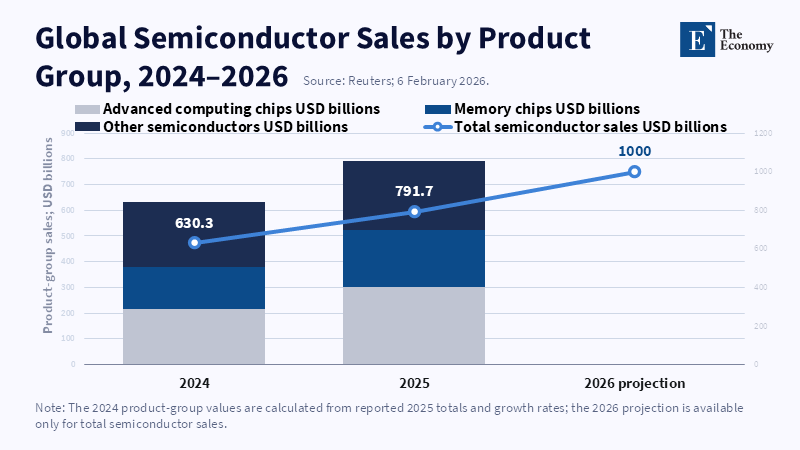
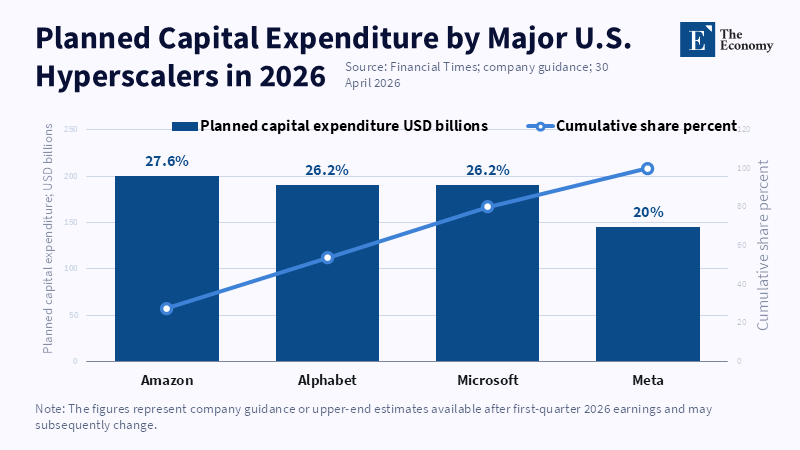
The United States still occupies the commanding heights of the global AI ecosystem.[8] According to the 2025 AI Index published by Stanford in 2025, in 2024, institutions based in the United States developed 40 notable AI models, while China had 15 and European countries had three; that same year private AI investment in the United States reached $109.1 billion, compared with $9.3 billion in China, making it nearly twelve times larger.[9] Four major U.S. hyperscalers are projected to spend approximately $725 billion in capital expenditure in 2026.10] On the semiconductor side, the Semiconductor Industry Association reports that U.S.-based firms still capture just over half of the global chip market[11] and the OECD further points to: Synopsys, Cadence and Siemens EDA controlling most of the advanced chip-design software market,[12] while Arm is a leading supplier of semiconductor intellectual property.[13] The picture painted here is one of ecosystem power, rather than just success stories: a merger of world-leading design expertise, financial resources and software tools that no other country can yet match.
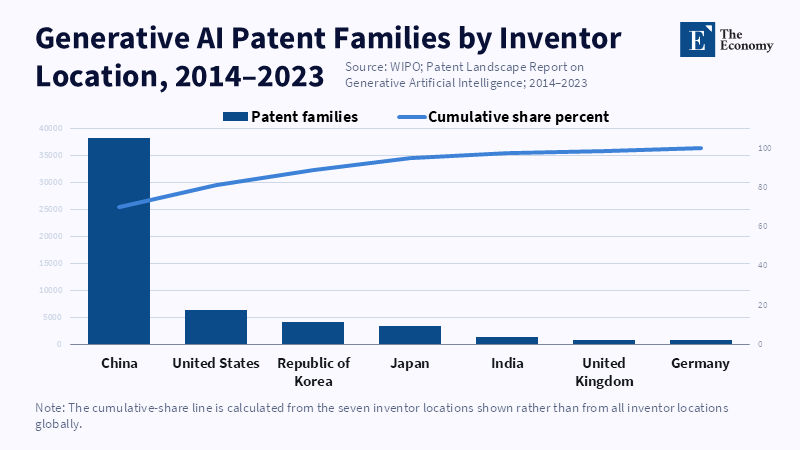
The same evidence that warrants caution also illustrates why complacency is misguided. Stanford observes that Chinese models have rapidly narrowed the gap on recent benchmarks like MMLU and HumanEval to near-parity while China remains at the forefront of AI publishing and patenting.[14] WIPO reports that China produced more than 38,000 GenAI patent families between 2014 and 2023, approximately six times the U.S. total of 6,276.[15] Reuters reporting on Z.ai and DeepSeek indicates that leading Chinese laboratories are developing models approaching frontier U.S. performance while adapting them to domestic hardware and specialized applications.[16] The lesson here is not that China has caught up to or overtaken the U.S. at the frontier. Rather, this suggests that the two are now separated by only a handful of choke points, rather than a broad technological gap.
That constriction has one particularly significant implication. If model capabilities are converging, the remaining U.S. advantage lies elsewhere. It is skewed toward access to dense compute, sophisticated memory, manufacturing tools, foundry networks and scale finance. The BIS has therefore been within reason to regard high-bandwidth memory as a strategic chokepoint and link a few quantities of advanced compute to significant national-security risks when deployment occurs in quantities adequate for frontier model training.[17] Reuters has reported that Huawei Ascend 950PR is making progress, but also that output availability remains limited by American export restrictions on high-performance chip fabrication tooling.[18] Demand within China has therefore become increasingly oriented toward domestic substitution, but not yet fully insulated from shortages of frontier hardware. That is precisely the rationale behind the strategic usefulness of targeted export controls. With residual lead concentrated in compute, restoring unrestricted compute access would accelerate the narrowing of the hardware gap.
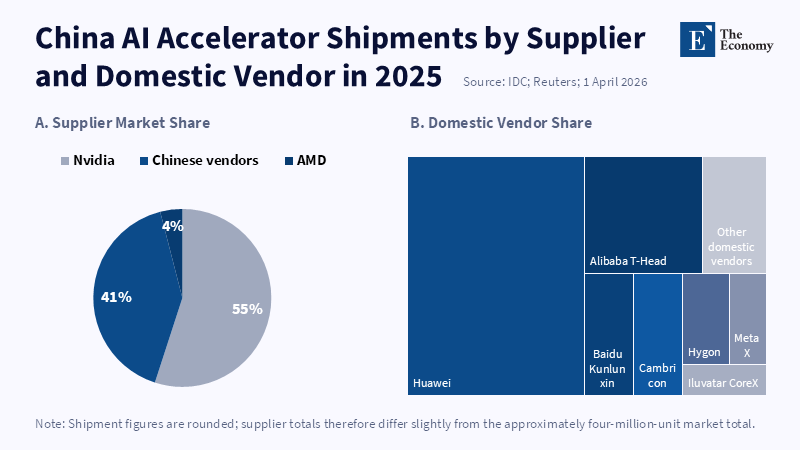
Chinese vendors supplied 1.65 million of the approximately 4 million AI accelerator cards shipped in China in 2025, giving them a 41% share rather than nearly 50%.[19] These figures show rapid substitution, but card counts alone do not establish frontier parity because they do not capture performance, interconnect quality, memory capacity or usable training compute.
This matters because AI is no longer only an economic multiplier. It is becoming a general-purpose strategic technology. Assessments of Ukraine's military development say that Kyiv's goal is to reduce personnel exposure to direct combat that characterizes conventional warfare by using AI-enabled unmanned systems to reduce human force and converge data more efficiently.[20] The ICRC also remarks that AI decision support systems are increasingly used earlier in military decision-making, shaping planning, targeting and effects estimation.[21] This matters for export policy because these technologies blur the previously clearer boundary between civilian front-end computers and military applications. The same infrastructure used to train commercial coding systems can also support targeting, intelligence, cyber operations, logistics and military simulation.
The White House has now signaled this synthesis. NSPM-11 directs the entire national security enterprise to establish sufficient access to state-of-the-art computing technologies, to accelerate the first introduction of advanced AI models and to publish new policies on autonomy in weapon systems on a yearly timetable.[22] This is more than rhetorical inflation. This is an institutional redefinition. When a capability is incorporated into procurement, doctrine, exchange of intelligence and secure computer-based planning, it has shifted from commercial relevance to strategic importance In these circumstances, frontier chips are not ordinary export goods. They are components of strategic infrastructure. To authorize their wide export to Chinese frontier users would thus constitute an injection of resources into the very stratum where the U.S. advantage remains tangible.[23]
This is also why the language of strategic leadership, though frequently used interchangeably, is not entirely misplaced here. Strategic leadership in the twenty-first century will not depend on AI alone, but AI will increasingly influence the speed of military adaptation, the productivity of industrial systems, the quality of intelligence analysis, the pace of cyber attack and cyber defense and the fundamental standards that help organize global platforms. A state that prioritizes controlling frontier compute and deployable model ecosystems will not merely sell more software. It will shape technical standards for others’ adoption and gain greater influence among its allies, defining global safety and security standards. The issue extends beyond Nvidia's sales in China, for it is a question of whether the United States wants to prolong the one cost-bottleneck of its remaining major hegemonic rivalry.
3. China’s Rule-Bending and the Limits of Export Controls
The argument is not that China is uniquely immoral, while the U.S. is uniquely innocent. That would be of no analytical value. A more serious observation is that the competitive space is structurally asymmetrical. China is not just another market player seeking to acquire more computing power. Rather, it is a state-supported strategic rival that has consistently combined import reliance, targeted knowledge transfer, cyber-enabled theft, human capital acquisition, industrial subsidy, regulatory dominance and illicit supply chains in the pursuit of technological self-sufficiency. The USTR's 2024 review stands out precisely because it is not vertically even between the U.S. and China. While noting that the Section 301 pressure prompted certain changes to domestic law in China's practices, including an explicit formal ban on forced technology transfer by administrative fiat, it nonetheless finds that China's relevant technological transfer practices remain intact, that cyber-enabled technology theft continues and that these activities are woven into the broader framework of the Chinese push toward technological self-sufficiency and economic leadership within the global economy.[24] This is not the tableau of a single market entrant that operates under reciprocal market rules, conforming to market logic and within the bounds of the rules.
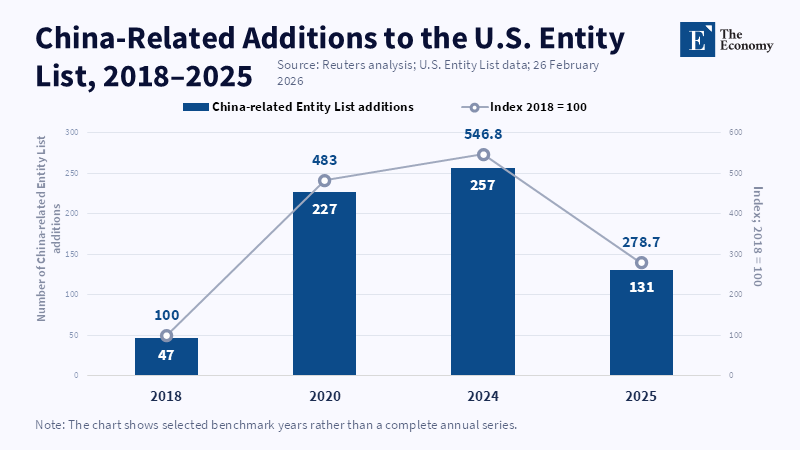
These recent enforcement cases provide concrete evidence: in February 2025, the U.S. Department of Justice announced a superseding indictment against Ding Linwei, who was accused of seven counts of economic espionage and seven counts of theft of trade secrets for uploading proprietary AI model information from Google to a personal cloud account between 2022 and 2023; the indictment said over 1,000 distinct files had been uploaded.[25] In December 2025, it announced it had broken up an extensive Chinese-origin AI-technology smuggling network, seizing funds and equipment worth over $50 million; in March 2026, it brought charges against a Chinese national and two Americans for conspiring illegally to supply China with millions of dollars’ worth of export-controlled computer chips via Thailand.[26] These cases do not implicate every Chinese company, but they establish that frontier AI competition with China already extends into illegal activity.
European and Allied reporting points are oriented in the same direction. Reuters reported in May 2025 that the Dutch defense minister stated that Chinese espionage operations targeting Dutch industry were increasing in intensity, with semiconductors specifically named as a current target.[27] The Netherlands 2025 Cyber Security Assessment argues that Chinese actors are consistently effective in hacking Western governments and enterprises and identifies a close nexus between Chinese state intelligence agencies, businesses and think tanks.[28] MI5 has meanwhile issued a warning that when foreign states steal strategic United Kingdom assets or interfere in electoral processes, they undermine national sovereignty.[29] None of this is proof of commercial reciprocity. It indicates a state-directed approach to economic openness that considers the opening of the economy to be an input to strategic accumulation. That distinction is vital: under those conditions, openness is effectively a subsidy in the strategic game.
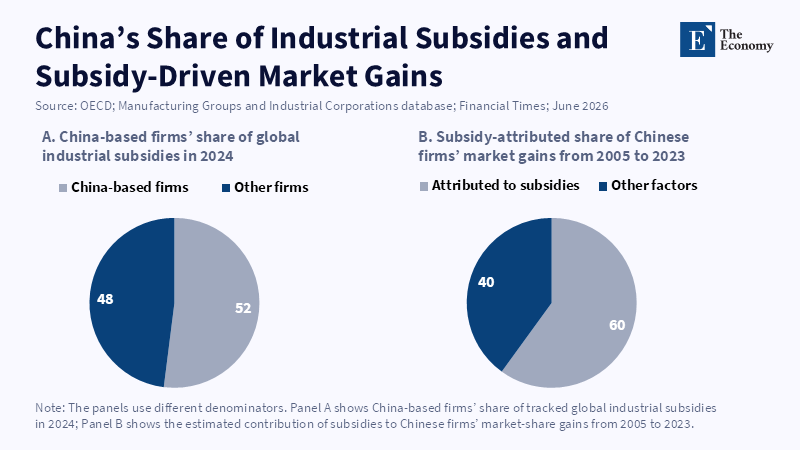
The subsidy question is clearer in semiconductor finance. OECD analysis published in 2025 revealed that gross subsidies to China-based firms had risen from an average of just under 5% of revenue after 2018-19 to 10% of revenue by 2023, even before counting the additional support via state guidance funds and subsidized state equity packages.[30] A separate OECD release in June 2026 found that Chinese companies received between three and eight times more government support than firms in developed economies during 2005–2024.[31] This subsidy-driven competitive model is not just aggressive industrial policy. It affects pricing, investment horizons, loss tolerance and the pace of strategic substitution. When state firms that were already massively subsidized suddenly find themselves lawfully able to access not just 5G but frontier U.S. chips, then this is not marginal trade. It would accelerate strategic absorption.
This shifts the question of export into a specific causal direction. If China were a competitor under reciprocal rules, with a stable commitment to market trade and no collective record of illicit acquisition, one could at least argue that sales of frontier U.S. chips could maintain reliance on U.S. ecosystems and slow AI decoupling. But that is not the competitive environment the evidence defines. In that competitive environment, legal exports would be coupled with espionage, with illicit channels, with state subsidy and with a proclaimed imperative for indigenous substitution. The outcome would be a faster compression of the hardware and software gap that exists between the United States and China. Chinese laboratories have already shown that they can do more with limited computing; Reuters' reporting on DeepSeek and Z.ai supports just this hypothesis. Upping or substantially relaxing the compute constraint would not offer restraint; it would lift the last artificial limit on an adversary that has shown it can use limited computing resources efficiently.
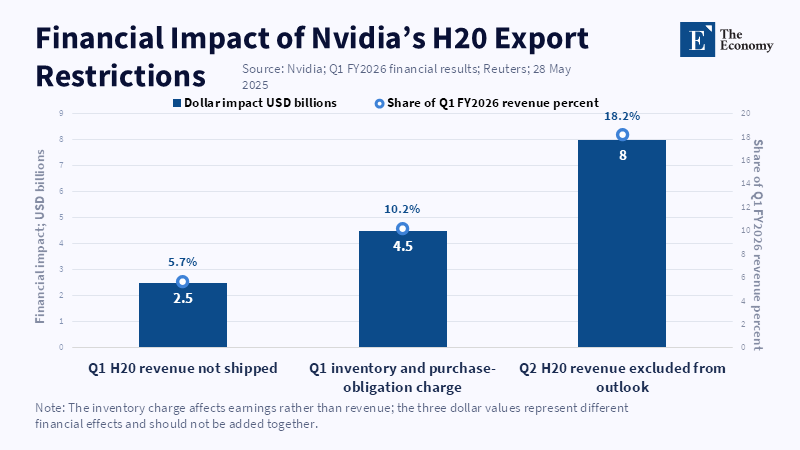
The strongest counterargument merits serious consideration. Nvidia and others have contended that controls are failing in their objectives, costing billions in lost sales and may ultimately bolstering Huawei and other Chinese domestic suppliers.[32] Reuters reported that April 2025 restrictions cost Nvidia $2.5 billion in first-quarter revenues and the company anticipated an $8 billion loss in the second quarter;[33] Reuters also indicated the company would no longer include China-related revenue in its guidance.[34] Brookings adds a widespread concern: since U.S. firms are already shut out of the Chinese AI-chip market, escalating steps against third countries or Chinese models could cut U.S. firms off from worldwide customers without doing much to inhibit China.[35] These are not insignificant points. Revenues matter to innovation. They may also weaken U.S. firms in third-country markets while accelerating China’s domestic ecosystem.
Those criticisms show why controls must remain narrow, predictable and tied to measurable security objectives. The commercial costs are real, but the relevant comparison is not between revenue and immorality. It is between short-term corporate revenue and long-term strategic dilution. Furthermore, the evidence indicates that the Chinese market is already politically constrained by both Beijing and Washington. Reuters pointed out that since the Trump administration authorized H200 exports to approximately ten Chinese firms, none had been delivered by mid-May 2026 and Chinese customs have already indicated that the imports had not been authorized.[36] Brookings' principal point thus becomes less an argument for reopening than a recognition that the previous age of interdependence has come to an end. If so, then the case for reopening becomes hollow. A market that Beijing itself restricts cannot reasonably be the stabilizing foundation of America's influence over the ecosystem.
That said, there is a more refined form of the counterargument. It suggests that since China has already begun to substitute toward Huawei and domestic providers, a ban on exports might merely hasten the advent of an entirely separate Chinese stack. While this is a concern, it does not warrant the broad reopening proposed. A rival’s eventual substitution does not justify accelerating its transition at the frontier; it strengthens the case for using controls only to buy time for domestic and allied investment. That is not where the critique is strongest, however. Erratic U.S. policy can hasten Chinese substitution even while maintaining coercive leverage. Reuters has documented that, in 2025, Washington temporarily restricted access to EDA software, then reversed those restrictions; it has also reported that, in response to Beijing’s rare-earth restrictions, the same administration relaxed technology controls on China.[37] Such policy instability reinforces Chinese concerns about dependence on U.S. suppliers as a political risk, given the U.S. provision, and therefore must push for hastening self-sufficiency.[38, 45, 46] This requires not a liberalization, but resilient and strategically legible restrictions.
In this larger context, the reciprocity issue is then resolved at the strategic level. China’s conduct weakens the case for unconditional openness, but it does not prove that broad export restrictions will remain effective, because the U.S. would have little incentive to resume wider frontier-chip exports tomorrow as the software gap diminishes and the military promise of AI increases. But the existence of the behavior reduces the case for reopening even more. As things stand, unconditional openness would be strategically imprudent.
4. From Restriction to Substitution: The Likely AI Equilibrium
The most likely equilibrium is neither renewed integration nor immediate great-power war. It is a sustained coercive competition with lines of contestation in a partially bifurcated standards regime, competing compute ecosystems, chokepoints in both directions, more aggressive espionage and crisis-prone moments of escalation. The historical analogy to the 1940-41 U.S.-Japan embargoes should therefore be applied rigorously. Chips are not oil, China is not imperial Japan and nuclear deterrence and global financial interdependence stand to fundamentally change international politics.
However, the historical record can still inform the nature of the problem. Documentation by the U.S. Department of State's Historian's Office indicates that U.S. policymakers thought in definitive strategic terms before Pearl Harbor about how time buys, rearmament and resource curtailment would affect Japanese preferences.[39] By the Historian's Office, Japan, facing substantial shortages and unwilling to redress, it concluded that action would have to be swift; The conclusion is not that embargoes will always lead to shooting wars. It is that when a rising power ensures its access denial has existential stakes and the status quo wants to deprive the neighboring state of precisely that, trade policy constitutes coercive statecraft.
That is already happening in the U.S.-Chinese contest. Reuters reports that China has substantially expanded its export-control system since the 2020 Export Control Law. Staffing and enforcement of compliance have shot up. Reuters also documented how Beijing's rare-earth controls have become a leverage tool, under which the United States has, in turn, relaxed some of its restrictions on sophisticated AI chips and other products.[40] That reciprocal use of economic coercion matters. It implies the eventual equilibrium will not be a one-sided American constraint on Chinese progress. It will be a continuous strategic contest in which each side hunts for newly identified bottlenecks in the other's technology stack: chips, memory, lithography, design tools, rare earths, cloud accessibility, open-source diffusion, financial sanctions and standards organizations.
This results in the bifurcated standards order. In one corner would be a U.S.-led ecosystem dedicated to secure computing environments, embedded U.S. hardware and foundry capacity, control over critical chip-design software and a governance narrative surrounding security alliances and diffusion controls. RAND's framing of the January 2025 AI diffusion paradigm reflected this approach: a U.S.-proposed dominant global AI ecosystem that achieved a necessary balance of leading, spreading and securing. In another corner would be a China-proposed ecosystem reliant upon Huawei Ascend clusters, in-house cloud offerings, open-source diffusion, bureaucratic procurement preferences, industrial subsidies and a governance framework sympathetic to state governance and opaque strategic maneuvering.[41] Reuters' report that Chinese algorithms are becoming more tailored to local chip architecture, as well as Brookings' finding that top American companies have exited the Chinese AI-chip sector, suggest that this bifurcation is no longer merely theoretical.
The cumulative effects of such a split would be more gradual than dramatic, at least initially. Global firms and third-country governments would suffer increased switching costs, lower interoperability and increasing pressure to choose sides. Capital goods investment would become increasingly uneconomical, as the two blocs race to re-establish cumulative cloud, semiconductors, models and tooling resource overlaps. Black markets and opaque procurement networks would become more attractive, which would in turn increase the net benefits of smuggling, transshipment, shell companies and associated enforcement failures. As Reuters has already reported, a China-linked smuggling/laundering pipeline is funneling export-controlled AI chips through third countries[42] and evidence that the prices for prohibited Nvidia chips are spiking in black markets suggests that scarcity is producing the exact incentives that would accompany a dual-stack framework.[43] What the system converges upon is unlikely to be a clean separation; a more nuanced equilibrium, with partial separation and persistent adaptation, seems more likely.
The military consequences may be more serious. As the two technology systems diverge, a crack widens between commercial and strategic infrastructure. How much computing power does the side that can afford and secure a bigger, better and cheaper batch already possess? Who can use it to train and coordinate more capable autonomous and semi-autonomous systems? Who can use it to simulate more, to synchronize more quickly, to crunch more efficiently their ISR and field more scalable autonomy in the kill chain? If this is the battlefield upon which prerogatives are being challenged, then a future with incompatible AI stacks is a future with governments and military institutions with less understanding of each other’s systems, less confident in shared standards, more dependent on automated early-warning, target-proposal and cyber-defense technologies that the other cannot fully comprehend. Such conditions would undermine strategic stability. This could encourage hasty decision-making at high levels of uncertainty.
However, a bifurcated equilibrium does not mean that all decisions by the United States would be wise. Here again, the Brookings warning remains relevant. Broadening controls in a way that alienates allies, deprives U.S. firms of access to numerous large non-Chinese markets, or politicizes every layer of the stack can erode the very coalition on which U.S. leverage relies. The United States remains relatively powerful because its semiconductor advantage is a byproduct of alliances: its design software and capital, Dutch lithography, Taiwan’s foundries, Korea’s memory and the global cloud markets. Reuters’ behind-the-scenes reporting regarding proposed 2026 legislation affecting ASML demonstrates the coalition’s delicate balance.[44] If Washington expands technological chokepoints into unchecked extraterritorial control, allies will hedge. The strategic takeaway is to use selective controls without treating them as a substitute for innovation and market leadership on frontier tools that go directly into Chinese sovereign AI systems and military capability development.
This is where the analogy with Japan breaks down again, although in a narrower sense. The danger in the 1941 analogy did not come from the embargo alone, but from the combination of coercive constraints, strategically ill-matched objectives and eroding trust that negotiations could lead to a stable equilibrium. A similar dynamic is becoming apparent with AI, albeit through a more mediated technological lens. In Beijing, advanced technology itself is considered essential; in Washington, USTR tied that goal to state-orchestrated market preeminence. The earlier expectation that interdependence would moderate rivalry has given way to the view that technological dependence is a strategic vulnerability. Competitive conduct is now on the cusp of entering a phase where contestants increasingly consider their dependence on each other nothing but temporary, dangerous, or a strategic advantage. Once there, standards do not just diverge: they crystallize. At the same time, controls that are inconsistent or excessively broad can accelerate Chinese self-reliance and open-source adaptation.[45][46]
How history will recount this period will inevitably, as often does, depend on how the balance of power ultimately develops. If the U.S. maintains its supremacy, expands its allies' capabilities and denies China access to enough frontier compute to keep the chasm open, the current restrictions will come to be viewed an accomplished and successful preemptive denial strategy; if China endures parity or overtakes it despite this, the same measures will be remembered less as strategic instrument and more as showing that the U.S. recognized the challenge too late and responded inconsistently precisely the reason why, in the retrospective view, current policy must not falsely conflate tactical losses with strategic irrelevance. The fact that the existing degree of technological decoupling is no reason to give up those remaining levers; it is a reason to carefully preserve them.
5. Conclusion - Selective Controls and Durable AI Leadership
The case for reopening U.S. frontier-chip exports to China suffers from a category error. It draws a strategic choke point into the marketplace. The available evidence points elsewhere. The U.S. maintains a lead in the advanced-manufacturing segments of the technology stack that are most central to maintaining a frontier advantage: private capital, hyperscale compute, software for circuit design, high-bandwidth memory and the broader ecosystem that supports advanced manufacturing. Meanwhile, Chinese model quality has improved substantially: the remaining U.S. lead is not so much one of abstract knowledge but of frontier computational capacity and the infrastructure required to deploy this capacity.
China's documented record of cyber-enabled theft, export-control circumvention, strategic subsidy and state-directed technology acquisition changes the implications of openness under these circumstances. Any broad export liberalization would be inadequate to restore benign interdependence; it would enable a principal strategic competitor to shrink the most vital leverage point still in American hands. The best course is selective, enforceable controls combined with faster domestic investment, allied coordination and continued competition in global markets. The United States should tightly control frontier chips, high-bandwidth memory, advanced tools and diversion channels; coordinate with close allies; strengthen enforcement at diversion points while expanding domestic power generation, research, manufacturing capacity and technical talent. As AI becomes the defining strategic infrastructure of the next era, the United States should maintain meaningful influence over emerging global AI rules.
References
[1, 35] Brookings Institution (2025) ‘The new AI diffusion export control rule will undermine US AI leadership’. Brookings Institution.
[2, 34] MarketWatch (2026) ‘Nvidia’s outlook still doesn’t include China’. MarketWatch.
[3, 22] White House (2024) ‘Memorandum on advancing the United States’ leadership in artificial intelligence; harnessing artificial intelligence to fulfil national security objectives; and fostering the safety, security, and trustworthiness of artificial intelligence’. Executive Office of the President.
[4, 17] Bureau of Industry and Security (2024) ‘Commerce strengthens export controls to restrict China’s capability to produce advanced semiconductors for military applications’. U.S. Department of Commerce.
[5, 24] Office of the U.S. Trade Representative (2024) Four-Year Review of Actions Taken in the Section 301 Investigation: China’s Acts, Policies, and Practices Related to Technology Transfer, Intellectual Property, and Innovation. USTR.
[6, 9, 14] Maslej, N., Fattorini, L., Perrault, R., Gil, Y., Parli, V., Kariuki, N., Capstick, E., Reuel, A., Brynjolfsson, E., Etchemendy, J., Ligett, K., Lyons, T., Manyika, J., Niebles, J.C., Shoham, Y., Wald, R. and Clark, J. (2025) Artificial Intelligence Index Report 2025. Stanford Institute for Human-Centered Artificial Intelligence.
[7] Reuters (2026) ‘DeepSeek-V4, the Chinese AI model adapted for Huawei chips’. Reuters.
[8, 23] RAND Corporation (2025) ‘China’s AI models are closing the gap, but America’s real advantage lies elsewhere’. RAND Corporation.
[10] Financial Times (2026) ‘Google outpaces rivals as Big Tech’s AI spending plans rise to $725bn’. Financial Times.
[11] Semiconductor Industry Association (2025) 2025 SIA Factbook. Semiconductor Industry Association.
[12] Reuters (2025) ‘Synopsys restarts some China services, sales of core tools still blocked, source says’. Reuters.
[13] Arm Holdings plc (2025) Annual Report 2025. Arm Holdings plc.
[15] World Intellectual Property Organization (2024) Patent Landscape Report: Generative Artificial Intelligence. WIPO.
[16] Reuters (2026) ‘After Anthropic shutdown, China’s Z.ai closes frontier gap as it plans dual listing’. Reuters.
[18] Reuters (2026) ‘Huawei looks beyond Moore’s Law’. Reuters.
[19] Reuters (2026) ‘Chinese chipmakers claim nearly half of local market as Nvidia’s lead shrinks’. Reuters.
[20] Reuters (2026) ‘Ukraine’s defence AI chief predicts new paradigm of warfare’. Reuters.
[21] International Committee of the Red Cross (2025) Artificial Intelligence in the Military Domain: ICRC Submission to the United Nations Secretary-General. ICRC.
[25] Reuters (2025) ‘Ex-Google engineer faces new US charges he stole AI secrets for Chinese companies’. Reuters.
[26, 42] Reuters (2025) ‘US Justice Department accuses two Chinese men of trying to smuggle Nvidia chips’. Reuters.
[27] Reuters (2025) ‘Chinese spying on Dutch industries intensifying: Dutch defence minister’. Reuters.
[28] National Coordinator for Security and Counterterrorism (2025) Cyber Security Assessment Netherlands 2025. Government of the Netherlands.
[29] Reuters (2025) ‘UK’s MI5 warns politicians they are targets of Russian and Chinese spying’. Reuters.
[30, 31] Organisation for Economic Co-operation and Development (2026) Manufacturing Groups and Industrial Corporations Database. OECD.
[32] Gupta, R., Walker, L. and Reddie, A.W. (2024) ‘Whack-a-Chip: The futility of hardware-centric export controls’. arXiv.
[33] NVIDIA Corporation (2025) ‘NVIDIA announces financial results for first quarter fiscal 2026’. NVIDIA Corporation.
[36] Reuters (2026) ‘China’s customs agents told Nvidia’s H200 chips are not permitted, sources say’. Reuters.
[37] Reuters (2025) ‘China navigates delicate US truce while affirming trade consensus’. Reuters.
[38, 40] Reuters (2026) ‘As Trump reins in China tech curbs, Beijing’s export controls come of age’. Reuters.
[39] U.S. Department of State, Office of the Historian (n.d.) ‘Japan, China, the United States and the road to Pearl Harbor, 1937–41’. U.S. Department of State.
[41] RAND Corporation (2025) Full Stack: China’s Evolving Industrial Policy for AI. RAND Corporation.
[43] Financial Times (2026) ‘Nvidia’s banned AI chips double in price on China’s black market’. Financial Times.
[44] Reuters (2026) ‘Dutch official presses US lawmakers over China chip export bill’. Reuters.
[45] Liu, J. and Lee, J-A. (2026) ‘Strategic stalemates: The paradox of export controls in the U.S.-China AI race’. arXiv.
[46] Wang, J., Kunievsky, N., Lou, B., Sun, T. and Evans, J. (2026) ‘U.S. policies unintentionally accelerated China’s open AI ecosystems’. arXiv.