As Iran Unleashes Low-Cost Drone Barrages, US Goes All-In on Unmanned Warfare as Economics of War Shift From ‘Blood’ to ‘Money’

Authored On
Modified
Iran’s mass deployment of low-cost drones accelerates depletion of US interceptor stockpiles
Pressure to preserve combat power drives wider use of one-way attack surface drones and AI-enabled kill chains
Benchmark for warfighting capability shifts from weapons performance to production and replenishment capacity
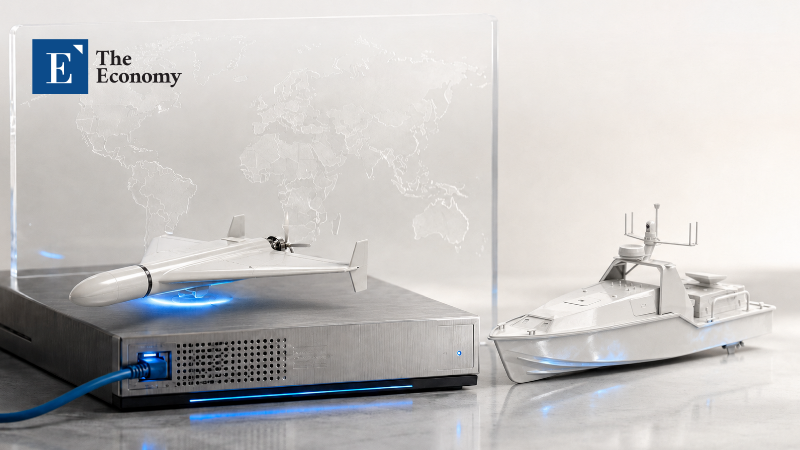
The US military has deployed one-way attack surface drones in combat for the first time in its history. Confronted by Iran’s mass deployment of low-cost unmanned systems and the rapid depletion of expensive interceptor inventories, the United States has converted assets previously used primarily for surveillance and reconnaissance into direct-strike weapons. As the critical measure of military power shifts from weapons performance and precision to wartime output, replenishment speed and cost per strike, the ability to sustain a war is increasingly determined not by battlefield casualties but by industrial capacity and the rate at which weapons inventories can be depleted and restored.
US Deploys One-Way Attack Surface Drones Against Iran for First Time
According to Reuters on July 14, US Central Command (CENTCOM) struck submarine and ship maintenance facilities at the Bandar Abbas naval base in southern Iran with unmanned surface vessels on July 12. CENTCOM said on social media platform X that it had deployed three Corsair unmanned surface vessels, each measuring about 7.3 meters in length, to attack the targets. Video released alongside the announcement showed a drone traversing the water before crashing into a pier and exploding. “Using multiple expendable attack surface drones, we successfully struck Iran’s submarine and ship maintenance facilities,” CENTCOM said. “This marks the first time US forces have employed maritime drones in an offensive mission.”
Developed by US defense startup Saronic Technologies, the Corsair’s principal strengths are its exceptional range and payload capacity. It can autonomously navigate more than 1,150 miles, or about 1,850 kilometers, on a single mission and carry up to 1,000 pounds, or roughly 450 kilograms, of high explosives. At less than $1 million per vessel, it is considerably cheaper than a conventional large warship or precision-guided missile, aligning with the Pentagon’s drive to build a massed unmanned force centered on cost-effectiveness. Last month, the Corsair also demonstrated its versatility by rescuing the crew of an Apache helicopter that had crashed off the coast of Oman.
The operation demonstrates that the US military’s transition toward unmanned warfare has moved beyond experimentation and pilot deployments into direct strikes against operational targets. Task Force 59, under the US Navy’s Fifth Fleet, has already established a surveillance and reconnaissance architecture using unmanned surface vessels and aerial drones in Middle Eastern waters. The addition of expendable attack missions has now expanded the role of unmanned systems from surveillance and intelligence collection to the direct projection of firepower. The US military deployed a unit of one-way attack drones to the Middle East last December and used the Low-cost Unmanned Combat Attack System, or LUCAS, in combat for the first time during Operation Epic Fury in February.
LUCAS takes its name from the initials of “Low-cost Unmanned Combat Attack System.” After dismantling a Shahed-136 captured several years earlier, the US military developed LUCAS by retaining the Iranian drone’s basic airframe configuration while equipping it with advanced US technology. LUCAS and the Shahed share a similar triangular profile. The Shahed measures 3.5 meters in length and 2.5 meters in width, weighs 200 kilograms and has a maximum range of 2,500 kilometers. It can carry a warhead of up to 50 kilograms in its nose and fly autonomously to strike a target. LUCAS measures 3 meters in length and 2.43 meters in width, weighs 80 kilograms and has a maximum flight range of 800 kilometers, with an explosive payload capacity of about 20 kilograms.

Unmanned Operations Push the Ethics of War Aside
It would be difficult to conclude that the United States initially suffered from a technological gap in the field of one-way attack drones. The country had already accumulated substantial technical expertise and operational experience in such systems. It fielded the Switchblade family of loitering munitions early on and supplied more than 700 units to Ukraine following Russia’s invasion in 2022. Although the United States had also secured much of the technology required for autonomous navigation, target tracking and precision strikes, its attention was focused less on weapons-development capabilities than on how much authority artificial intelligence should be granted over decisions involving human life and death.
Those concerns are reflected in the Pentagon’s revised 2023 directive on autonomous weapons, DoD Directive 3000.09. The directive requires commanders and operators to exercise “appropriate levels of human judgment” in the use of force involving autonomous and semi-autonomous weapon systems. At the same time, it leaves room for the method and timing of human intervention to be tailored to individual weapons systems and operational environments. This approach appears to reflect the practical judgment that imposing uniform restrictions on AI use could sharply reduce response speeds on battlefields where large drone swarms and hypersonic weapons operate on a timescale of seconds.
The war with Iran is regarded as the first conflict in which these principles have been tested on an actual battlefield. According to The Washington Post, during the first 24 hours of the war, the US military used US AI company Palantir’s Maven Smart System and Anthropic’s generative AI model Claude to identify and prioritize more than 1,000 strike targets. By analyzing satellite imagery, drone footage and communications intelligence, AI also dramatically shortened the kill chain from detection and target selection to battle-damage assessment.
As the scale of operations expanded, however, the limitations of requiring a human to approve every individual strike became increasingly apparent. During the first 12 hours of the war, the United States and Israel conducted about 900 airstrikes using drones, missiles and other weapons. In an operational environment where dozens of one-way attack drones are deployed against a single target and hundreds of targets are struck simultaneously, a small number of operators cannot individually determine the target and impact timing of every platform. Experts have therefore focused on the possibility that commanders pre-established parameters such as operational areas, target categories and required AI identification accuracy, allowing strikes to proceed autonomously within those boundaries.
As damage to US bases and equipment accumulated under Iran’s low-cost drone offensive and inventories of expensive interceptors dwindled rapidly, preserving combat power and accelerating response times became increasingly important. This explains the growing attention paid to a human-on-the-loop system, in which commanders establish mission parameters and supervise AI-led operations, rather than a human-in-the-loop model requiring direct human involvement in every engagement. Ultimately, the cautious approach rooted in wartime ethics appears to have been relegated to a secondary consideration as mounting battlefield damage and ammunition expenditure gave greater weight to military judgments centered on operational efficiency.
The deployment of the Corsair shows that this transformation has spread to naval warfare. The US military launched three Corsairs toward the predesignated Bandar Abbas naval base, and the vessels navigated across the water using autonomous-navigation technology before crashing into their targets. Automated functions are believed to have played a central role as the vessels selected different routes and adjusted their courses to changing maritime conditions. If the same system is deployed against moving ships or multiple targets in the future, the scope of decisions entrusted to AI is likely to expand further.
Low-Cost Unmanned Forces Expand Across Both Offensive and Interceptor Missions
As competition in unmanned warfare intensifies, Iran’s drone-production capacity is also continuing to expand. According to Iran’s Tasnim News Agency, acting Defense Minister Majid Ebn al-Reza said on July 11 that “defense production did not cease even during the most intense phase of the war, and drone-production capacity has tripled.” He said Iran had established a wartime production-surge system by investing in advanced technology and expanding its domestic manufacturing base.
The resilience of Iran’s drone industry stems from its distributed production network. The Shahed family has a relatively simple airframe and can make extensive use of commercially available electronics and small engines, reducing its dependence on large, dedicated factories. University laboratories, military-affiliated institutions, small assembly facilities and suppliers of dual-use components all participate in the production process, while procurement networks operating through front companies and overseas intermediaries have also been established. The Washington Institute, a US think tank, assessed that even if the US military strikes major production facilities, eliminating a manufacturing ecosystem rooted in small workshops and civilian supply chains would remain difficult.
The United States is responding by simultaneously ramping up production of both attack and interceptor drones. According to The Wall Street Journal, the US Army signed a contract worth up to $500 million with defense startup Neros, which manufactures the low-cost first-person-view attack drone Archer. Including its warhead, the Archer costs $5,000 per unit. Neros, which currently produces 1,200 units a week, plans to raise annual output to 1 million drones by 2028. The US Army is also pursuing a plan to increase annual drone procurement from 50,000 units to more than 1 million within the next two years.
Large-scale funding is also being directed toward the procurement of defensive systems. On July 1, the US Army signed a $500 million contract with US drone manufacturer AeroVironment (AVAV) to supply counter-drone systems. The contract runs through June 2029 and covers a multilayered defense architecture designed to counter small reconnaissance drones, FPV attack drones and long-range one-way attack aircraft. The initiative is understood as an attempt to narrow the cost disparity created by Iran by converting both strike and interception capabilities to low-cost unmanned systems.
Accordingly, the decisive variables in warfighting capability are expected to shift from the performance and precision of advanced weapons systems to wartime production volumes, replenishment speed and cost per strike. Even if advanced fighter aircraft and air-defense missiles offer superior performance, the defender’s inventories and budget may be exhausted first if an adversary can manufacture low-cost drones more rapidly. Sustaining a prolonged war, in particular, requires not only sufficient monthly output but also resilient supply chains for critical components and the industrial capacity to replace expended weapons on schedule. This transformation may also alter the composition of war costs. As militaries gain the ability to conduct repeated strikes without deploying personnel into hazardous areas, the financial burden is shifting from human casualties to platform-production costs, ammunition inventories and industrial-facility utilization rates. The factors determining whether a war can be sustained are already moving away from losses of personnel and equipment toward the supply rate of low-cost weapons and the capacity to replace expended stocks. In effect, “money” is taking the place once occupied by “blood” behind defense and national security.
Similar Post