“FCAS Collapse, GCAP Survival, and America’s Solo Push” Diverging Sixth-Generation Fighter Strategies Reshape Western Defense Landscape amid China’s Expanding Airpower

As one of the youngest members of the team, Tyler Hansbrough is a rising star in financial journalism. His fresh perspective and analytical approach bring a modern edge to business reporting. Whether he’s covering stock market trends or dissecting corporate earnings, his sharp insights resonate with the new generation of investors.
Authored On
Modified
France, Germany, and Spain’s FCAS fighter development program ultimately collapses
UK-Italy-Japan GCAP secures crucial funding after repeated setbacks
US presses ahead with independent sixth-generation fighter development, while mid-tier defense powers focus on fifth-generation capabilities
Europe’s joint sixth-generation fighter development initiative, the Future Combat Air System (FCAS), has collapsed. France, Germany, and Spain ultimately failed to bridge their differences over critical issues such as technological and industrial leadership, bringing their long-running partnership to an end. The Global Combat Air Programme (GCAP), a joint initiative involving the United Kingdom, Italy, and Japan that had faced a similar crisis, has only recently managed to preserve its momentum through major collective contracts, while the United States is accelerating its sixth-generation fighter program independently, without a multinational consortium. Experts attribute the Western allies’ aggressive fighter development efforts to China’s rapidly expanding airpower.
Collapse of the FCAS Coalition
On July 11, Spanish general-interest daily La Razón reported, citing a collection of reports from European policy institutes, that the joint FCAS fighter development program had already been officially terminated. The German government said last month that it had “concluded that the companies involved would be unable to reach an agreement on jointly producing a next-generation fighter,” adding that it had “decided not to proceed with the FCAS fighter development and acquisition program pursued with France and Spain.” Around the same time, France’s Élysée Palace also announced the project’s cancellation, stating that “the German authorities determined that it would be impossible to continue pressuring the companies concerned.”
Launched in 2017, FCAS was intended to develop a next-generation aircraft to replace France’s Rafale and the Eurofighter Typhoons operated by Germany and Spain, but the program was beset by discord from the outset. Under the proposed division of labor, France’s Dassault Aviation, which had experience developing the Rafale, was responsible for the fighter aircraft, while Airbus, in which German and Spanish interests hold stakes, was tasked with developing the drones that would operate alongside it. The two companies clashed over intellectual property rights and revenue-sharing arrangements from the program’s inception, with the dispute soon escalating into a struggle for overall control. Dassault argued that the company responsible for developing the fighter should lead the entire program. It demanded unequivocal prime-contractor authority and rejected an equal partnership with Airbus. Airbus countered that it had no intention of participating in the project as a subcontractor to Dassault.
Another obstacle was the divergence between the performance requirements sought by France and Germany. France wanted a fighter capable of carrying nuclear weapons and operating from aircraft carriers, while Germany, which has no aircraft carriers, favored a larger aircraft designed to launch from land bases and conduct air-superiority missions. International concerns that Russia could move beyond Ukraine and invade a member of the North Atlantic Treaty Organization (NATO) within the next several years also weighed against the FCAS program. The fighter was not scheduled to enter operational service until 2040. Given the urgency of the security environment, the FCAS partners effectively lacked the latitude to commit substantial budgets to the program over such an extended period.
GCAP’s Emergence into a New Phase after Overcoming Crisis
The danger of a similar defense partnership unraveling was also evident in the GCAP initiative involving the United Kingdom, Italy, and Japan. GCAP is rooted in Britain’s Tempest program and Japan’s F-X project. Rather than joining FCAS, Britain established Tempest as an independent next-generation fighter development initiative centered on companies including BAE Systems and Rolls-Royce, with Italy subsequently joining as a partner. Japan’s F-X program was intended to replace the Japan Air Self-Defense Force’s Mitsubishi F-2 fighter. Given the financial and technological burden of developing F-X, Japan sought an overseas partner and ultimately selected the United Kingdom. In December 2022, the United Kingdom, Italy, and Japan formally announced that Tempest and F-X would be merged into GCAP, setting a target of beginning full-scale deployment of the next-generation fighter in 2035.
The three countries’ plans repeatedly encountered obstacles over the following years. The initial impediment was Japan’s stringent defense export restrictions. Without the ability to sell completed fighters to third countries, it would have been difficult to implement the export-oriented business model demanded by Britain and Italy. In March 2024, the Japanese government therefore revised its defense equipment transfer principles to permit exports of finished fighters jointly developed under GCAP to third countries. However, eligible destinations were limited to countries that had signed defense equipment agreements with Japan and were not actively engaged in military conflict. Britain’s defense budget shortfall subsequently emerged as another major challenge. Delays in the British government’s Defense Investment Plan postponed the signing of full-scale design and development contracts by Edgewing, the three countries’ joint industrial venture. This provoked strong opposition from Japan. With its existing F-2 fleet scheduled to begin retiring in phases from 2035, Japan viewed the replacement fighter’s deployment timetable as paramount. Britain and Italy, by contrast, placed greater emphasis on the overall maturity of the system than on the delivery deadline.
Since the beginning of this year, however, these conflicts have gradually begun to ease. In April, the three governments awarded Edgewing an initial joint contract worth $926 million. The agreement effectively provided bridge financing intended to prevent essential design and engineering work from grinding to a halt. The British government subsequently committed $11.6 billion to GCAP over the next four years, while the three governments signed a follow-on contract worth $6.2 billion with Edgewing on July 3. The contract is designed to support the finalization of the fighter’s performance requirements, detailed design work, and testing and validation. The program has therefore secured the financial foundation required to advance from preliminary research into full-scale joint development. However, because some contracts and decisions have already been delayed, the design and testing schedules will likely have to be compressed considerably if the partners are to preserve the 2035 target for operational deployment.
Canada has also recently begun exploring the possibility of participating in GCAP. Ottawa is considering first obtaining observer status, which would grant it access to certain program information, before potentially expanding its role as either a customer or a joint development partner. The discussions reflect a convergence of interests between Canada, whose deteriorating relationship with the United States has constrained additional F-35 acquisitions, and the existing GCAP partners, which need to secure both development funding and export orders. Japan, however, remains cautious, arguing that the admission of another member could cause further delays to the development timetable.
Western Efforts to Counter China’s Fighter Expansion
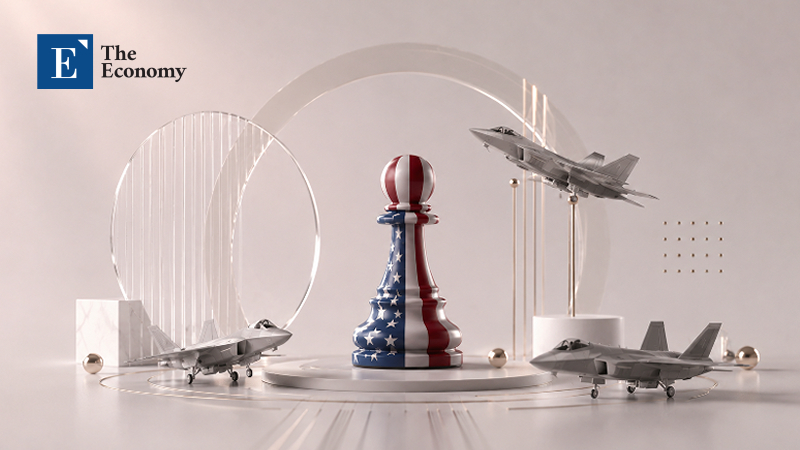
Unlike European countries pursuing next-generation fighter programs through multinational partnerships, the United States is independently accelerating development of the F-47, the sixth-generation centerpiece of its Next Generation Air Dominance (NGAD) system. Designed to replace the F-22, the F-47 is intended to secure air superiority even within China’s long-range air-defense network through a combat radius exceeding 1,000 nautical miles, or approximately 1,850 kilometers, speeds in the Mach 2 class, and enhanced stealth capabilities. Boeing is the prime contractor. The US Air Force has already begun building test aircraft, with the maiden flight scheduled for 2028. However, the aircraft’s precise configuration, engine, and weapons systems remain classified, while no decision has yet been made on whether it will be offered for export.
Mid-tier defense powers lacking the financial resources and industrial foundations required to undertake sixth-generation fighter programs are instead concentrating on establishing indigenous fifth-generation capabilities. South Korea and Türkiye are prominent examples. After being expelled from the US-led F-35 joint development program over its acquisition of Russia’s S-400 air-defense system, Türkiye elevated the KAAN, which incorporates internal weapons bays and stealth-oriented design features, into a flagship national defense program. South Korea is currently mass-producing the 4.5-generation KF-21 while progressively enhancing its air-to-ground armament and electronic warfare capabilities, with a longer-term plan to develop the platform into a fifth-generation successor model.
Western countries and their allies are staking so much on fighter development because China’s airpower has expanded at a rapid pace. Following the operational deployment of the J-20, China is developing the J-35 family of medium-weight fifth-generation stealth fighters. The J-35A, a multirole fighter intended for the air force, is designed to perform both air-combat and ground-attack missions, while the carrier-based J-35 is expected to deploy aboard aircraft carriers equipped with electromagnetic catapult systems. China is also believed to have already established a mass-production base. Foreign media outlets have reported that multiple J-35 and J-35A airframes were observed undergoing simultaneous assembly at Shenyang Aircraft Corporation facilities, alongside joint test flights involving factory-fresh aircraft. These observations have prompted assessments that China now possesses the infrastructure to manufacture the air force and carrier-based variants in parallel. Its precise annual production capacity, however, remains unknown.
China is also conducting test flights of next-generation fighter prototypes commonly referred to as the J-36 and J-50. The J-36, believed to have been developed by Chengdu Aircraft Corporation, is a long-range combat aircraft featuring a large delta-wing airframe, three engines, and a spacious internal weapons bay. Shenyang Aircraft Corporation’s J-50 is a smaller twin-engine fighter likely intended for air-superiority missions or eventual aircraft-carrier operations. Both aircraft employ tailless configurations without vertical stabilizers, a design believed to reduce radar reflections from the sides and rear and thereby enhance all-aspect stealth performance. Their detailed capabilities, armaments, and actual mass-production schedules have yet to be disclosed. The US Department of Defense estimates that they could enter operational service around 2035.
As one of the youngest members of the team, Tyler Hansbrough is a rising star in financial journalism. His fresh perspective and analytical approach bring a modern edge to business reporting. Whether he’s covering stock market trends or dissecting corporate earnings, his sharp insights resonate with the new generation of investors.
Similar Post