“Japan’s Labor Shortage Opens a Window”: Young Koreans Turn to Japan Amid a Domestic Jobs Crisis, but ‘Black Company’ Culture Raises Concerns Over Job Quality

Aoife Brennan is a contributing writer for The Economy, with a focus on education, youth, and societal change. Based in Limerick, she holds a degree in political communication from Queen’s University Belfast. Aoife’s work draws connections between cultural narratives and public discourse in Europe and Asia.
Authored On
Modified
Korean Job Seekers Turn to Japan’s Employment Market
Japan’s Foreign Workforce Surges, but Job Quality Remains in Question
Reports of Mistreatment Proliferate Amid Broker and Staffing-Agency Involvement

The number of young Koreans seeking employment in Japan is rising rapidly. Entry barriers have climbed in South Korea as employers increasingly favor experienced hires, while the Japanese government and companies grappling with chronic labor shortages have stepped up efforts to recruit overseas talent. As workers from South Korea and other Asian countries pour into Japan, some market observers warn that the quantitative expansion of foreign employment offers no guarantee of job quality.
Surge in Young Koreans Taking Jobs in Japan
Reuters reported on August 3 that a growing number of Korean job seekers are turning to Japanese companies. While major Korean corporations have raised the employment threshold for young people by favoring experienced candidates over entry-level recruits, Japanese companies are attracting talent through large-scale graduate recruitment programs and systematic in-house training. The trend is borne out by official statistics. According to the Human Resources Development Service of Korea’s country-by-country overseas employment data, 2,257 Koreans secured jobs in Japan last year, an increase of 726, or 47%, from 1,531 a year earlier.
Employment of young Koreans in Japan fell sharply to 586 in 2021 amid the COVID-19 pandemic and deteriorating relations between the two countries, but has rebounded in recent years. In 2024, Japan overtook the United States for the first time in four years to become the leading destination for Koreans finding work overseas. It retained the top position last year and widened its lead over the United States. Working holiday visas, which allow young people to remain in participating countries for up to one year while combining travel, employment and language study, are also being widely used. According to Japan’s Ministry of Foreign Affairs, the number of working holiday visas issued to Koreans surged from 207 in 2021 to 7,444 in 2024. Koreans accounted for 33.9% of the 21,963 working holiday visas issued to foreign nationals.
Diverging Realities in Korean and Japanese Labor Markets
The shift reflects sharply divergent employment conditions in South Korea and Japan. In South Korea, youth unemployment has become an entrenched social problem. The employment rate among people aged 15 to 29 stood at 43.9% in June, down 1.7 percentage points from a year earlier, while the unemployment rate rose 0.9 percentage points to 7.0%. The number of employed people in their 20s fell by 199,000 over the same period. Youth employment indicators deteriorated across the board even as the overall number of employed people increased. The Bank of Korea has also found that the proportion of young people who took more than a year to secure their first job rose from 24.1% in 2004 to 31.3% last year.
Japanese companies, meanwhile, are struggling to recruit new workers amid a falling birth rate and an aging population. Japan’s working-age population, defined as people aged 15 to 64, declined from approximately 87 million in 1995 to around 72 million in 2024 and is projected to fall to roughly 65 million by 2035. “Labor shortages have become chronic in Japan across hospitality and food services, wholesale and retail, health care and welfare, as well as manufacturing and information technology,” one market specialist said. “As local workers can no longer meet recruitment demand, securing foreign talent has become critical to business continuity.”
Japan’s Foreign Workforce Reaches Record High
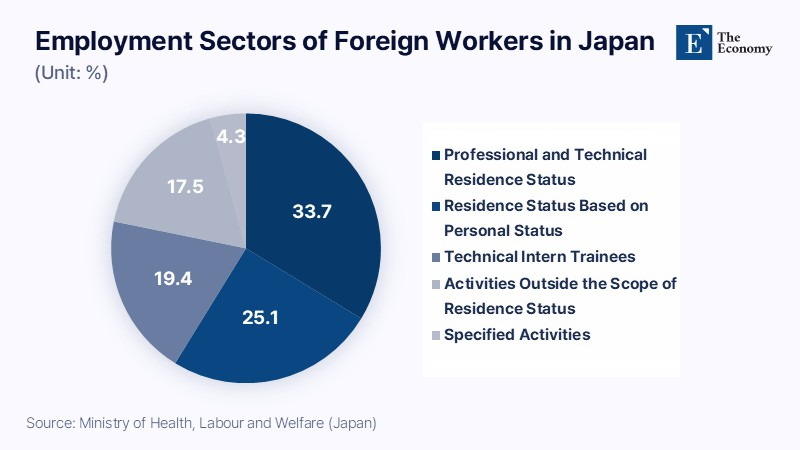
According to Japan’s Ministry of Health, Labour and Welfare, the number of foreign workers employed in the country reached 2,571,037 as of the end of October last year, up 268,450, or 11.7%, from a year earlier. This marked the highest level since mandatory reporting was introduced in 2007. Vietnamese nationals formed the largest group at 605,906, followed by Chinese nationals at 431,949. The number of Korean workers stood at 80,193. By residency category, holders of professional and technical statuses of residence surged 20.4% in one year to 865,588, accounting for 33.7% of all foreign workers. Of these, 468,068, or 18.2% of the total, worked under the Engineer/Specialist in Humanities/International Services category in fields such as office administration, IT, interpretation, translation and design. Specified Skilled Workers employed in labor-short sectors including manufacturing, construction, hospitality, food services and caregiving numbered 286,225, representing 11.1%.
Outside the professional and technical categories, status-based residents with no employment restrictions, including permanent residents and spouses of Japanese nationals, constituted the largest group at 645,590, or 25.1%. They were followed by 499,394 technical interns, accounting for 19.4%; 449,324 workers engaged in activities outside their authorized status, including part-time employment by international students, at 17.5%; and 111,074 workers under the Designated Activities category, including working holiday participants and nursing and caregiving candidates, at 4.3%. By industry, manufacturing employed the largest share at 24.7%, followed by other services at 15.2%, wholesale and retail at 13.3%, accommodation and food services at 12.4%, construction at 8.0%, health care and welfare at 5.7%, and information and communications at 3.8%.
Risks from Exploitative Employers Come into Focus
Job quality remains a pressing concern for foreign workers. In Japan, companies notorious for abusive practices such as excessive workloads, unpaid overtime and workplace harassment are commonly referred to as “black companies.” Many businesses engaged in continuous recruitment due to labor shortages are shunned by Japanese job seekers because of poor working conditions and high turnover. Foreign workers arriving in Japan in search of new opportunities may consequently find themselves trapped in low-quality employment.
These risks have already surfaced in labor inspections conducted by the Japanese government. During fiscal 2024, the Ministry of Health, Labour and Welfare investigated 26,512 workplaces suspected of imposing excessively long working hours and uncovered illegal overtime at 11,230, or 42.4%, of the inspected sites. At 5,464 workplaces, some employees recorded more than 80 hours of overtime and holiday work per month, while the figure exceeded 100 hours at 3,191 sites. Another 2,118 workplaces failed to pay overtime allowances properly. Labor-law violations were also identified at 76.4% of the 5,750 workplaces employing Specified Skilled Workers that authorities inspected in 2024 based on reports or warning signs. The principal violations included failure to comply with safety standards at 24.0% of workplaces, nonpayment of premium wages at 17.2%, illegal working hours at 15.4%, failure to provide paid leave at 12.2%, and violations involving wage payments and the disclosure of working conditions at 10.3% each. Violations were also found at 73.2% of the inspected workplaces employing technical interns.
Table 1. Poor Working Conditions Faced by Foreign Workers in Japan
| Category | Survey Findings |
|---|---|
| Principal problems | Long working hours, low wages, unpaid overtime and workplace harassment |
| Workplaces suspected of imposing excessively long hours | Illegal overtime detected at 11,230 of 26,512 workplaces |
| More than 80 hours of monthly overtime | 5,464 workplaces |
| More than 100 hours of monthly overtime | 3,191 workplaces, included among those exceeding 80 hours |
| Unpaid overtime allowances | 2,118 workplaces |
| Workplaces employing Specified Skilled Workers | Labor-law violations detected at 76.4% of 5,750 inspected workplaces |
| Principal violations at Specified Skilled Worker workplaces | Failure to comply with safety standards 24.0%; nonpayment of premium wages 17.2%; illegal working hours 15.4%; failure to provide paid leave 12.2%; violations involving wage payments 10.3%; failure to disclose working conditions 10.3% |
| Workplaces employing technical interns | Labor-law violations detected at 73.2% of inspected workplaces |
Treatment of Vietnamese Workers
Cases have also emerged in which companies and brokers used the Engineer/Specialist in Humanities/International Services visa category as a façade to supply foreign workers to manual-labor sites. According to a January report by Japanese newsweekly Aera, a Vietnamese woman entered Japan under the category after being told that she would perform accounting duties, only to be assigned to a production line at a local food-processing plant. Immigration authorities subsequently cited the woman for engaging in activities outside her authorized status before taking action against the company that arranged her employment. Although she had been deceived by false representations from the company and broker, she still faced criminal and immigration penalties because she had performed unauthorized work.
Vietnamese workers assigned to manufacturing sites through staffing agencies also frequently face dismissal and unpaid wages. Last year, the Aichi Labour Bureau referred the head of a staffing agency based in Toyota City to prosecutors for allegedly failing to pay two months of wages totaling approximately $106,500 to 73 Vietnamese temporary workers. The company brought the workers into Japan under the Engineer/Specialist in Humanities/International Services category and dispatched them to around 30 workplaces, including automotive-parts manufacturers in Aichi, Gifu and Mie prefectures. In Shizuoka Prefecture, a company that dispatched Vietnamese and other foreign workers to manufacturing and packaging businesses abruptly ceased operations amid financial difficulties, leaving hundreds of people unemployed and several hundred thousand dollars in unpaid wages. Many of the dismissed Vietnamese workers held Engineer/Specialist in Humanities/International Services status, and some reportedly did not receive separation notices or certificates confirming the loss of health-insurance eligibility, documents required to change jobs and apply for unemployment benefits.
Aoife Brennan is a contributing writer for The Economy, with a focus on education, youth, and societal change. Based in Limerick, she holds a degree in political communication from Queen’s University Belfast. Aoife’s work draws connections between cultural narratives and public discourse in Europe and Asia.
Similar Post