$29.5 Billion SK Hynix ADR Listing Nears as Chipmaker Targets Wall Street Valuation Premium

Authored On
Modified
SK hynix Nears Completion of Nasdaq Listing Process
Proceeds to Be Concentrated on EUV and Advanced Packaging Investments
ADS Structure Expected to Expand Access for U.S. Investors
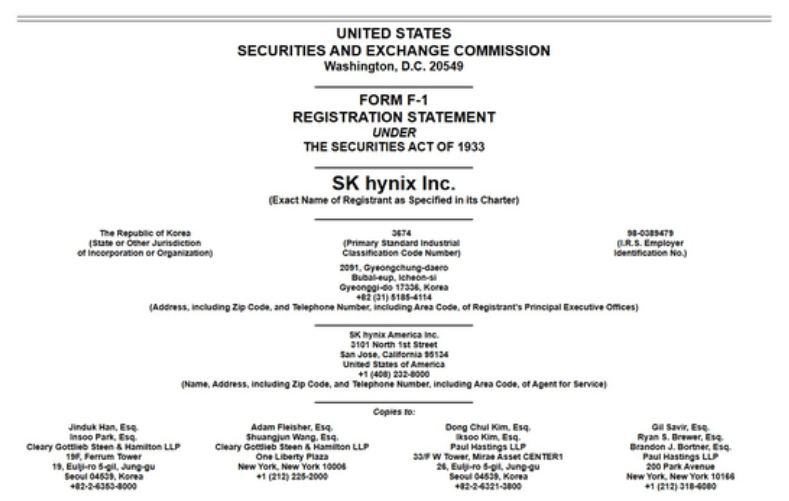
SK Hynix has submitted an amended registration statement for its planned listing on the Nasdaq Stock Market, bringing the application process for a U.S. listing in the world's largest capital market into its final stage. The amended filing newly specifies the intended use of offering proceeds, large-scale investment plans, and a structure designed to improve accessibility for U.S. investors. Market observers believe the move demonstrates the company's strategy to significantly strengthen its presence in the U.S. capital market through the listing.
Up to 17.79 Million New Shares to Be Issued as ADRs
According to investment banking sources on July 2, SK Hynix submitted an amended Form F-1 registration statement to the SEC's EDGAR system on June 30 (local time) for its planned Nasdaq listing. The amended filing includes details regarding the use of proceeds raised through the issuance of American Depositary Receipts (ADRs), the company's long-term domestic investment plans, and antitrust litigation risks. SK Hynix plans to allocate the proceeds toward acquiring equipment for next-generation manufacturing processes, expanding domestic production facilities, and investing in advanced packaging infrastructure. The investment is widely viewed as part of the company's strategy to strengthen production capacity for advanced memory products, including high-bandwidth memory (HBM), in response to surging demand for AI semiconductors.
The filing also reflects the company's recently announced domestic semiconductor investment program valued at approximately $710 billion. SK Hynix noted, however, that the size and timeline of the investment plan remain subject to changes depending on market demand, customers' investment schedules, and discussions with central and local governments regarding permits and infrastructure development. The company stated that it intends to prioritize internally generated cash flow to fund the investment while leaving open the possibility of external financing, including borrowings or equity issuance, if necessary. SK Hynix also emphasized that its long-term investment program does not affect the intended use of proceeds from the ADR offering. In other words, while the capital raised through the Nasdaq listing will primarily fund domestic production facilities and equipment investments, the approximately $710 billion investment initiative remains a separate long-term corporate strategy.
The overall ADR offering structure remains unchanged. SK Hynix plans to issue up to 17.79 million new shares in ADR form, representing approximately 2.50% of its outstanding shares. The company estimated the maximum offering size at $29.47 billion. Key offering terms, however, have yet to be finalized. The amended filing continues to leave blank the offering price, the number of ADRs to be issued, and the ADR-to-common-share conversion ratio. The final offering price will be determined through discussions between SK Hynix and the underwriting syndicate based on the company's latest trading price and prevailing market conditions.
The "Risk Factors" section newly includes a U.S. antitrust class-action lawsuit. On June 25, 14 U.S. consumers and three small PC manufacturers filed suit against Samsung Electronics, SK Hynix, and Micron in the U.S. District Court for the Northern District of California. The plaintiffs allege that increases in conventional DRAM prices led to higher prices for IT products such as MacBooks and iPads, causing financial harm. The filing also highlights SK Hynix's leadership in the HBM market. According to market research firm IDC, the company ranked first globally in the HBM market during the first quarter of this year with a 56.4% market share, while placing second in the overall DRAM market, including HBM, with a 29.1% share.
Substantial Portion of Proceeds Allocated to EUV Lithography Equipment
An initial Form F-1 filing typically provides only a broad overview, with key market-sensitive information—such as the listing exchange, offering size, and intended use of proceeds—often left blank. The amended filing has now filled in most of those previously omitted items. This is generally interpreted in one of two ways: either the company has addressed the SEC's initial review comments, or it has substantially finalized key offering terms following preliminary discussions with institutional investors. In either case, the filing clearly indicates that the listing process has entered its final phase.
The amended registration statement also provides a more detailed explanation of the listing structure. SK Hynix plans to list its ADRs on the Nasdaq Global Select Market, Nasdaq's premier tier with the most stringent financial and corporate governance requirements. The ADRs will be backed by the company's common shares, with the offering primarily targeted at overseas institutional investors. Bank of America, Citigroup, Goldman Sachs, and JPMorgan are serving as lead underwriters.
Most notably, the amended filing provides a far more detailed capital allocation plan. What had previously been described only as "capital expenditures" has now been broken down into specific investment categories and projected spending levels. The offering proceeds will be concentrated on expanding domestic manufacturing facilities and building advanced packaging infrastructure. The primary investment targets include the first fabrication plant (Y1) at the Yongin Semiconductor Cluster and the P&T7 advanced packaging facility in Cheongju, alongside the procurement of extreme ultraviolet (EUV) lithography systems, a critical component for next-generation semiconductor manufacturing. In particular, the company has earmarked approximately $7.7 billion for EUV scanners alone, with deliveries scheduled to continue through the end of 2027.
The planned allocation underscores the company's strategic priorities. SK Hynix believes that the competitive battleground in AI memory is shifting away from sheer manufacturing capacity toward process technology and advanced packaging capabilities. With demand for HBM expanding at an unprecedented pace, securing next-generation DRAM competitiveness and transitioning to cutting-edge manufacturing processes would be difficult without EUV lithography. From that perspective, the U.S. listing serves primarily as a means of securing the capital required to finance those investments.
Expanding Access for U.S. Investors
Market participants increasingly believe that the significance of the offering extends well beyond the size of the capital raise. Rather, the primary objective appears to be creating a structure that enables U.S. investors to purchase and trade SK Hynix shares more easily. The ADR structure is the clearest example. SK Hynix plans to issue one ADR representing 0.1 common share. Assuming the underlying common stock trades at approximately $1,740 per share, each ADR would trade at roughly $174, significantly lowering the investment threshold for U.S. investors.
Without splitting the underlying shares through the ADR structure, SK Hynix would become the fourth-highest-priced stock on Nasdaq, following Citizens Bancshares, SanDisk, and ASML. Such a price level would represent a significant hurdle even for institutional investors overseas. One securities industry executive said, "In the U.S. market, stocks priced above $1,000 are generally regarded as four-digit stocks, a price range that naturally raises the barrier for investors. Issuing ADRs based on fractional underlying shares lowers the per-share trading price to around Nvidia's current level of approximately $195, substantially reducing that burden."
Some market observers also believe the ADR structure may have been designed with the possibility of a future stock split in mind. Speculation surrounding a potential stock split has persisted since SK Hynix's share price first exceeded $645. Although the company has consistently maintained that it has no immediate plans to pursue a split, industry analysts believe the ADR structure makes it difficult to completely rule out that possibility over the longer term. Numerous global companies with high-priced shares have first reduced the effective trading unit through ADRs before subsequently implementing stock splits in their home markets to improve liquidity and broaden their investor base.
There is also a precedent within the SK Group. SK Telecom, then known as Korea Mobile Telecommunications, listed ADRs on the New York Stock Exchange in 1996. Although its common shares traded at approximately $755 apiece at the time, the company structured the ADR program by dividing one common share into 90 ADRs, allowing trading to begin at $16.125 per ADR. The market subsequently speculated that the company would eventually pursue a stock split to ease the burden associated with its high share price, and SK Telecom ultimately carried out the split. The company has continued to maintain a long-standing U.S. investor base ever since.
Similar examples can also be found overseas. Kioxia Holdings of Japan, which is targeting an ADR listing next spring, is likewise considering a stock split alongside its U.S. market debut. The strategy is to lower the trading threshold for overseas investors through the ADR structure before eventually improving accessibility to the underlying shares as well. Although SK Hynix continues to deny having any plans for a stock split, many analysts believe the overall design of the ADR program strongly suggests that expanding its investor base and improving trading liquidity were key considerations behind the listing structure.
Similar Post