“ECB Tightens Despite Growth Warnings” First Rate Hike in Three Years Looms as Iran War Revives Stagflation Fears

Anne-Marie Nicholson is a fearless reporter covering international markets and global economic shifts. With a background in international relations, she provides a nuanced perspective on trade policies, foreign investments, and macroeconomic developments. Quick-witted and always on the move, she delivers hard-hitting stories that connect the dots in an ever-changing global economy.
Authored On
Modified
Core CPI at 2.5%, Services Inflation Surges to 3.5%
ECB May Raise Rates After Seven Consecutive Holds
Europe Has Little Room for Either Stimulus or Tightening
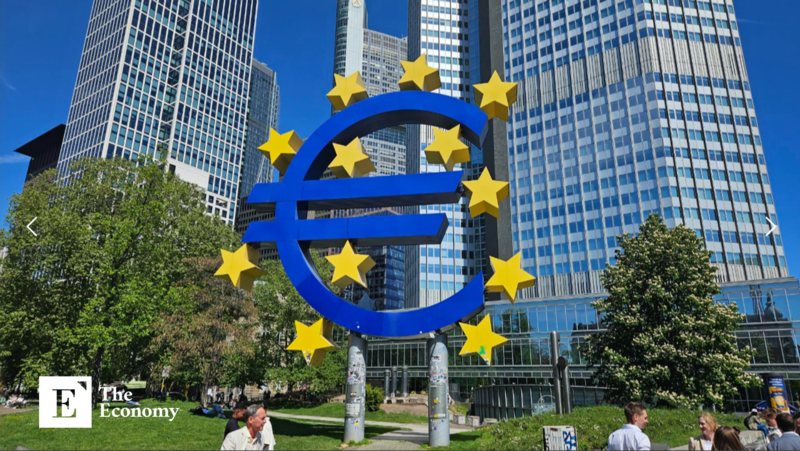
Europe’s economy is once again trapped in the shadow of inflation. As the energy shock triggered by the Iran war pushes prices higher, the European Central Bank (ECB) is now considering its first rate hike in nearly three years. With growth slowing, sovereign debt mounting, and inflation once again moving beyond target, Europe faces renewed pressure from the convergence of high prices and weak growth.
European Inflation at Highest Since September 2023, Rate Hike Seen as Inevitable
According to Eurostat, the European Union’s statistical agency, on the 9th local time, eurozone consumer prices in May were provisionally estimated to have risen 3.2% from a year earlier and 0.1% from the previous month. It marks the first time since September 2023, when inflation stood at 4.3%, that eurozone inflation has exceeded 3.0%. After recording 1.7% in January, eurozone inflation has risen for four consecutive months, far surpassing the ECB’s medium-term target of 2.0%.
Energy prices were the main driver, jumping 10.9% from a year earlier, while services inflation climbed to 3.5%. Core inflation, excluding food and energy, also reached 2.5%, its highest level in more than a year. Inflation in the four largest eurozone economies also exceeded the ECB’s 2% target, with Germany at 2.7%, France at 2.8%, Italy at 3.3%, and Spain at 3.6%. The ECB’s April monetary policy meeting minutes also confirmed a sharp rise in short-term inflation expectations, while the ECB’s consumer survey showed one-year-ahead inflation expectations surging from 2.5% in March to 4.0% in April.
Markets now expect the ECB to raise policy rates by 0.25 percentage point this month and deliver one additional hike by year-end. According to Germany’s Commerzbank, most economists now see an ECB rate hike this week as virtually certain. Yannis Stournaras, governor of the Bank of Greece and a known dove, said a rate increase was “the most likely outcome” at the June meeting. Gediminas Simkus, governor of the Bank of Lithuania and another dove, also joined in, saying the ECB should not shock markets by failing to act.
A further hike later this year is expected in September. Dean Turner, chief eurozone and U.K. economist at UBS Global Wealth Management, said it would make sense to move rates from the lower end to the upper end of the neutral range to prevent inflationary pressures from intensifying further. Simona Delle Chiaie, chief eurozone economist at Bloomberg Economics, said ECB President Christine Lagarde would offer clues on the next move at this meeting after making ambiguous remarks on the March rate outlook, adding that “we expect her to signal more clearly than before the possibility of a second rate increase.”
The ECB previously decided at its late-April Governing Council meeting to keep all three policy rates unchanged for a seventh consecutive time. As a result, the deposit facility rate paid to banks for parking funds at the ECB instead of lending them has remained at 2.0% for a year. During the inflationary period, the deposit rate, the ECB’s key policy rate, stood at 4.0% when the central bank began cutting rates two years ago. The ECB is scheduled to hold its rate-setting Governing Council meeting on the 11th, where the deposit facility rate, main refinancing rate, and marginal lending facility rate are expected to be raised for the first time in nearly three years.

Hormuz Blockade Shatters Hopes for a V-Shaped Recovery
The ECB’s heightened sensitivity to rising prices is rooted in lessons from the 2022 Russia-Ukraine war. At the time, the ECB and other eurozone central banks viewed the war-driven price shock as a temporary phenomenon. The prevailing assumption was that the war would end quickly, and the possibility that supply-chain disruption would spread into global inflation was not fully reflected.
The outcome proved different. Reduced Russian natural gas supplies and disruptions to Ukrainian grain exports combined to leave Europe facing its sharpest surge in energy and food prices in decades. Central banks belatedly launched aggressive rate hikes, but inflation expectations had already spread widely. The ECB then had to embark on an unprecedented tightening cycle from the second half of 2022, forcing the European economy into a phase where slowing growth and high inflation coexisted.
Europe had only just begun recovering from that economic shock, but the Iran war has now become a new drag. The fallout from the Iran war is deepening the ECB’s vigilance because its transmission channels are broader than those of the Ukraine war. In the early stages of the conflict, Europe expected a sharp but short-lived shock that could produce a V-shaped recovery. With the Strait of Hormuz blockade continuing, it now faces the prospect of a slower U-shaped recovery.
If the Russia shock directly unsettled Europe’s dependence on natural gas, the current Middle East risk is a complex supply shock affecting crude oil, liquefied natural gas, maritime shipping, insurance costs, and fertilizer prices at the same time. Europe has sharply increased its reliance on Russian LNG since the outbreak of the Ukraine war, and if LNG supplies from Qatar and other Middle Eastern producers are disrupted, energy price volatility could widen again.
What European policymakers are watching most closely is inflation expectations rather than prices themselves. The 2022 experience showed that suppressing inflation expectations at an early stage is far less costly than responding after a supply shock has taken hold. Recent ECB minutes also repeatedly cited concerns over rising inflation expectations. For central banks, higher expected inflation is considered an even more difficult variable than actual price indicators. Companies raise prices in anticipation of higher future costs, while workers demand higher wages to defend real incomes. If this process repeats, price increases that began as a supply shock can become embedded in the economy’s broader price-setting mechanism.
Growth Slowdown and Debt Burden Leave Fiscal Space Depleted
The problem is that Europe’s capacity to absorb shocks has weakened significantly from the past. Prices and growth are first moving in opposite directions. The European Commission cut its 2026 eurozone growth forecast sharply from 1.4% to 0.9% in the aftermath of the Strait of Hormuz crisis. Its assessment is that the energy shock following the Iran war is simultaneously weakening corporate investment and consumer sentiment. The Organization for Economic Cooperation and Development also lowered its eurozone growth forecast to 0.8%, warning that soaring energy prices are undermining Europe’s recovery. According to the OECD’s latest economic outlook report, the Strait of Hormuz blockade has disrupted 5% of EU crude oil imports, 10% of LNG imports, and 45% of jet fuel imports.
Fiscal space is also limited. At the end of the fourth quarter last year, the eurozone government debt ratio stood at 87.8% of gross domestic product. By country, the ratio was highest in Greece at 146.1%, followed by Italy at 137.1%, France at 115.6%, Belgium at 107.9%, and Spain at 100.7%. Among the eurozone’s four largest economies, France, Italy, and Spain all remain in high-debt structures hovering around 100%, with Germany the only exception.
If the ECB raises rates under these conditions, the burden on highly indebted countries will inevitably grow. Moody’s and Standard & Poor’s recently warned in reports that if European sovereign yields remain elevated for an extended period, interest costs in major countries such as France and Italy could rise faster than economic growth. According to the European Commission, eurozone-wide interest expenditures are expected to climb from 1.6% of GDP in 2021 to around 2.7% this year. This reflects the continued need to refinance bonds issued during the ultra-low-rate environment of the COVID-19 pandemic at higher rates as they mature.
Fiscal policy options have also narrowed compared with the past. During the Ukraine war, European governments absorbed the shock by deploying large-scale energy subsidies, corporate support measures, and household aid. Energy support introduced by member states since 2022 alone is estimated to have exceeded a cumulative $935 billion. Yet EU fiscal rules demanding a restoration of fiscal soundness are now back in force, while France, Italy, and Belgium are already under EU fiscal surveillance due to excessive deficits. The environment leaves little room for additional stimulus measures.
Anne-Marie Nicholson is a fearless reporter covering international markets and global economic shifts. With a background in international relations, she provides a nuanced perspective on trade policies, foreign investments, and macroeconomic developments. Quick-witted and always on the move, she delivers hard-hitting stories that connect the dots in an ever-changing global economy.
Similar Post