A Nation and Its Households Buried in Debt, Yet Trump ‘Celebrates Inflation’

Anne-Marie Nicholson is a fearless reporter covering international markets and global economic shifts. With a background in international relations, she provides a nuanced perspective on trade policies, foreign investments, and macroeconomic developments. Quick-witted and always on the move, she delivers hard-hitting stories that connect the dots in an ever-changing global economy.
Authored On
Modified
Highest CPI Increase in Three Years
Rising Cost-of-Living Pressures, Slowing Labor-Market Momentum
America’s Fiscal Stability Faces a Critical Test Amid Surging Debt

U.S. President Donald Trump has ignited controversy after declaring that he “loves inflation” despite rapidly rising consumer prices. From the federal government’s perspective, inflation reduces the real value of national debt, but for households it translates into diminished purchasing power and higher living costs. Despite a booming stock market and continued economic expansion, the U.S. economy has entered a phase in which consumer polarization and fiscal deterioration are deepening simultaneously.
Consumer Prices Hit Three-Year High, Yet Trump Says ‘I Love Inflation’
According to The Washington Post (WP) on June 11, Trump was asked during a White House press briefing whether he was concerned that the U.S. Consumer Price Index (CPI) had posted its highest annual increase in more than three years. He responded, “The numbers were terrific. Do you know what I really love? I love inflation.” He then added, “Because as soon as the war with Iran ended…” before continuing, “I can tell you something you didn’t know. Do you know that we’re bringing in millions of barrels of oil? Nobody knows that.”
Trump further claimed that the U.S. military had conducted a covert operation near the Strait of Hormuz that enabled a massive increase in oil supplies. “A few nights ago, we got 22 ships out with no lights on. We destroyed their radar, so they had no radar,” he said. “We got them out, and that’s why oil is at $85 a barrel.” After the exchange, Trump posted on Truth Social that the U.S. military had carried out a secret operation involving vessels transiting the Strait of Hormuz, helping deliver more than 100 million barrels of oil to global markets.
The remarks immediately sparked criticism. With U.S. CPI inflation reaching 4.2% year-over-year in May—the highest level since April 2023—many argued that Trump’s comments were disconnected from the realities facing Americans struggling with elevated prices. As the controversy intensified, Trump told the New York Post (NP) that he had been referring to inflation that would decline after the war ended and that his comments had been reported without proper context. “Inflation under the Trump administration will fall significantly after the peace agreement,” he said. “It is already low, and it will go even lower.”
Trump recently faced criticism over another remark perceived as dismissive of household financial concerns. Before departing Washington, D.C. for a visit to China on May 12, he was asked whether rising living costs provided additional motivation to secure a rapid agreement with Iran. He replied, “Not at all. I do not think about Americans’ financial situation.” The comment came as he emphasized the importance of preventing Iran from acquiring nuclear weapons. Regardless of context, the statement drew criticism for suggesting that the president was unconcerned about the financial well-being of ordinary Americans.
Wealthy Consumers Spend, Working-Class Households Endure: Deepening K-Shaped Polarization
Viewed solely through the lens of capital markets and macroeconomic indicators, the U.S. economy remains resilient. The reality experienced by households, however, is unfolding in a markedly different direction. In its Beige Book released on June 3, the Federal Reserve (Fed) reported that economic activity expanded across 10 of its 12 districts while warning that consumption disparities based on income levels had become increasingly pronounced. Economists describe this phenomenon as a “K-shaped economy,” characterized by widening divergence among income groups.
High-income households remained relatively insensitive to price increases and continued spending robustly. Middle-income consumers became increasingly selective, scrutinizing the value of purchases before spending. Lower-income households, meanwhile, turned more heavily to credit cards to cope with mounting living expenses. Rising prices have eroded purchasing power across broad segments of the population. In some regions, delinquency rates on mortgages and consumer loans have begun to climb. The automotive sector has also seen demand for new vehicles weaken as higher vehicle prices and fuel costs push consumers toward used cars and hybrid models.
Inflationary pressures strengthened further in May compared with April. Energy-cost increases stemming from the Iran conflict spread into transportation, packaging, food, and fertilizer prices, placing additional burdens on households and businesses. Many companies have been unable to fully pass higher input costs on to consumers, resulting in mounting margin pressure. “Jobless growth” has also emerged as a concern. While manufacturing employment has benefited from AI-related data-center construction and defense-sector demand, overall labor-market dynamism remains subdued. Businesses continue to approach new hiring cautiously due to economic uncertainty.
Massive investment in artificial intelligence is also contributing to the K-shaped economy because stock-market gains have not translated into broad-based job creation. Shares of the Magnificent Seven (M7) technology giants have driven the market more than 15% higher this year, yet the wealthiest 10% of Americans own roughly 87% of the stock market. Economists warn that an economy driven disproportionately by upper-income households lacks long-term sustainability. If unemployment rises further while inflation remains elevated, middle- and lower-income consumers could continue reducing spending, increasing the risk of an economic downturn.
U.S. National Debt Approaches $40 Trillion, Leaving Few Tools for the Next Crisis
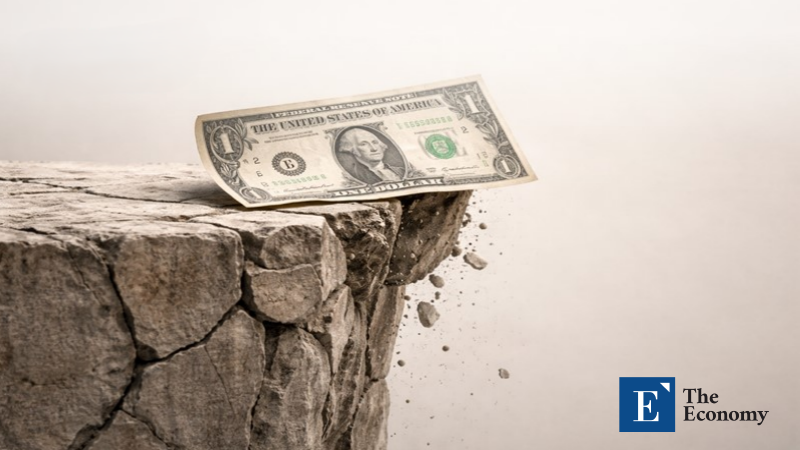
As household purchasing power weakens, the federal government’s fiscal burden is also approaching dangerous levels. According to the U.S. Treasury Department, federal debt stood at approximately $39.02 trillion at the end of the first quarter. Since Trump returned to office, federal debt has increased by approximately $2.8 trillion in just over a year.
The primary drivers of the surge are rapidly escalating interest expenses and large-scale tax cuts. With interest rates remaining elevated to combat inflation and the total debt burden continuing to rise, the cost of borrowing to service existing obligations has climbed sharply. The One Big Beautiful Bill Act (OBBBA), the sweeping tax-cut package enacted last year, has further accelerated debt accumulation by reducing government revenue.
The Iran war has also weighed on America’s fiscal position. Reports indicate that on March 18, the U.S. Department of Defense requested more than $200 billion in supplemental funding from the White House to support military operations against Iran. That figure exceeds one-fifth of the current fiscal year’s defense budget. Prior to the conflict, Trump had already announced plans in January to increase next year’s defense budget to $1.5 trillion.
Meanwhile, tariff revenue—considered a key funding source for Trump’s pledge to “impose tariffs to make a debt-free country”—has encountered significant legal obstacles. In February, the U.S. Supreme Court ruled that most of the administration’s tariff measures were unlawful, undermining the foundation of its debt-reduction strategy. Michael Peterson, Chief Executive Officer of the Peterson Foundation, warned that “at the current pace, debt will approach $40 trillion before the November midterm elections.”
America’s fiscal challenges extend well beyond the sheer size of its debt. The investor base needed to absorb Treasury issuance is also showing signs of strain. CNBC recently argued that “there is no such thing as free debt,” noting growing skepticism over whether demand can continue to absorb the enormous volume of government bonds issued each year. With debt expanding faster than economic growth, investors may demand higher yields, further accelerating the federal government’s interest burden.
The fact that U.S. budget deficits continue to breach historic thresholds is sounding increasingly urgent alarm bells. According to Kevin Kosar of the American Enterprise Institute (AEI), there have been only eight instances since 1946 in which the federal deficit exceeded its historical average of 3.8% of gross domestic product (GDP). Remarkably, three of those instances occurred between 2023 and 2025. Three consecutive years above that emergency threshold is unprecedented in modern U.S. fiscal history. Data from the Committee for a Responsible Federal Budget (CRFB) show that federal debt amounted to approximately 35% and 80% of GDP, respectively, when the United States entered previous major recessions. Today, that ratio exceeds 100%, indicating that the fiscal tools traditionally deployed during crises have been largely exhausted.
Anne-Marie Nicholson is a fearless reporter covering international markets and global economic shifts. With a background in international relations, she provides a nuanced perspective on trade policies, foreign investments, and macroeconomic developments. Quick-witted and always on the move, she delivers hard-hitting stories that connect the dots in an ever-changing global economy.
Similar Post